21,95 €
21,95 €
inkl. MwSt.
Sofort per Download lieferbar

11 °P sammeln
21,95 €
Als Download kaufen
21,95 €
inkl. MwSt.
Sofort per Download lieferbar
11 °P sammeln
Jetzt verschenken
Alle Infos zum eBook verschenken
21,95 €
inkl. MwSt.
Sofort per Download lieferbar
Alle Infos zum eBook verschenken
11 °P sammeln

Andere Kunden interessierten sich auch für
") Mohammed VI's Strategies for Moroccan Economic Development (eBook, PDF)41,95 €
Mohammed VI's Strategies for Moroccan Economic Development (eBook, PDF)41,95 €") Economic Development and Political Action in the Arab World (eBook, PDF)45,95 €
Economic Development and Political Action in the Arab World (eBook, PDF)45,95 €") China's Economic Development (eBook, PDF)42,95 €
China's Economic Development (eBook, PDF)42,95 €") Social Transformation and the Global Economy (eBook, PDF)42,95 €
Social Transformation and the Global Economy (eBook, PDF)42,95 €") The Political Economy of Transnational Power and Production (eBook, PDF)43,95 €
The Political Economy of Transnational Power and Production (eBook, PDF)43,95 €") The Political Economy of Financial Development in Malaysia (eBook, PDF)21,95 €
The Political Economy of Financial Development in Malaysia (eBook, PDF)21,95 €") The Chinese Way (eBook, PDF)42,95 €
The Chinese Way (eBook, PDF)42,95 €


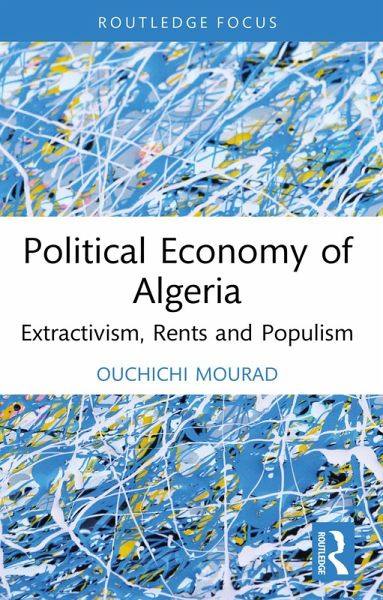
Algeria, the largest country in North Africa, is geopolitically significant due to its strategic location and natural resources. Despite its potential, the country remains entrenched in a rent-based economy, heavily dependent on hydrocarbon exports, a situation that has persisted since its independence in 1962.
This book provides a comprehensive analysis of Algeria's complex politico-economic system, focusing on its rentier and extractivist nature. The study examines the historical evolution of Algeria's economy, beginning with the ambitious yet ultimately unsuccessful industrialisation efforts of the 1960s and 1970s. This failure led to the country's specialization in the extraction and export of hydrocarbons. Subsequent reforms aimed at transitioning to a market economy have failed to break the country's dependency on oil revenues, instead deepening its rentier and extractivist characteristics. The book critically explores the limitations of applying conventional economic and political science frameworks to analyse the Algerian economy. It argues that these disciplines, developed within the context of Western capitalism, are insufficient to fully capture the unique dynamics of an economy like Algeria's, where the market plays a marginal role, and state-controlled rents dominate wealth distribution. To address these challenges, the book adopts the concept of extractivism, originally developed in Latin American contexts, to better understand the interplay between political struggles, social movements, and economic practices in Algeria. It posits that Algeria is both a rentier and an extractivist state, with these two aspects reinforcing each other and hindering the development of a productive economy.
The book will be of interest to readers of political economy, Middle East and North African studies and international politics.
This book provides a comprehensive analysis of Algeria's complex politico-economic system, focusing on its rentier and extractivist nature. The study examines the historical evolution of Algeria's economy, beginning with the ambitious yet ultimately unsuccessful industrialisation efforts of the 1960s and 1970s. This failure led to the country's specialization in the extraction and export of hydrocarbons. Subsequent reforms aimed at transitioning to a market economy have failed to break the country's dependency on oil revenues, instead deepening its rentier and extractivist characteristics. The book critically explores the limitations of applying conventional economic and political science frameworks to analyse the Algerian economy. It argues that these disciplines, developed within the context of Western capitalism, are insufficient to fully capture the unique dynamics of an economy like Algeria's, where the market plays a marginal role, and state-controlled rents dominate wealth distribution. To address these challenges, the book adopts the concept of extractivism, originally developed in Latin American contexts, to better understand the interplay between political struggles, social movements, and economic practices in Algeria. It posits that Algeria is both a rentier and an extractivist state, with these two aspects reinforcing each other and hindering the development of a productive economy.
The book will be of interest to readers of political economy, Middle East and North African studies and international politics.
Dieser Download kann aus rechtlichen Gründen nur mit Rechnungsadresse in A, B, BG, CY, CZ, D, DK, EW, E, FIN, F, GR, HR, H, IRL, I, LT, L, LR, M, NL, PL, P, R, S, SLO, SK ausgeliefert werden.