41,95 €
inkl. MwSt.
Sofort per Download lieferbar
21 °P sammeln

Andere Kunden interessierten sich auch für
") China-US Rivalry and Regional Reordering in Latin America and the Caribbean (eBook, ePUB)42,95 €
China-US Rivalry and Regional Reordering in Latin America and the Caribbean (eBook, ePUB)42,95 €") The European Union, China and Central Asia (eBook, ePUB)41,95 €
The European Union, China and Central Asia (eBook, ePUB)41,95 €") The Chinese Shadow on India's Eastward Engagement (eBook, ePUB)42,95 €
The Chinese Shadow on India's Eastward Engagement (eBook, ePUB)42,95 €") Propaganda and the Genocide in Indonesia (eBook, ePUB)41,95 €
Propaganda and the Genocide in Indonesia (eBook, ePUB)41,95 €") China, Pakistan and the Belt and Road Initiative (eBook, ePUB)42,95 €
China, Pakistan and the Belt and Road Initiative (eBook, ePUB)42,95 €") Hong Kong Politics after the National Security Law (eBook, ePUB)39,95 €
Hong Kong Politics after the National Security Law (eBook, ePUB)39,95 €") China, the United States, and South-East Asia (eBook, ePUB)45,95 €
China, the United States, and South-East Asia (eBook, ePUB)45,95 €





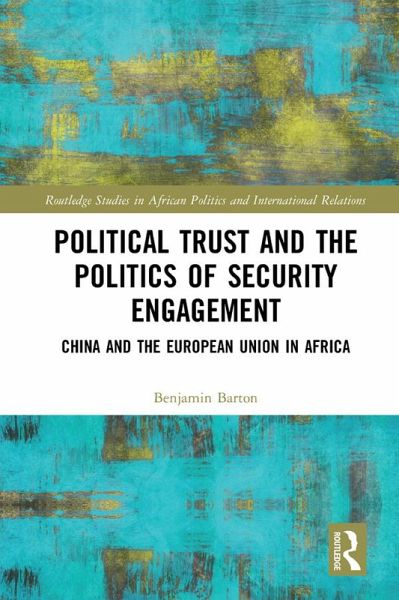
The EU and China are often characterised as parties whose bilateral political differences still remain too large to bridge, so that they have failed to convert rhetorical promises into tangible results of cooperation, particularly with regards to the field of international security. Yet in terms of their bilateral interaction on security risk management in Africa; EU and Chinese naval officers jointly brought down the number of successful Somali pirate attacks in the Gulf of Aden and to a lesser extent were jointly involved in seeking a resolution to the lingering conflict in Darfur.
This book asks how we can make sense as a whole of this relatively sudden shift in regards to the dealings between their respective officials on the topic of security risk management. It argues that the outcomes of Sino-European bilateral dealings on this topic are above all determined by the ability/inability of these officials to build political trust as a complex and cognitive social phenomenon. Consequently, the book applies an innovative conceptual framework on political trust to explain why EU and Chinese officials bridged their 'endemic' political differences to practically cooperate on Somali piracy but were unable to do so when it came to their interaction on Darfur. To conclude, it examines the longer term impact of this bilateral trust-building process by covering more recent examples of bilateral engagement in Libya and Mali and aims to show that although this trust-building process may be case specific, ramifications may go beyond the realm of their bilateral dealings on security matters in Africa, to impact wider issues of international security.
This text will be of key interest to scholars and students of African and Chinese politics, EU politics, security and maritime studies, and more broadly of international relations and to governmental actors.
This book asks how we can make sense as a whole of this relatively sudden shift in regards to the dealings between their respective officials on the topic of security risk management. It argues that the outcomes of Sino-European bilateral dealings on this topic are above all determined by the ability/inability of these officials to build political trust as a complex and cognitive social phenomenon. Consequently, the book applies an innovative conceptual framework on political trust to explain why EU and Chinese officials bridged their 'endemic' political differences to practically cooperate on Somali piracy but were unable to do so when it came to their interaction on Darfur. To conclude, it examines the longer term impact of this bilateral trust-building process by covering more recent examples of bilateral engagement in Libya and Mali and aims to show that although this trust-building process may be case specific, ramifications may go beyond the realm of their bilateral dealings on security matters in Africa, to impact wider issues of international security.
This text will be of key interest to scholars and students of African and Chinese politics, EU politics, security and maritime studies, and more broadly of international relations and to governmental actors.
Dieser Download kann aus rechtlichen Gründen nur mit Rechnungsadresse in A, B, BG, CY, CZ, D, DK, EW, E, FIN, F, GR, HR, H, IRL, I, LT, L, LR, M, NL, PL, P, R, S, SLO, SK ausgeliefert werden.