23,95 €
inkl. MwSt.
Sofort per Download lieferbar
12 °P sammeln

Andere Kunden interessierten sich auch für
") Outclassed (eBook, ePUB)11,95 €
Outclassed (eBook, ePUB)11,95 €") Maelstrom (eBook, ePUB)38,95 €
Maelstrom (eBook, ePUB)38,95 €") The End of Race Politics (eBook, ePUB)2,99 €
The End of Race Politics (eBook, ePUB)2,99 €") Dividing Paradise (eBook, ePUB)22,95 €
Dividing Paradise (eBook, ePUB)22,95 € (eBook, ePUB)") Privilege in the Soviet Union (Routledge Revivals) (eBook, ePUB)39,95 €
Privilege in the Soviet Union (Routledge Revivals) (eBook, ePUB)39,95 €") Brains, Media and Politics (eBook, ePUB)41,95 €
Brains, Media and Politics (eBook, ePUB)41,95 €") Woke Racism (eBook, ePUB)11,95 €
Woke Racism (eBook, ePUB)11,95 €



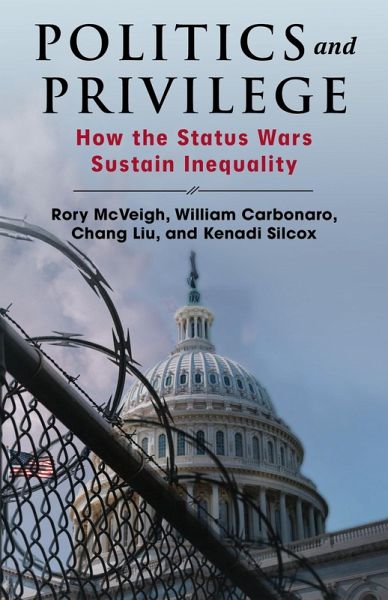
In the United States, the bottom 50 percent of households hold only 1 percent of the nation's wealth. Scholars and commentators have long viewed democracy as the antidote to economic inequality, but US electoral politics bears little resemblance to a struggle between the haves and the have-nots. What makes extreme disparities of wealth and income so persistent, and why has the political process failed to address the problem?
Based on data from an innovative experiment, this book presents a bold new theory that shows why American politics revolves around status differences, not class conflict. Analyzing a sample of nearly 2,600 participants, the authors investigate whether Americans are more likely to support a social-change organization if it explicitly opposes racism, sexism, homophobia, xenophobia, and religious bigotry or if it focuses exclusively on economic equality. Drawing on the results, they argue that privileged groups' desire to preserve their status is the primary obstacle to forming progressive alliances. Status hierarchies are at the heart of political polarization, which stalls legislative efforts to reduce economic inequality or tackle pressing issues such as climate change, gun violence, and access to health care. Rigorous and timely, Politics and Privilege demonstrates why an agenda that simultaneously addresses economic and status inequalities is essential to progressive politics today.
Based on data from an innovative experiment, this book presents a bold new theory that shows why American politics revolves around status differences, not class conflict. Analyzing a sample of nearly 2,600 participants, the authors investigate whether Americans are more likely to support a social-change organization if it explicitly opposes racism, sexism, homophobia, xenophobia, and religious bigotry or if it focuses exclusively on economic equality. Drawing on the results, they argue that privileged groups' desire to preserve their status is the primary obstacle to forming progressive alliances. Status hierarchies are at the heart of political polarization, which stalls legislative efforts to reduce economic inequality or tackle pressing issues such as climate change, gun violence, and access to health care. Rigorous and timely, Politics and Privilege demonstrates why an agenda that simultaneously addresses economic and status inequalities is essential to progressive politics today.
Dieser Download kann aus rechtlichen Gründen nur mit Rechnungsadresse in A, D ausgeliefert werden.