26,95 €
26,95 €
inkl. MwSt.
Sofort per Download lieferbar

13 °P sammeln
26,95 €
Als Download kaufen
26,95 €
inkl. MwSt.
Sofort per Download lieferbar
13 °P sammeln
Jetzt verschenken
Alle Infos zum eBook verschenken
26,95 €
inkl. MwSt.
Sofort per Download lieferbar
Alle Infos zum eBook verschenken
13 °P sammeln

Andere Kunden interessierten sich auch für
") Politics as Form in Lars von Trier (eBook, PDF)26,95 €
Politics as Form in Lars von Trier (eBook, PDF)26,95 €") Lars Von Trier (eBook, ePUB)27,95 €
Lars Von Trier (eBook, ePUB)27,95 €") Lars von Triers Antichrist: Eine Analyse (eBook, ePUB)29,99 €
Lars von Triers Antichrist: Eine Analyse (eBook, ePUB)29,99 €") Rausch, Wahn und Dogma (eBook, ePUB)13,99 €
Rausch, Wahn und Dogma (eBook, ePUB)13,99 €") Die Einfachheit der Wirklichkeit. Das Manifest Dogma 95 von Lars von Trier und Thomas Vinterberg (eBook, ePUB)15,99 €
Die Einfachheit der Wirklichkeit. Das Manifest Dogma 95 von Lars von Trier und Thomas Vinterberg (eBook, ePUB)15,99 €") Lars von Trier Beyond Depression (eBook, ePUB)15,95 €
Lars von Trier Beyond Depression (eBook, ePUB)15,95 €") Psycho in the Shower (eBook, ePUB)22,95 €
Psycho in the Shower (eBook, ePUB)22,95 €



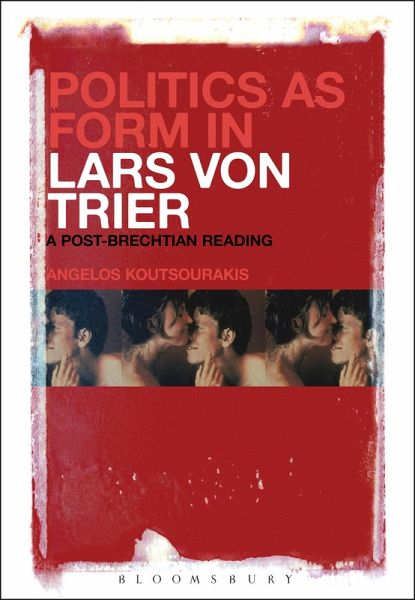
This is the first study that employs a materialist framework to discuss the political implications of form in the films of Lars von Trier. Focusing mainly on early films, Politics as Form in Lars von Trier identifies recurring formal elements in von Trier's oeuvre and discusses the formal complexity of his films under the rubric of the post-Brechtian. Through an in depth formal analysis, the book shows that Brecht is more important to von Trier's work than most critics acknowledge and deems von Trier a dialectical filmmaker. This study draws on many untranslated resources and features interviews with Lars von Trier and his mentor, the great Danish director Jørgen Leth.
Koutsourakis's examination of the often-examined Lars von Trier is refreshing for a couple of reasons. First, Koutsourakis (research fellow, Centre for Modernism Studies, Univ. of New South Wales, Australia) foregoes biographical attention to von Trier the man in the interest of restoring focus on the formal complexities of the films themselves. Second, Koutsourakis interprets the films through a postmodern rethinking of Bertolt Brecht, and he dedicates the first chapter, 50 pages or so, to Brecht and defining "post-Brechtian"--which should interest scholars of theater, performance studies, and contemporary cinema. The book is strongly argued and will prove useful to those interested in von Trier. Summing Up: Recommended. Upper-division undergraduates through faculty. J. Sundquist, Eastern Washington University CHOICE