127,95 €
inkl. MwSt.
Sofort per Download lieferbar
64 °P sammeln

Andere Kunden interessierten sich auch für
") Polymeric Nanocomposites with Carbonaceous Nanofillers for Aerospace Applications (eBook, ePUB)146,95 €
Polymeric Nanocomposites with Carbonaceous Nanofillers for Aerospace Applications (eBook, ePUB)146,95 €") Nanostructured Materials for Food Packaging Applications (eBook, ePUB)160,95 €
Nanostructured Materials for Food Packaging Applications (eBook, ePUB)160,95 €") Polymer Blend Nanocomposites for Energy Storage Applications (eBook, ePUB)167,95 €
Polymer Blend Nanocomposites for Energy Storage Applications (eBook, ePUB)167,95 €") Cellulose-Reinforced Nanofibre Composites (eBook, ePUB)211,95 €
Cellulose-Reinforced Nanofibre Composites (eBook, ePUB)211,95 €") Shape Memory Polymer-Derived Nanocomposites (eBook, ePUB)146,95 €
Shape Memory Polymer-Derived Nanocomposites (eBook, ePUB)146,95 €") Polymer Hybrid Materials and Nanocomposites (eBook, ePUB)160,95 €
Polymer Hybrid Materials and Nanocomposites (eBook, ePUB)160,95 €") Health and Environmental Safety of Nanomaterials (eBook, ePUB)160,95 €
Health and Environmental Safety of Nanomaterials (eBook, ePUB)160,95 €

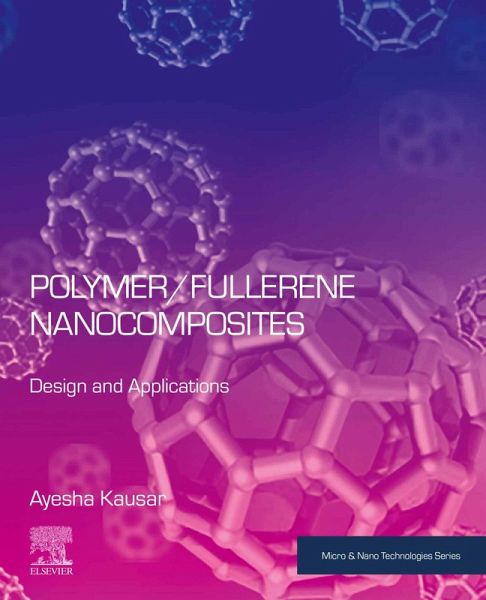
Polymer/Fullerene Nanocomposites: Design and Applications synopsizes state-of-the-art essentials and versatile inventions in polymers and fullerenes derived nanocomposites. As the design, fabrication and exploration of polymeric materials with fullerenes in advanced nanomaterials is progressing quickly because of their unique combination of properties, including optical, electronic, electrical, mechanical, thermal, photovoltaic, sensing, shape memory, capacitive, antimicrobial, and other applications, this book fills a void in literature compilation and assessment for a field still in its infancy. The introductory chapter of this manuscript provides a comprehensive update on the fundamentals and applications of fullerenes, with following chapters revealing the properties and essential aspects of polymeric nanocomposites. - Reconnoiters state-of-the-art of fullerenes - Focuses on fullerene nano-additives, developing covalent interactions, and physical dispersion with conjugated polymers and other polymeric matrices - Emphasizes fullerene nanowhisker and nanoball nanofillers in nanocomposites - Unfolds advanced applications of polymer/fullerene nanomaterials in stimuli-responsive systems, optoelectronic devices (photovoltaics, light emitting diodes and optical sensors), fuel cells, supercapacitors and biomedical fields
Dieser Download kann aus rechtlichen Gründen nur mit Rechnungsadresse in A, B, BG, CY, CZ, D, DK, EW, E, FIN, F, GR, HR, H, IRL, I, LT, L, LR, M, NL, PL, P, R, S, SLO, SK ausgeliefert werden.