52,95 €
inkl. MwSt.
Sofort per Download lieferbar
26 °P sammeln

Andere Kunden interessierten sich auch für
") Diophantine m-tuples and Elliptic Curves (eBook, PDF)104,95 €
Diophantine m-tuples and Elliptic Curves (eBook, PDF)104,95 €") Class Groups of Number Fields and Related Topics (eBook, PDF)160,95 €
Class Groups of Number Fields and Related Topics (eBook, PDF)160,95 €") Class Groups of Number Fields and Related Topics (eBook, PDF)64,95 €
Class Groups of Number Fields and Related Topics (eBook, PDF)64,95 €") A Journey Through The Realm of Numbers (eBook, PDF)28,95 €
A Journey Through The Realm of Numbers (eBook, PDF)28,95 €") Quadratic Diophantine Equations (eBook, PDF)40,95 €
Quadratic Diophantine Equations (eBook, PDF)40,95 €") Recurrent Sequences (eBook, PDF)44,95 €
Recurrent Sequences (eBook, PDF)44,95 €") Elliptic Curves and Arithmetic Invariants (eBook, PDF)104,95 €
Elliptic Curves and Arithmetic Invariants (eBook, PDF)104,95 €
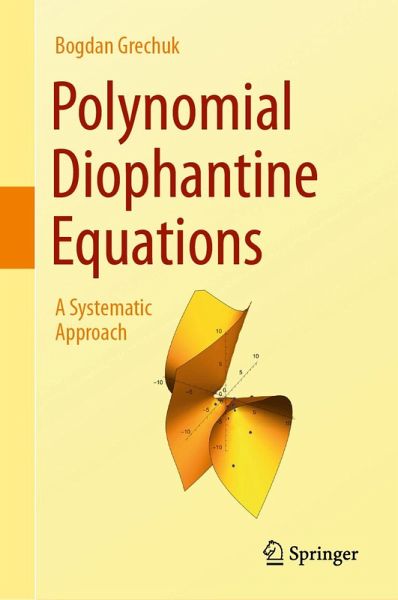
This book proposes a novel approach to the study of Diophantine equations: define an appropriate version of the equation's size, order all polynomial Diophantine equations by size, and then solve the equations in order.
Natural questions about the solution set of Diophantine equations are studied in this book using this approach. Is the set empty? Is it finite or infinite? Can all integer solutions be parametrized? By ordering equations by size, the book attempts to answer these questions in a systematic manner. When the size grows, the difficulty of finding solutions increases and the methods required to determine solutions become more advanced. Along the way, the reader will learn dozens of methods for solving Diophantine equations, each of which is illustrated by worked examples and exercises. The book ends with solutions to exercises and a large collection of open problems, often simple to write down yet still unsolved.
The original approach pursued in this book makes it widely accessible. Many equations require only high school mathematics and creativity to be solved, so a large part of the book is accessible to high school students, especially those interested in mathematical competitions such as olympiads. The main intended audience is undergraduate students, for whom the book will serve as an unusually rich introduction to the topic of Diophantine equations. Many methods from the book will be useful for graduate students, while Ph.D. students and researchers may use it as a source of fascinating open questions of varying levels of difficulty.
Natural questions about the solution set of Diophantine equations are studied in this book using this approach. Is the set empty? Is it finite or infinite? Can all integer solutions be parametrized? By ordering equations by size, the book attempts to answer these questions in a systematic manner. When the size grows, the difficulty of finding solutions increases and the methods required to determine solutions become more advanced. Along the way, the reader will learn dozens of methods for solving Diophantine equations, each of which is illustrated by worked examples and exercises. The book ends with solutions to exercises and a large collection of open problems, often simple to write down yet still unsolved.
The original approach pursued in this book makes it widely accessible. Many equations require only high school mathematics and creativity to be solved, so a large part of the book is accessible to high school students, especially those interested in mathematical competitions such as olympiads. The main intended audience is undergraduate students, for whom the book will serve as an unusually rich introduction to the topic of Diophantine equations. Many methods from the book will be useful for graduate students, while Ph.D. students and researchers may use it as a source of fascinating open questions of varying levels of difficulty.
Dieser Download kann aus rechtlichen Gründen nur mit Rechnungsadresse in A, B, BG, CY, CZ, D, DK, EW, E, FIN, F, GR, HR, H, IRL, I, LT, L, LR, M, NL, PL, P, R, S, SLO, SK ausgeliefert werden.
The book is based on some deep theorems from theory of Diophantine equations as well as a large variety of elementary methods. Each method is illustrated by a number of solved examples and unsolved exercises. In each chapter, the corresponding problem is solved up to as high size H as one can, and also the smallest unsolved equations are listed as open questions. Software such as Mathematica, Magma and Maple are used for analysis of the equations. (Ranjeet Sehmi, zbMATH 1564.11003, 2025)
Many open problems are mentioned. Clear solutions are provided where possible and for many problems the outlines of solutions are given as exercises. ... most of the book is self-contained, elementary and accessible to undergraduates. The presentation is very well organized and so the book is easy to read throughout. As expected from such a book, the list of references is also long and valuable. (Sankar Sitaraman, Mathematical Reviews, November 6, 2025)
Many open problems are mentioned. Clear solutions are provided where possible and for many problems the outlines of solutions are given as exercises. ... most of the book is self-contained, elementary and accessible to undergraduates. The presentation is very well organized and so the book is easy to read throughout. As expected from such a book, the list of references is also long and valuable. (Sankar Sitaraman, Mathematical Reviews, November 6, 2025)