Carla Vilela, Ricardo João Borges Pinto, Susana Pinto, Paula Marques, Armando Silvestre, Carmen Sofia Da Rocha Freire Barros
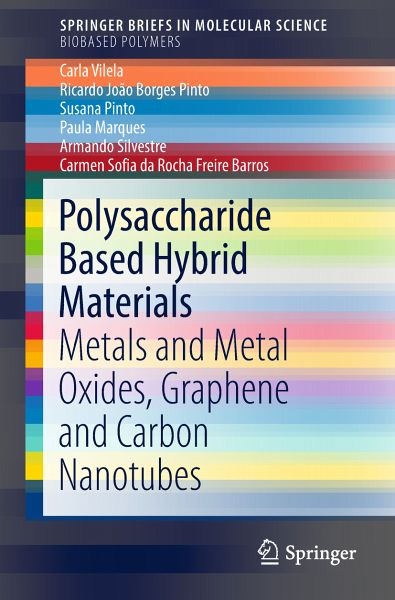
Polysaccharide Based Hybrid Materials (eBook, PDF)
Metals and Metal Oxides, Graphene and Carbon Nanotubes
40,95 €
40,95 €
inkl. MwSt.
Sofort per Download lieferbar

20 °P sammeln
40,95 €
Als Download kaufen
40,95 €
inkl. MwSt.
Sofort per Download lieferbar
20 °P sammeln
Jetzt verschenken
Alle Infos zum eBook verschenken
40,95 €
inkl. MwSt.
Sofort per Download lieferbar
Alle Infos zum eBook verschenken
20 °P sammeln

Carla Vilela, Ricardo João Borges Pinto, Susana Pinto, Paula Marques, Armando Silvestre, Carmen Sofia Da Rocha Freire Barros
Polysaccharide Based Hybrid Materials (eBook, PDF)
Metals and Metal Oxides, Graphene and Carbon Nanotubes
- Format: PDF
- Merkliste
- Auf die Merkliste
- Bewerten Bewerten
- Teilen
- Produkt teilen
- Produkterinnerung
- Produkterinnerung

Bitte loggen Sie sich zunächst in Ihr Kundenkonto ein oder registrieren Sie sich bei
bücher.de, um das eBook-Abo tolino select nutzen zu können.
Hier können Sie sich einloggen
Sie sind bereits eingeloggt. Klicken Sie auf 2. tolino select Abo, um fortzufahren.

Bitte loggen Sie sich zunächst in Ihr Kundenkonto ein oder registrieren Sie sich bei bücher.de, um das eBook-Abo tolino select nutzen zu können.
Includes tables and figures detailing the diversity and major polysaccharide/inorganic nanosystems used to produce hybrids Features polysaccharide nano-based materials Authored by recognized academics
- Geräte: PC
- ohne Kopierschutz
- eBook Hilfe
- Größe: 2.97MB
Andere Kunden interessierten sich auch für
Polysaccharide Based Graft Copolymers (eBook, PDF)72,95 €
Hybrid and Hierarchical Composite Materials (eBook, PDF)72,95 €
Organic and Hybrid Photonic Crystals (eBook, PDF)80,95 €
Organic-Inorganic Hybrid Nanomaterials (eBook, PDF)160,95 €
Quantum Materials, Lateral Semiconductor Nanostructures, Hybrid Systems and Nanocrystals (eBook, PDF)136,95 €
Enzymatic Polymerization towards Green Polymer Chemistry (eBook, PDF)128,95 €
Hermann EhrlichMarine Biological Materials of Invertebrate Origin (eBook, PDF)160,95 €-
-
-
Includes tables and figures detailing the diversity and major polysaccharide/inorganic nanosystems used to produce hybrids
Features polysaccharide nano-based materials
Authored by recognized academics
Dieser Download kann aus rechtlichen Gründen nur mit Rechnungsadresse in A, B, BG, CY, CZ, D, DK, EW, E, FIN, F, GR, HR, H, IRL, I, LT, L, LR, M, NL, PL, P, R, S, SLO, SK ausgeliefert werden.
Produktdetails
- Produktdetails
- Verlag: Springer International Publishing
- Seitenzahl: 116
- Erscheinungstermin: 26. September 2018
- Englisch
- ISBN-13: 9783030003470
- Artikelnr.: 58936226
- Verlag: Springer International Publishing
- Seitenzahl: 116
- Erscheinungstermin: 26. September 2018
- Englisch
- ISBN-13: 9783030003470
- Artikelnr.: 58936226
- Herstellerkennzeichnung Die Herstellerinformationen sind derzeit nicht verfügbar.
Carla Vilela (PhD), postdoctoral researcher at CICECO - Aveiro Institute of Materials, University of Aveiro.
Her research interests are dedicated to the sustainable use of biopolymers (bacterial cellulose, chitosan, alginate, pullulan, proteins, etc.) to design and engineer functional nanostructured materials for both biomedical (e.g. drug delivery and wound healing) and technological (e.g. active packaging and fuel cells) applications.
ORCID: https://orcid.org/0000-0002-9212-2704 .
Ricardo Pinto (PhD), Post-Doc Researcher at CICECO-Aveiro Institute of Materials and TEMA (Centre of Mechanical Technology and Automation of Aveiro), University of Aveiro
Research interests: metallic nanoparticles biosynthesis using plant extracts and preparation and characterization of biobased nanocomposites materials for antimicrobial, catalytic, and conductive applications.
ORCID: https://orcid.org/0000-0001-5600-2396).
Susana Pinto is a PhD student at the Centre of Mechanical Technology and Automation of Aveiro (TEMA-NRG), Department of Mechanical Engineering - University of Aveiro, holding a doctoral grant from the Portuguese Foundation from Science and Technology (SFRH/BD/111515/2015).
Her current interests include the preparation and characterization of multifunctional nanocomposite materials based on cellulose/graphene cellular materials.
ORCID: https://orcid.org/0000-0003-2658-1045
Paula Marques (PhD), Principal Researcher at TEMA (Centre of Mechanical Technology and Automation of Aveiro) from the Department of Mechanical Engineering, University of Aveiro.
Research interests: engineering and development of mechanical and electrical stimulus responsive 3D graphene/polymer fibrous scaffolds for tissue engineering; production and application of functionalized graphene-based foams for water remediation; graphene oxide/polymer nanocomposite fibre mats obtained by electrospinning for photocatalytic degradation of pollutants in aqueous and gaseous systems; use of functionalized graphene oxide as mechanical reinforcement of polymer matrixes.
ORCID: http://orcid.org/0000-0002-7498-452X
Armando Silvestre (PhD), Full Professor at the Department of Chemistry and at CICECO- Aveiro Institute of Materials, University of Aveiro.
His research interests are focused on the Biorefinery concept development namely through the sustainable extraction and upgrading of added-value compounds from biomass, addressing mainly bioactive compounds through the use benign solvents (using ionic liquids, and deep eutecticamong others; new biobased polymers derived from 2,5-furandicarboxylic acid and new functional (nano)composite materials and biomaterials based on biopolymers and cellulose (nano)fibers.
ORCID: http://orcid.org/0000-0002-6320-4663.
Carmen Freire (PhD), Principal Researcher at CICECO-Aveiro Institute of Materials (University of Aveiro) and Department of Chemistry.
Her research interests are centered on the production and application of biogenic nanofibers (bacterial cellulose and protein fibrils), nanostructured biocomposites and hybrid materials; bio-based materials for biomedical applications (wound healing and drug delivery); biocomposites and functional paper materials; chemical modification of (nano)cellulose fibers and other polysaccharides and their characterization and applications; and isolation, characterization and chemical transformations of bioactive components.
ORCID: http://orcid.org/0000-0002-6320-4663.
Her research interests are dedicated to the sustainable use of biopolymers (bacterial cellulose, chitosan, alginate, pullulan, proteins, etc.) to design and engineer functional nanostructured materials for both biomedical (e.g. drug delivery and wound healing) and technological (e.g. active packaging and fuel cells) applications.
ORCID: https://orcid.org/0000-0002-9212-2704 .
Ricardo Pinto (PhD), Post-Doc Researcher at CICECO-Aveiro Institute of Materials and TEMA (Centre of Mechanical Technology and Automation of Aveiro), University of Aveiro
Research interests: metallic nanoparticles biosynthesis using plant extracts and preparation and characterization of biobased nanocomposites materials for antimicrobial, catalytic, and conductive applications.
ORCID: https://orcid.org/0000-0001-5600-2396).
Susana Pinto is a PhD student at the Centre of Mechanical Technology and Automation of Aveiro (TEMA-NRG), Department of Mechanical Engineering - University of Aveiro, holding a doctoral grant from the Portuguese Foundation from Science and Technology (SFRH/BD/111515/2015).
Her current interests include the preparation and characterization of multifunctional nanocomposite materials based on cellulose/graphene cellular materials.
ORCID: https://orcid.org/0000-0003-2658-1045
Paula Marques (PhD), Principal Researcher at TEMA (Centre of Mechanical Technology and Automation of Aveiro) from the Department of Mechanical Engineering, University of Aveiro.
Research interests: engineering and development of mechanical and electrical stimulus responsive 3D graphene/polymer fibrous scaffolds for tissue engineering; production and application of functionalized graphene-based foams for water remediation; graphene oxide/polymer nanocomposite fibre mats obtained by electrospinning for photocatalytic degradation of pollutants in aqueous and gaseous systems; use of functionalized graphene oxide as mechanical reinforcement of polymer matrixes.
ORCID: http://orcid.org/0000-0002-7498-452X
Armando Silvestre (PhD), Full Professor at the Department of Chemistry and at CICECO- Aveiro Institute of Materials, University of Aveiro.
His research interests are focused on the Biorefinery concept development namely through the sustainable extraction and upgrading of added-value compounds from biomass, addressing mainly bioactive compounds through the use benign solvents (using ionic liquids, and deep eutecticamong others; new biobased polymers derived from 2,5-furandicarboxylic acid and new functional (nano)composite materials and biomaterials based on biopolymers and cellulose (nano)fibers.
ORCID: http://orcid.org/0000-0002-6320-4663.
Carmen Freire (PhD), Principal Researcher at CICECO-Aveiro Institute of Materials (University of Aveiro) and Department of Chemistry.
Her research interests are centered on the production and application of biogenic nanofibers (bacterial cellulose and protein fibrils), nanostructured biocomposites and hybrid materials; bio-based materials for biomedical applications (wound healing and drug delivery); biocomposites and functional paper materials; chemical modification of (nano)cellulose fibers and other polysaccharides and their characterization and applications; and isolation, characterization and chemical transformations of bioactive components.
ORCID: http://orcid.org/0000-0002-6320-4663.
1. Introduction.- 2. Polysaccharides-based hybrids with metal nanoparticles.- 3. Polysaccharides-based hybrids with metal oxide nanoparticles.- 4. Polysaccharides-based hybrids with graphene.- 5. Polysaccharides-based hybrids with carbon nanotubes.- 6. Conclusions and future perspectives.