21,95 €
21,95 €
inkl. MwSt.
Sofort per Download lieferbar

11 °P sammeln
21,95 €
Als Download kaufen
21,95 €
inkl. MwSt.
Sofort per Download lieferbar
11 °P sammeln
Jetzt verschenken
Alle Infos zum eBook verschenken
21,95 €
inkl. MwSt.
Sofort per Download lieferbar
Alle Infos zum eBook verschenken
11 °P sammeln

Andere Kunden interessierten sich auch für
") Negotiation Theory and the EU (eBook, PDF)45,95 €
Negotiation Theory and the EU (eBook, PDF)45,95 €") Politics of Change in Middle East and North Africa since Arab Spring (eBook, PDF)39,95 €
Politics of Change in Middle East and North Africa since Arab Spring (eBook, PDF)39,95 €") Putinism - Post-Soviet Russian Regime Ideology (eBook, PDF)39,95 €
Putinism - Post-Soviet Russian Regime Ideology (eBook, PDF)39,95 € The "Russian Idea" in International Relations (eBook, PDF)38,95 €
") International Relations Theory (eBook, PDF)35,95 €
International Relations Theory (eBook, PDF)35,95 €") The Survival Regime (eBook, PDF)39,95 €
The Survival Regime (eBook, PDF)39,95 €") Legislative Networks and Reforms in Post-Soviet States (eBook, PDF)35,95 €
Legislative Networks and Reforms in Post-Soviet States (eBook, PDF)35,95 €





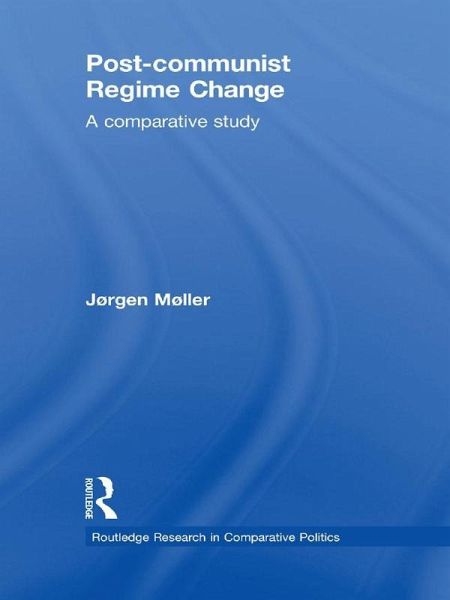
This book seeks to explain the divergent political pathways of twenty six post-communist states, following the breakdown and eventual collapse of communism in 1989-1991.
Considering the trajectories of individual states between 1990 - 2007, this book challenges two central bodies of theory relating to democratization and regime change. Through a sustained analysis of global and post-communist developments within this time period, the author shows that claims of an increasing asymmetry between the 'electoral' and 'liberal' elements of modern democracy have been greatly exaggerated. The author goes on to contend that in accounting for the geographical dispersion of post-communist regime forms, deeper structural factors should be considered as crucial. The book is divided into the following parts:
This book will be of interest to students and scholars of post-communist studies, democratization studies, comparative politics and regime change.
Considering the trajectories of individual states between 1990 - 2007, this book challenges two central bodies of theory relating to democratization and regime change. Through a sustained analysis of global and post-communist developments within this time period, the author shows that claims of an increasing asymmetry between the 'electoral' and 'liberal' elements of modern democracy have been greatly exaggerated. The author goes on to contend that in accounting for the geographical dispersion of post-communist regime forms, deeper structural factors should be considered as crucial. The book is divided into the following parts:
- Part I demonstrates how different conceptualisations of democracy can lead to very different conclusions about the empirical dynamics of democratization.
- Part II contrasts different explanations of post-communist political change and provides an integrated framework for explaining the political pathways encountered within the former Eastern Bloc.
This book will be of interest to students and scholars of post-communist studies, democratization studies, comparative politics and regime change.
Dieser Download kann aus rechtlichen Gründen nur mit Rechnungsadresse in A, B, BG, CY, CZ, D, DK, EW, E, FIN, F, GR, HR, H, IRL, I, LT, L, LR, M, NL, PL, P, R, S, SLO, SK ausgeliefert werden.