37,95 €
inkl. MwSt.
Sofort per Download lieferbar
19 °P sammeln

Andere Kunden interessierten sich auch für
") Post-Conflict Participatory Arts (eBook, ePUB)37,95 €
Post-Conflict Participatory Arts (eBook, ePUB)37,95 €") Participatory Arts in International Development (eBook, PDF)41,95 €
Participatory Arts in International Development (eBook, PDF)41,95 €") Routledge Handbook of Arts and Global Development (eBook, PDF)47,95 €
Routledge Handbook of Arts and Global Development (eBook, PDF)47,95 €") Arts-based Research in Global Development (eBook, PDF)42,95 €
Arts-based Research in Global Development (eBook, PDF)42,95 €") Performing Sustainability in West Africa (eBook, PDF)0,00 €
Performing Sustainability in West Africa (eBook, PDF)0,00 €") Arts and Culture in Global Development Practice (eBook, PDF)34,95 €
Arts and Culture in Global Development Practice (eBook, PDF)34,95 €") Sustainable Development Goal 16 and the Global Governance of Violence (eBook, PDF)39,95 €
Sustainable Development Goal 16 and the Global Governance of Violence (eBook, PDF)39,95 €


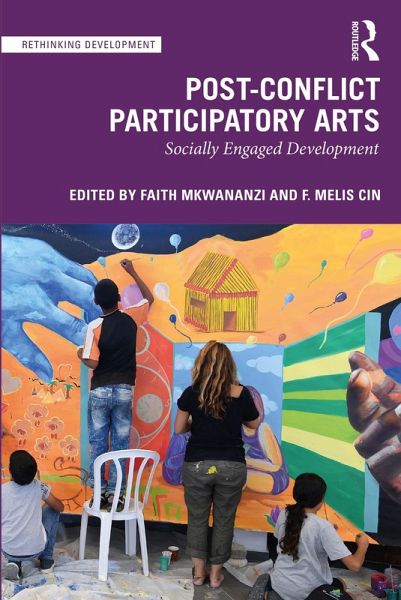
This book investigates the power of art to enhance human development and to initiate positive social change for individuals and societies recovering from conflict.
Interventions aimed at reinforcing social justice and bringing communities together after conflict are often accused of being top-down, or failing to consider all groups and contexts within a society. The use of participatory arts can help to address these challenges by fostering community engagement, social cohesion, influencing public policy, and ultimately, advancing social justice. Arts-based methods can be particularly effective at reaching youth communities, providing voice and political agency to young people who are often not given a platform. Situated at the intersection of participatory arts, social and epistemic justice, this book brings together case studies from across the world to reflect on best practice for the use of bottom-up, participatory, co-produced, and co-designed arts processes in conflict settings.
This book provides an important guide to the role that arts can play in addressing epistemic injustice and contributing to social justice and human development. As such, it will be of interest to international development and arts practitioners, policy makers, and to students and researchers across participatory arts, youth studies, international development, social justice, and peace and conflict studies.
Interventions aimed at reinforcing social justice and bringing communities together after conflict are often accused of being top-down, or failing to consider all groups and contexts within a society. The use of participatory arts can help to address these challenges by fostering community engagement, social cohesion, influencing public policy, and ultimately, advancing social justice. Arts-based methods can be particularly effective at reaching youth communities, providing voice and political agency to young people who are often not given a platform. Situated at the intersection of participatory arts, social and epistemic justice, this book brings together case studies from across the world to reflect on best practice for the use of bottom-up, participatory, co-produced, and co-designed arts processes in conflict settings.
This book provides an important guide to the role that arts can play in addressing epistemic injustice and contributing to social justice and human development. As such, it will be of interest to international development and arts practitioners, policy makers, and to students and researchers across participatory arts, youth studies, international development, social justice, and peace and conflict studies.
Dieser Download kann aus rechtlichen Gründen nur mit Rechnungsadresse in A, B, BG, CY, CZ, D, DK, EW, E, FIN, F, GR, HR, H, IRL, I, LT, L, LR, M, NL, PL, P, R, S, SLO, SK ausgeliefert werden.
"The authors and editors of Post-Conflict Participatory Arts have brought together a jewel of a book, weaving together years of experience in many different countries with a strong theoretical framing. It offers much to practitioners and to scholars of both participatory methodology and of peace and social justice. Whether dance, photovoice, graffiti or participatory video, the book demonstrates some of the potential and limitations of participatory arts in challenging environments and offers hope and inspiration for those seeking to work across boundaries in post-conflict contexts." - Chris High, Lecturer in Peace and Development, Linnaeus University, Sweden
"This well-inquired book brings together ways in which the public is empowered to act, respond and interact around issues of civic engagement and political spaces through participatory art to improve people's lives and wellbeing. It investigates concepts such as agency, power, with a focus on human advancement viewpoint in post-conflict communities that are often ignored by unequal epistemic relations and neoliberal development agendas. While the book could be a critical asset for policy-makers, artists, and art-based organisations, it too reminds us of Eugene Delacroix's decree: 'What moves men of genius, or rather what rouses their work, is not new ideas, but their obsession with the idea that what has already been said is still not enough.'" - Peggy Himoonde, BBA History, Lusaka National Museum, Zambia
"Very insightful... The practicality of arts as an effective media towards the realization of epistemic/ social justice, is indeed a creative colorful approach." - Aubrey Bango, Visual Artist, Zimbabwe
"This well-inquired book brings together ways in which the public is empowered to act, respond and interact around issues of civic engagement and political spaces through participatory art to improve people's lives and wellbeing. It investigates concepts such as agency, power, with a focus on human advancement viewpoint in post-conflict communities that are often ignored by unequal epistemic relations and neoliberal development agendas. While the book could be a critical asset for policy-makers, artists, and art-based organisations, it too reminds us of Eugene Delacroix's decree: 'What moves men of genius, or rather what rouses their work, is not new ideas, but their obsession with the idea that what has already been said is still not enough.'" - Peggy Himoonde, BBA History, Lusaka National Museum, Zambia
"Very insightful... The practicality of arts as an effective media towards the realization of epistemic/ social justice, is indeed a creative colorful approach." - Aubrey Bango, Visual Artist, Zimbabwe
"The authors and editors of Post-Conflict Participatory Arts have brought together a jewel of a book, weaving together years of experience in many different countries with a strong theoretical framing. It offers much to practitioners and to scholars of both participatory methodology and of peace and social justice. Whether dance, photovoice, graffiti or participatory video, the book demonstrates some of the potential and limitations of participatory arts in challenging environments and offers hope and inspiration for those seeking to work across boundaries in post-conflict contexts." - Chris High, Lecturer in Peace and Development, Linnaeus University, Sweden
"This well-inquired book brings together ways in which the public is empowered to act, respond and interact around issues of civic engagement and political spaces through participatory art to improve people's lives and wellbeing. It investigates concepts such as agency, power, with a focus on human advancement viewpoint in post-conflict communities that are often ignored by unequal epistemic relations and neoliberal development agendas. While the book could be a critical asset for policy-makers, artists, and art-based organisations, it too reminds us of Eugene Delacroix's decree: 'What moves men of genius, or rather what rouses their work, is not new ideas, but their obsession with the idea that what has already been said is still not enough.'" - Peggy Himoonde, BBA History, Lusaka National Museum, Zambia
"Very insightful... The practicality of arts as an effective media towards the realization of epistemic/ social justice, is indeed a creative colorful approach." - Aubrey Bango, Visual Artist, Zimbabwe
"This well-inquired book brings together ways in which the public is empowered to act, respond and interact around issues of civic engagement and political spaces through participatory art to improve people's lives and wellbeing. It investigates concepts such as agency, power, with a focus on human advancement viewpoint in post-conflict communities that are often ignored by unequal epistemic relations and neoliberal development agendas. While the book could be a critical asset for policy-makers, artists, and art-based organisations, it too reminds us of Eugene Delacroix's decree: 'What moves men of genius, or rather what rouses their work, is not new ideas, but their obsession with the idea that what has already been said is still not enough.'" - Peggy Himoonde, BBA History, Lusaka National Museum, Zambia
"Very insightful... The practicality of arts as an effective media towards the realization of epistemic/ social justice, is indeed a creative colorful approach." - Aubrey Bango, Visual Artist, Zimbabwe