44,95 €
inkl. MwSt.
Sofort per Download lieferbar
22 °P sammeln

Andere Kunden interessierten sich auch für
") Foundations for Teaching Chemistry (eBook, PDF)24,95 €
Foundations for Teaching Chemistry (eBook, PDF)24,95 €") Post-Secondary Chemistry Education in Developing Countries (eBook, ePUB)44,95 €
Post-Secondary Chemistry Education in Developing Countries (eBook, ePUB)44,95 €") The Reform of Teacher Education in the Post-Soviet Space (eBook, PDF)41,95 €
The Reform of Teacher Education in the Post-Soviet Space (eBook, PDF)41,95 €") Pragmatism, Post-modernism, and Complexity Theory (eBook, PDF)54,95 €
Pragmatism, Post-modernism, and Complexity Theory (eBook, PDF)54,95 €") The Turning Point for the Teaching Profession (eBook, PDF)24,95 €
The Turning Point for the Teaching Profession (eBook, PDF)24,95 €") Key Profession (eBook, PDF)32,95 €
Key Profession (eBook, PDF)32,95 €") European Dimensions and the Secondary School Curriculum (eBook, PDF)22,95 €
European Dimensions and the Secondary School Curriculum (eBook, PDF)22,95 €


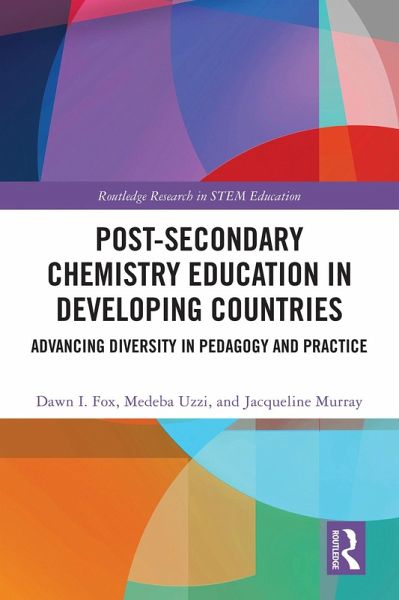
This book considers how post-secondary chemistry education can be advanced in developing countries, in order to respond to emerging global, regional, and local needs.
Taking Guyana as a case study, it pays particular attention to local challenges facing such territories, including human and financial resource shortages, tension between quality and quantity of graduates, cultural inequalities, unequal access to increasingly important Information and Communication Technology or Technologies (ICTs), and increasing competition from international universities in the developed world. Written by a team with over 70 years in combined teaching experience, it asks whether these challenges can be met and overcome and considers how tertiary chemistry education can better meet the rapidly changing needs of society. The authors examine the status quo of tertiary chemistry education in Guyana against the introductory backdrop of the internal and external stresses on the education system, before exploring selected best practices grounded in a three-pronged model focused on pedagogy, programming, and people. Advancing diversity on each of these levels, the book ultimately shows how this framework can support better learning and teaching, and the development of a better equipped and more diverse Science, Technology, Engineering and Mathematics (STEM) workforce.
It will appeal to scholars, researchers, graduate students, and tertiary level curriculum developers in chemistry education, interested in an innovative, holistic approach for transforming chemistry teaching that focuses on pedagogical diversity, strategic co-curricular programming, and accommodating diversity and diverse learning styles in the classroom.
Taking Guyana as a case study, it pays particular attention to local challenges facing such territories, including human and financial resource shortages, tension between quality and quantity of graduates, cultural inequalities, unequal access to increasingly important Information and Communication Technology or Technologies (ICTs), and increasing competition from international universities in the developed world. Written by a team with over 70 years in combined teaching experience, it asks whether these challenges can be met and overcome and considers how tertiary chemistry education can better meet the rapidly changing needs of society. The authors examine the status quo of tertiary chemistry education in Guyana against the introductory backdrop of the internal and external stresses on the education system, before exploring selected best practices grounded in a three-pronged model focused on pedagogy, programming, and people. Advancing diversity on each of these levels, the book ultimately shows how this framework can support better learning and teaching, and the development of a better equipped and more diverse Science, Technology, Engineering and Mathematics (STEM) workforce.
It will appeal to scholars, researchers, graduate students, and tertiary level curriculum developers in chemistry education, interested in an innovative, holistic approach for transforming chemistry teaching that focuses on pedagogical diversity, strategic co-curricular programming, and accommodating diversity and diverse learning styles in the classroom.
Dieser Download kann aus rechtlichen Gründen nur mit Rechnungsadresse in A, B, BG, CY, CZ, D, DK, EW, E, FIN, F, GR, HR, H, IRL, I, LT, L, LR, M, NL, PL, P, R, S, SLO, SK ausgeliefert werden.