41,95 €
41,95 €
inkl. MwSt.
Sofort per Download lieferbar

21 °P sammeln
41,95 €
Als Download kaufen
41,95 €
inkl. MwSt.
Sofort per Download lieferbar
21 °P sammeln
Jetzt verschenken
Alle Infos zum eBook verschenken
41,95 €
inkl. MwSt.
Sofort per Download lieferbar
Alle Infos zum eBook verschenken
21 °P sammeln

Andere Kunden interessierten sich auch für
") Postcolonial and Postsocialist Dialogues (eBook, PDF)41,95 €
Postcolonial and Postsocialist Dialogues (eBook, PDF)41,95 €") The Womanist Reader (eBook, ePUB)45,95 €
The Womanist Reader (eBook, ePUB)45,95 €") Borderlands in European Gender Studies (eBook, ePUB)41,95 €
Borderlands in European Gender Studies (eBook, ePUB)41,95 €") The Politics of Silence, Voice and the In-Between (eBook, ePUB)42,95 €
The Politics of Silence, Voice and the In-Between (eBook, ePUB)42,95 €") Mobilising the Racialised 'Others' (eBook, ePUB)0,00 €
Mobilising the Racialised 'Others' (eBook, ePUB)0,00 €") Ten Essays for a 21st Century Socialism (eBook, ePUB)42,95 €
Ten Essays for a 21st Century Socialism (eBook, ePUB)42,95 € (eBook, ePUB)") Engels Revisited (Routledge Revivals) (eBook, ePUB)45,95 €
Engels Revisited (Routledge Revivals) (eBook, ePUB)45,95 €


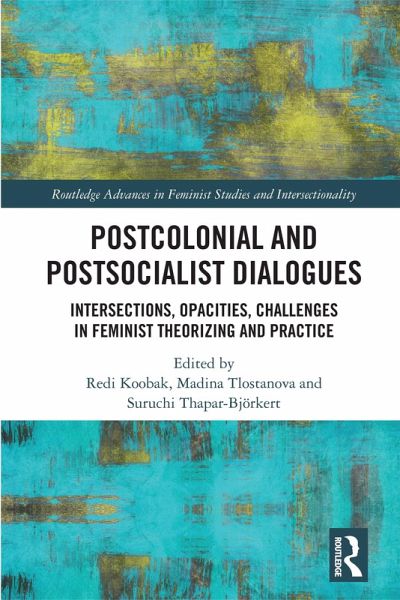
Through staging dialogues between scholars, activists, and artists from a variety of disciplinary, geographical, and historical specializations, Postcolonial and Postsocialist Dialogues explores the possible resonances and dissonances between the postcolonial and the postsocialist in feminist theorizing and practice.
While postcolonial and postsocialist perspectives have been explored in feminist studies, the two analytics tend to be viewed separately. This volume brings together attempts to understand if and how postcolonial and postsocialist dimensions of the human condition - historical, existential, political, and ideological - intersect and correlate in feminist experiences, identities, and struggles. In the three sections that probe the intersections, opacities, and challenges between the two discourses, the authors put under pressure what postcolonialism and postsocialism mean for feminist scholarship and activism.
The contributions address the emergence of new political and cultural formations as well as circuits of bodies and capital in a post-Cold War and postcolonial era in currently re-emerging neo-colonial and imperial conflicts. They engage with issues of gender, sexuality, race, migration, diasporas, indigeneity, and disability, while also developing new analytical tools such as postsocialist precarity, queer postsocialist coloniality, uneventful feminism, feminist opacity, feminist queer crip epistemologies. The collection will be of interest for postcolonial and postsocialist researchers, students of gender studies, feminist activists and scholars.
While postcolonial and postsocialist perspectives have been explored in feminist studies, the two analytics tend to be viewed separately. This volume brings together attempts to understand if and how postcolonial and postsocialist dimensions of the human condition - historical, existential, political, and ideological - intersect and correlate in feminist experiences, identities, and struggles. In the three sections that probe the intersections, opacities, and challenges between the two discourses, the authors put under pressure what postcolonialism and postsocialism mean for feminist scholarship and activism.
The contributions address the emergence of new political and cultural formations as well as circuits of bodies and capital in a post-Cold War and postcolonial era in currently re-emerging neo-colonial and imperial conflicts. They engage with issues of gender, sexuality, race, migration, diasporas, indigeneity, and disability, while also developing new analytical tools such as postsocialist precarity, queer postsocialist coloniality, uneventful feminism, feminist opacity, feminist queer crip epistemologies. The collection will be of interest for postcolonial and postsocialist researchers, students of gender studies, feminist activists and scholars.
Dieser Download kann aus rechtlichen Gründen nur mit Rechnungsadresse in A, B, BG, CY, CZ, D, DK, EW, E, FIN, F, GR, HR, H, IRL, I, LT, L, LR, M, NL, PL, P, R, S, SLO, SK ausgeliefert werden.
"This timely anthology comes together at the generative intersections of the asynchronous and sometimes contradictory struggles of postcolonial and postsocialist feminisms. Boldly confronting the race-blindness of postsocialism, and the overwhelming preoccupation with the capitalist West in postcolonialism, the contributions tackle the delicate challenge of theorizing from non-dominant locations-beyond complicity, and with a sensitive regard for difference. The collection highlights "uneventful activism" and especially "opacity" as resources for feminist resistance that confound easy legibility and cooptation by neoliberal recognition and success. The aim here is to safeguard "spaces of re-existence and change" and a politics of post-colonial/socialist coalitions against racial capitalism."
Mahua Sarkar, Professor, Binghampton University, SUNY
"To understand our current complicated and tantalizing geopolitical and corpopolitical situation, feminist scholarship needs to engage with positive meaning making as a way of fine-tuning the researcher's lens. This exemplary and diverse group of authors correlates postcolonial and postsocialist dimensions with feminist experiences in order to offer concepts and enlighten connections, and to combat "global white ignorance" with much needed innovative politics of knowledge, activism and organizing that may give the world its future dimension back."
Andrea Petö, Professor, Central European University, Budapest-Vienna
"This collection will be of great interest to researchers, students, and general readers interested in contemporary women and feminist writing across the geopolitical East, West, North and South. It illuminates powerfully how people in different locales theorize, argue and negotiate the meanings of postcolonialism, postsocialism and their own role as intellectuals, educators and activists in the making or unmaking of the oppressive historical systems and relations underlining these phenomena. Yet the volume articulates the contributors' desire for new epistemologies and conceptual constructs that could better capture the complexity and globality especially of postsocialism as a condition, marking important theoretical and political debates about postcoloniality, globalization, political economy, race, and power in transnational feminism, postcolonial studies, and women, gender and sexuality studies."
Miglena Todorova, Assistant Professor, University of Toronto
Mahua Sarkar, Professor, Binghampton University, SUNY
"To understand our current complicated and tantalizing geopolitical and corpopolitical situation, feminist scholarship needs to engage with positive meaning making as a way of fine-tuning the researcher's lens. This exemplary and diverse group of authors correlates postcolonial and postsocialist dimensions with feminist experiences in order to offer concepts and enlighten connections, and to combat "global white ignorance" with much needed innovative politics of knowledge, activism and organizing that may give the world its future dimension back."
Andrea Petö, Professor, Central European University, Budapest-Vienna
"This collection will be of great interest to researchers, students, and general readers interested in contemporary women and feminist writing across the geopolitical East, West, North and South. It illuminates powerfully how people in different locales theorize, argue and negotiate the meanings of postcolonialism, postsocialism and their own role as intellectuals, educators and activists in the making or unmaking of the oppressive historical systems and relations underlining these phenomena. Yet the volume articulates the contributors' desire for new epistemologies and conceptual constructs that could better capture the complexity and globality especially of postsocialism as a condition, marking important theoretical and political debates about postcoloniality, globalization, political economy, race, and power in transnational feminism, postcolonial studies, and women, gender and sexuality studies."
Miglena Todorova, Assistant Professor, University of Toronto