20,95 €
20,95 €
inkl. MwSt.
Sofort per Download lieferbar

10 °P sammeln
20,95 €
Als Download kaufen
20,95 €
inkl. MwSt.
Sofort per Download lieferbar
10 °P sammeln
Jetzt verschenken
Alle Infos zum eBook verschenken
20,95 €
inkl. MwSt.
Sofort per Download lieferbar
Alle Infos zum eBook verschenken
10 °P sammeln

Andere Kunden interessierten sich auch für
") Opéra de salon (eBook, PDF)48,95 €
Opéra de salon (eBook, PDF)48,95 €") The Musical Language of Italian Opera, 1813-1859 (eBook, PDF)51,95 €
The Musical Language of Italian Opera, 1813-1859 (eBook, PDF)51,95 €") Revisiting the Popular in Music History (eBook, PDF)42,95 €
Revisiting the Popular in Music History (eBook, PDF)42,95 €") Someone Else's Music (eBook, PDF)17,95 €
Someone Else's Music (eBook, PDF)17,95 €") Visions of the Village (eBook, PDF)48,95 €
Visions of the Village (eBook, PDF)48,95 €") Teaching Canonic Opera and Musical Theater with Intention (eBook, PDF)21,95 €
Teaching Canonic Opera and Musical Theater with Intention (eBook, PDF)21,95 €") The Complete Annotated Gilbert & Sullivan (eBook, PDF)24,95 €
The Complete Annotated Gilbert & Sullivan (eBook, PDF)24,95 €



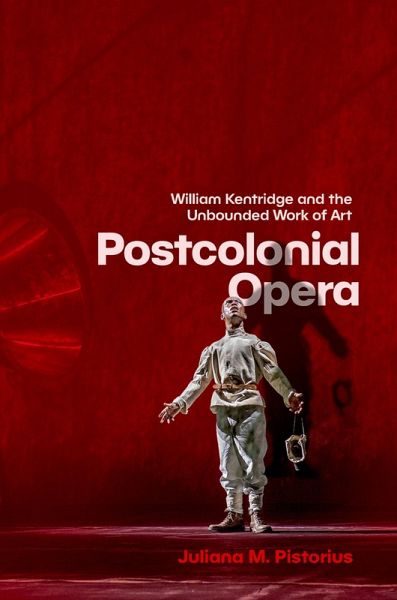
Opera has long been known for its ability to be used as a tool for colonial expression. But it is increasingly used to narrate histories of colonial trauma, oppression, and struggle. What does it mean for a colonial form to represent the experiences of those it used to exclude and undermine? How can opera adapt to meet the challenges of ethical representation and reparation? In response to these questions, Postcolonial Opera: William Kentridge and the Unbounded Work of Art examines the social and political role of opera in the postcolony. Taking the multimedia operatic experiments of William Kentridge, South Africa's most celebrated contemporary visual artist, as a starting point, author Juliana M. Pistorius investigates contemporary opera's potential to process the troubled histories that haunt post- and decolonial societies. Centered around the critical-theoretical themes of return, confession, mourning, time, displacement, and totality, the book considers Kentridge's productions for puppets (Il Ritorno d'Ulisse, 1998; Confessions of Zeno, 2002), his operatic installation for a miniature automated theatre (Black Box/Chambre Noire, 2005), his chamber work for performers and machines (Refuse the Hour, 2012), and his 'processional operas' (Triumphs and Laments, 2016; The Head & the Load, 2018). Pistorius argues that the artist's newly conceived operatic form, built on ideas of unboundedness rather than totality or formlessness, offers opportunities to engage anew with questions of race, coloniality, and cultural belonging in the postcolony. While Kentridge's pieces take the artist's responsibility to deal with the genre's colonial past seriously, she shows how they also offer humor, beauty, and catalytic opportunities to reimagine the form and function of opera in the postcolonial present. Postcolonial Opera intervenes in contemporary debates about opera's relevance and contributes to the growing study of the art form's relationship with race and coloniality. Ultimately, Pistorius argues that Kentridge's multimedia experiments--at once local and global--present compelling perspectives on the contradictions and compromises of the genre's position in the postcolony.
Dieser Download kann aus rechtlichen Gründen nur mit Rechnungsadresse in A, B, BG, CY, CZ, D, DK, EW, E, FIN, F, GR, HR, H, IRL, I, LT, L, LR, M, NL, PL, P, R, S, SLO, SK ausgeliefert werden.