Sie sind bereits eingeloggt. Klicken Sie auf 2. tolino select Abo, um fortzufahren.
Bitte loggen Sie sich zunächst in Ihr Kundenkonto ein oder registrieren Sie sich bei bücher.de, um das eBook-Abo tolino select nutzen zu können.
Originally published in 1997. The use of postmodern criminology's conceptual tools offers the potential for the development of a better understanding of the various configurations of repressive forces and directions for social change. This excellent text introduces the reader to the core ideas concerning subjectivity as it is related to discourses and how the discursive construction of social reality takes place. It discusses some of the key themes, dealing with both theoretical integrative work, applications, and recent developments in studying postmodern criminology. It is intended for…mehr
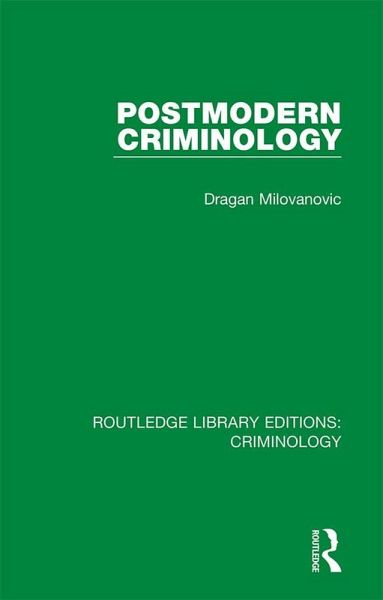
Originally published in 1997. The use of postmodern criminology's conceptual tools offers the potential for the development of a better understanding of the various configurations of repressive forces and directions for social change. This excellent text introduces the reader to the core ideas concerning subjectivity as it is related to discourses and how the discursive construction of social reality takes place. It discusses some of the key themes, dealing with both theoretical integrative work, applications, and recent developments in studying postmodern criminology. It is intended for students as well as those who are more familiar with the subject.
This book is composed of twelve essays organized into three parts, this important work contributes to the big discussion among criminologists about the postmodern aspects of crime.
Dieser Download kann aus rechtlichen Gründen nur mit Rechnungsadresse in A, B, BG, CY, CZ, D, DK, EW, E, FIN, F, GR, HR, H, IRL, I, LT, L, LR, M, NL, PL, P, R, S, SLO, SK ausgeliefert werden.
Die Herstellerinformationen sind derzeit nicht verfügbar.
Autorenporträt
Dragan Milovanovic is Professor in the Justice Studies Department at Northeastern Illinois University.
Inhaltsangabe
Series Editor's Foreword. Preface. Introduction Part 1: Theoretical Integration 1. Dueling Paradigms: Modernist v. Postmodernist Thought 2. The Decentered Subject in Law: Contributions of Topology, Psychoanalytic Semiotics, and Chaos Theory 3. Borromean Knots and the Constitution of Sense in Juridico-Discursive Production 4. Constitutive Criminology: The Maturation of Critical Theory Stuart Henry and Dragan Milovanovic Part 2: Application: Doing Affirmative Postmodern Analysis in Law, Crime, and Penology 5. Jailhouse Lawyers and Jailhouse Lawyering 6. Overcoming the Absurd: Prisoner Litigation as Primitive Rebellion Dragan Milovanovic and Jim Thomas 7. The Necessity Defense, Substantive Justice, and Oppositional Linguistic Practice Shelley Bannister and Dragan Milovanovic 8. Constitutive Penology Dragan Milovanovic and Stuart Henry 9. Topology, Chaos, and Psychoanalytic Semiotics Part 3: Emerging Postmodern Methodologies: Integration and Application 10. Chaos and Criminology: Phase Maps and Bifurcation Diagrams 11. Chaos, Meta-Modeling, and Criminology: Iterative Loops, COREL and Mandelbrot Sets 12. Catastrophe Theory, Crime, and Peacemaking. Conclusion: Toward the New Orderly (Dis)Order. References. Cases Cited
Es gelten unsere Allgemeinen Geschäftsbedingungen: www.buecher.de/agb
Impressum
www.buecher.de ist ein Internetauftritt der buecher.de internetstores GmbH
Geschäftsführung: Monica Sawhney | Roland Kölbl | Günter Hilger
Sitz der Gesellschaft: Batheyer Straße 115 - 117, 58099 Hagen
Postanschrift: Bürgermeister-Wegele-Str. 12, 86167 Augsburg
Amtsgericht Hagen HRB 13257
Steuernummer: 321/5800/1497
USt-IdNr: DE450055826