Sie sind bereits eingeloggt. Klicken Sie auf 2. tolino select Abo, um fortzufahren.
Bitte loggen Sie sich zunächst in Ihr Kundenkonto ein oder registrieren Sie sich bei bücher.de, um das eBook-Abo tolino select nutzen zu können.
Kramer was one of the most visionary musical thinkers of the second half of the 20th century. In his The Time of Music, he approached the idea of the many different ways that time itself is articulated musically. This book has become influential among composers, theorists, and aestheticians. Now, in his almost completed text written before his untimely death in 2004, he examines the concept of postmodernism in music. Kramer created a series of markers by which we can identify postmodern works. He suggests that the postmodern project actually creates a radically different relationship between…mehr
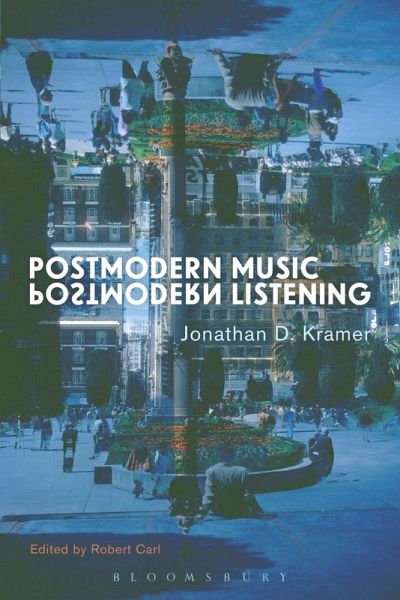
Kramer was one of the most visionary musical thinkers of the second half of the 20th century. In his The Time of Music, he approached the idea of the many different ways that time itself is articulated musically. This book has become influential among composers, theorists, and aestheticians. Now, in his almost completed text written before his untimely death in 2004, he examines the concept of postmodernism in music. Kramer created a series of markers by which we can identify postmodern works. He suggests that the postmodern project actually creates a radically different relationship between the composer and listener. Written with wit, precision, and at times playfully subverting traditional tropes to make a very serious point about this difference, Postmodern Music, Postmodern Listening leads us to a strongly grounded intellectual basis for stylistic description and an intuitive sensibility of what postmodernism in music entails. Postmodern Music, Postmodern Listening is an examination of how musical postmodernism is not just a style or movement, but a fundamental shift in the relationship between composer and listener. The result is a multifaceted and provocative look at a critical turning point in music history, one whose implications we are only just beginning to understand.
Die Herstellerinformationen sind derzeit nicht verfügbar.
Autorenporträt
Jonathan Kramer (1942-2004) was one of the most visionary musical thinkers of the second half of the 20th century. In his The Time of Music, he approached the idea of the many different ways that time itself is articulated musically. This book has become influential among composers, theorists, and aestheticians. He was program annotator for both the San Francisco and Cncinnati orchestras, and his notes for the latter were collected in the book Listen to the Music. His undergraduate and graduate studies were at Harvard and University of California Berkeley respectively; he then taught both composition and theory at Oberlin, Yale, University of Cincinnati, and Columbia. He also traveled worldwide as a lecturer and presenter at countless conferences and educational institutions. A recognized and widely performed composer, he worked in a range of genres from solo piano to orchestra.
Inhaltsangabe
Editor's Introduction by Robert Carl Preface by Jann Pasler Acknowledgements Foreword BOOK 1. IDEAS PART I. CHAPTERS ON POSTMODERN CONCEPTS OF MUSIC Chapter 1: The Nature and Origins of Musical Postmodernism Chapter 2: Postmodernism (Not) Defined Chapter 3: Modernism, Postmodernism, the Avant Garde, and Their Audiences PART II. CHAPTERS ON CONCEPTS OF POSTMODERN MUSIC Chapter 4: Postmodernism and Related Isms in Today's Music Chapter 5: Unity, Organicism, and Challenges to Their Ubiquity Chapter 6: Beyond Unity Chapter 7: Postmodern Listening Chapter 8: Postmodern Musical Time Chapter 9: Surrealism, Neoclassicism, and Postmodernism PART III. POSTMODERN CHAPTERS ON THE CONCEPT OF MUSIC Chapter 10: Economics, Politics, Technology, and Appropriation Chapter 11: Beyond the Beyond: Postmodernism Exemplified BOOK II. CASE HISTORIES Chapter 12: Postmodernism in the Finale of Mahler's Seventh Symphony Chapter 13: Unity and Disunity in Nielsen's Sixth Symphony BOOK III. ESSAYS ON POSTMODERNISM AND JONATHAN KRAMER Editor's note 1. Postmodern Musings, Postmodern Performing by Deborah Bradley-Kramer 2. Are We Postmodern Yet? By Brad Garton 3. Music in the Anthropocene by John Luther Adams 4. On (re-) Hearing Kramer: Five Reactions to Postmodernism Music, Postmodern Listening by John Halle 5. Uncommon Kindness: Reflections on Jonathan Kramer by Duncan Neilson 6. Kramer Post Kramer by Martin Bresnick Biographies Bibliography Index
Editor's Introduction by Robert Carl Preface by Jann Pasler Acknowledgements Foreword BOOK 1. IDEAS PART I. CHAPTERS ON POSTMODERN CONCEPTS OF MUSIC Chapter 1: The Nature and Origins of Musical Postmodernism Chapter 2: Postmodernism (Not) Defined Chapter 3: Modernism, Postmodernism, the Avant Garde, and Their Audiences PART II. CHAPTERS ON CONCEPTS OF POSTMODERN MUSIC Chapter 4: Postmodernism and Related Isms in Today's Music Chapter 5: Unity, Organicism, and Challenges to Their Ubiquity Chapter 6: Beyond Unity Chapter 7: Postmodern Listening Chapter 8: Postmodern Musical Time Chapter 9: Surrealism, Neoclassicism, and Postmodernism PART III. POSTMODERN CHAPTERS ON THE CONCEPT OF MUSIC Chapter 10: Economics, Politics, Technology, and Appropriation Chapter 11: Beyond the Beyond: Postmodernism Exemplified BOOK II. CASE HISTORIES Chapter 12: Postmodernism in the Finale of Mahler's Seventh Symphony Chapter 13: Unity and Disunity in Nielsen's Sixth Symphony BOOK III. ESSAYS ON POSTMODERNISM AND JONATHAN KRAMER Editor's note 1. Postmodern Musings, Postmodern Performing by Deborah Bradley-Kramer 2. Are We Postmodern Yet? By Brad Garton 3. Music in the Anthropocene by John Luther Adams 4. On (re-) Hearing Kramer: Five Reactions to Postmodernism Music, Postmodern Listening by John Halle 5. Uncommon Kindness: Reflections on Jonathan Kramer by Duncan Neilson 6. Kramer Post Kramer by Martin Bresnick Biographies Bibliography Index
Es gelten unsere Allgemeinen Geschäftsbedingungen: www.buecher.de/agb
Impressum
www.buecher.de ist ein Internetauftritt der buecher.de internetstores GmbH
Geschäftsführung: Monica Sawhney | Roland Kölbl | Günter Hilger
Sitz der Gesellschaft: Batheyer Straße 115 - 117, 58099 Hagen
Postanschrift: Bürgermeister-Wegele-Str. 12, 86167 Augsburg
Amtsgericht Hagen HRB 13257
Steuernummer: 321/5800/1497
USt-IdNr: DE450055826