98,99 €
98,99 €
inkl. MwSt.
Sofort per Download lieferbar

0 °P sammeln
98,99 €
Als Download kaufen
98,99 €
inkl. MwSt.
Sofort per Download lieferbar
0 °P sammeln
Jetzt verschenken
Alle Infos zum eBook verschenken
98,99 €
inkl. MwSt.
Sofort per Download lieferbar
Alle Infos zum eBook verschenken
0 °P sammeln

Andere Kunden interessierten sich auch für
") Power Electronics, A First Course (eBook, PDF)98,99 €
Power Electronics, A First Course (eBook, PDF)98,99 €") Wireless Power Transfer (eBook, ePUB)103,99 €
Wireless Power Transfer (eBook, ePUB)103,99 €") Power Electronics for Renewable Energy Systems, Transportation and Industrial Applications (eBook, ePUB)133,99 €
Power Electronics for Renewable Energy Systems, Transportation and Industrial Applications (eBook, ePUB)133,99 €") Electromechanical Motion Devices (eBook, ePUB)117,99 €
Electromechanical Motion Devices (eBook, ePUB)117,99 €") Origin of Power Converters (eBook, ePUB)114,99 €
Origin of Power Converters (eBook, ePUB)114,99 €") Introduction to the Analysis of Electromechanical Systems (eBook, ePUB)116,99 €
Introduction to the Analysis of Electromechanical Systems (eBook, ePUB)116,99 €") Integration of Large Scale Wind Energy with Electrical Power Systems in China (eBook, ePUB)123,99 €
Integration of Large Scale Wind Energy with Electrical Power Systems in China (eBook, ePUB)123,99 €
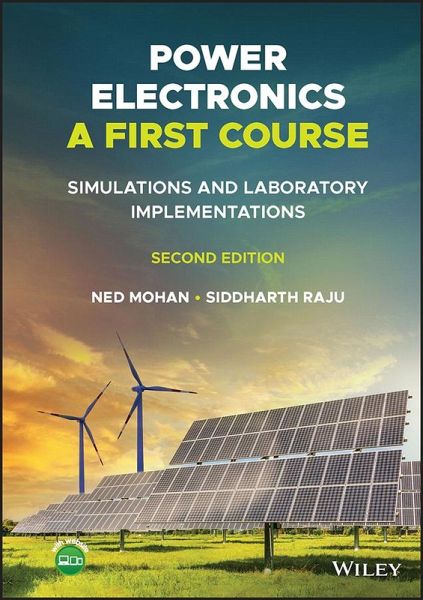
POWER ELECTRONICS A FIRST COURSE Enables students to understand power electronics systems, as one course, in an integrated electric energy systems curriculum Power Electronics A First Course provides instruction on fundamental concepts related to power electronics to undergraduate electrical engineering students, beginning with an introductory chapter and moving on to discussing topics such as switching power-poles, switch-mode dc-dc converters, and feedback controllers. The authors also cover diode rectifiers, power-factor-correction (PFC) circuits, and switch-mode dc power supplies. Later chapters touch on soft-switching in dc-dc power converters, voltage and current requirements imposed by various power applications, dc and low-frequency sinusoidal ac voltages, thyristor converters, and the utility applications of harnessing energy from renewable sources. Power Electronics A First Course is the only textbook that is integrated with hardware experiments and simulation results. The simulation files are available on a website associated with this textbook. The hardware experiments will be available through a University of Minnesota startup at a low cost. In Power Electronics A First Course, readers can expect to find detailed information on: * Availability of various power semiconductor devices that are essential in power electronic systems, plus their switching characteristics and various tradeoffs * Common foundational unit of various converters and their operation, plus fundamental concepts for feedback control, illustrated by means of regulated dc-dc converters * Basic concepts associated with magnetic circuits, to develop an understanding of inductors and transformers needed in power electronics * Problems associated with hard switching, and some of the practical circuits where this problem can be minimized with soft-switching Power Electronics A First Course is an ideal textbook for Junior/Senior-Undergraduate students in Electrical and Computer Engineering (ECE). It is also valuable to students outside of ECE, such as those in more general engineering fields. Basic understanding of electrical engineering concepts and control systems is a prerequisite.
Dieser Download kann aus rechtlichen Gründen nur mit Rechnungsadresse in D ausgeliefert werden.