52,95 €
inkl. MwSt.
Sofort per Download lieferbar
26 °P sammeln

Andere Kunden interessierten sich auch für
") Undesirable Practices (eBook, PDF)42,95 €
Undesirable Practices (eBook, PDF)42,95 €") AFL-CIO's Secret War against Developing Country Workers (eBook, PDF)35,95 €
AFL-CIO's Secret War against Developing Country Workers (eBook, PDF)35,95 €") Precarious Workers in the Gig Economy (eBook, PDF)104,95 €
Precarious Workers in the Gig Economy (eBook, PDF)104,95 €") Ragged Coast, Rugged Coves (eBook, PDF)31,95 €
Ragged Coast, Rugged Coves (eBook, PDF)31,95 €") Secrets and Truths (eBook, PDF)21,95 €
Secrets and Truths (eBook, PDF)21,95 €") Abortion in England 1900-1967 (eBook, PDF)45,95 €
Abortion in England 1900-1967 (eBook, PDF)45,95 €") Organizing Women Workers in the Informal Economy (eBook, PDF)22,95 €
Organizing Women Workers in the Informal Economy (eBook, PDF)22,95 €





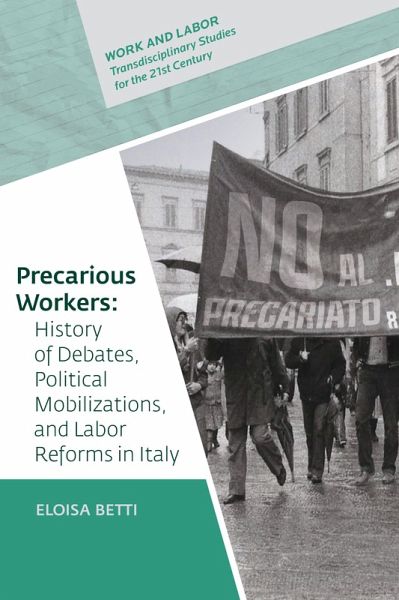
The recent vast upsurge in social science scholarship on job precarity has generally little to say about earlier forms of this phenomenon. Eloisa Betti's monograph convincingly demonstrates on the example of Italy that even in the post-war phase of Keynesian stability and welfare state, precarious labor was an underlying feature of economic development. She examines how in this short period exceptional politics of labor stability prevailed. The volume then presents the processes whereby labor precarity regained momentum- under the name of flexibility- in the post-Fordist phase from the early 1980s, taking on new forms in the Craxi and Berlusconi eras.
Multiple actors are addressed in the analysis. The book gives voice to intellectuals, scholars, politicians and trade unionists as they have framed the concept and debates on precarious work from the 1950s onwards. Views of labor law experts, politicians and public servants are investigated in regard to labor regulations. Positions of the very precarians are explored, ranging from rural women, industrial homeworkers and blue-collar workers to physicians, university researchers and trainees, unveiling the emergence of anti-precarity social movements. The continuous role of women's associations and feminist groups in opposing labor precarity since the 1950s is prominently exposed.
Multiple actors are addressed in the analysis. The book gives voice to intellectuals, scholars, politicians and trade unionists as they have framed the concept and debates on precarious work from the 1950s onwards. Views of labor law experts, politicians and public servants are investigated in regard to labor regulations. Positions of the very precarians are explored, ranging from rural women, industrial homeworkers and blue-collar workers to physicians, university researchers and trainees, unveiling the emergence of anti-precarity social movements. The continuous role of women's associations and feminist groups in opposing labor precarity since the 1950s is prominently exposed.
Dieser Download kann aus rechtlichen Gründen nur mit Rechnungsadresse in A, B, BG, CY, CZ, D, DK, EW, E, FIN, F, GR, HR, H, IRL, I, LT, L, LR, M, NL, PL, P, R, S, SLO, SK ausgeliefert werden.