Sie sind bereits eingeloggt. Klicken Sie auf 2. tolino select Abo, um fortzufahren.
Bitte loggen Sie sich zunächst in Ihr Kundenkonto ein oder registrieren Sie sich bei bücher.de, um das eBook-Abo tolino select nutzen zu können.
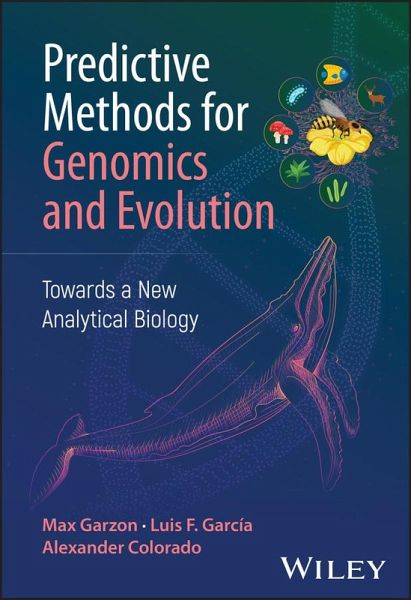
Innovative title providing a systematic account of new alignment-free methods in genomics and bioinformatics, emphasizing their potential to add predictive capabilities to address major and current questions in the science of biology Predictive Methods for Genomics and Evolution provides a cohesive overview of major alignment-based and alignment-free methods in genomics and bioinformatics, primarily based on DNA/RNA. Throughout the book, contrasts between current conventional methods and novel alignment-free methods are presented and evaluated across a wide range of topics. Written by a…mehr
Innovative title providing a systematic account of new alignment-free methods in genomics and bioinformatics, emphasizing their potential to add predictive capabilities to address major and current questions in the science of biology
Predictive Methods for Genomics and Evolution provides a cohesive overview of major alignment-based and alignment-free methods in genomics and bioinformatics, primarily based on DNA/RNA. Throughout the book, contrasts between current conventional methods and novel alignment-free methods are presented and evaluated across a wide range of topics.
Written by a team of experienced academics with significant research experience in the field, Predictive Methods for Genomics and Evolution discusses major topics including:
Major unresolved problems in biology including the most fundamental concept of species, the nature of evolution and speciation, phylogenetic inference, pathogenicity, and the origin of life
Novel interpretations of current hypotheses from a biological perspective with wide-ranging applications in bioinformatics and medicine
Insights on the shift in the research status quo towards a wider application of more efficient alignment-free methodologies, fueled by the increased availability of data, deeper knowledge of DNA/RNA structure and powerful methods from the fields of machine learning and data science.
Predictive Methods for Genomics and Evolution is an essential guide on the subject for professionals, academics, researchers, and students within the fields of genomics, evolutionary biology, phylogenetics and taxonomy, and computational biology and bioinformatics, as well as medical practitioners in related fields. A companion website for this text can be found here: bmc.memphis.edu/predBiology
Dieser Download kann aus rechtlichen Gründen nur mit Rechnungsadresse in D ausgeliefert werden.
Die Herstellerinformationen sind derzeit nicht verfügbar.
Autorenporträt
Max Garzon is Professor of computer science and bioinformatics at the University of Memphis, where he teaches both undergraduate and graduate courses in data science, neurocomputing, bioinformatics, foundations of computing and cyber ethics.
Luis F. García is an Associate Professor at the National University of Colombia, where he teaches and advises both undergraduate and graduate students in evolution, molecular systematics, phylogenetics, genetics and computational biology.
Alexander Colorado is a researcher and educator who has spent doctoral stays at Clemson University and the University of Alberta, Canada, and served as mentor in programs for aspiring young biologists in Colombia. His main research interest is the integrative taxonomy of black flies (Diptera: Simuliidae).
Inhaltsangabe
Preface xi Acknowledgments xiii Acronyms xv 1 What Is Biology? 1 1.1 DNA: Nature, Role, and Function 3 1.2 Hybridization Affinity 19 1.3 Summary 30 2 Genomes to Phenotypes, Environments, and Genomes 37 2.1 Phenotype Determination: The Conventional View 37 2.2 Environments and Autopoiesis 45 2.3 Phenotype Determination: An Alternative View 47 2.4 Summary 52 3 Species Definitions and Their Limitations 57 3.1 The Importance of the Concept of Species 57 3.2 Current Species Definitions 62 3.3 What Exactly Is a "Species"? 69 3.4 A Deeper Definition of "Species" 73 3.5 Summary 84 4 Speciation and Evolution 89 4.1 Darwinian Evolution 89 4.2 Neo-Darwinian Evolution: The Modern Synthesis 94 4.3 Speciation Processes 97 4.4 Summary 108 5 From Genomes to Evolution 113 5.1 From Genotypes to Phenotypes: Evolutionary Scale 114 5.2 Is the Course of Evolution Predictable at the Macroscale? 120 5.3 Is the Course of Evolution Predictable at the Lineage Scale? 125 5.4 Summary 134 6 Conventional Phylogenetics and Systematics 139 6.1 DNA: The Thin Thread of Life 140 6.2 Distance Methods versus Parsimony Analysis 146 6.3 Probabilistic Methods and Evolutionary Models 149 6.4 Case Study in Molecular Taxonomy: COI 155 6.5 Summary 165 7 New Approaches to Phylogenetics 173 7.1 Phylogenetic Trees 173 7.2 Phylogenetic Tree Assessment 177 7.3 Phylogenetic Hypotheses Based on Deep DNA Structure 178 7.4 Summary 180 8 About the Origin of Life 185 8.1 Theories of the Origin of Life on Earth: From Creationism to Panspermia 185 8.2 Complex Systems: A Holistic Approach 188 8.3 A Case Study: Polytene Chromosomes in Black Flies 195 8.4 Summary 210 9 Toward an Analytical Biology 217 9.1 What Is Data Science (DS)? 218 9.2 What Is Machine Learning (ML)? 224 9.3 Causality vs. Correlation 226 9.4 What Is Artificial Intelligence (AI)? 228 9.5 The Natural Intelligence of DNA and Biological Organisms 229 9.6 Summary 231 10 Appendices 235 10.1 Genotypes 235 10.2 Standard Biological Taxonomies 235 10.3 Divergence in Black Flies 238 10.4 Software 244 Bibliography 244 Index 245
Es gelten unsere Allgemeinen Geschäftsbedingungen: www.buecher.de/agb
Impressum
www.buecher.de ist ein Internetauftritt der buecher.de internetstores GmbH
Geschäftsführung: Monica Sawhney | Roland Kölbl | Günter Hilger
Sitz der Gesellschaft: Batheyer Straße 115 - 117, 58099 Hagen
Postanschrift: Bürgermeister-Wegele-Str. 12, 86167 Augsburg
Amtsgericht Hagen HRB 13257
Steuernummer: 321/5800/1497
USt-IdNr: DE450055826