Sie sind bereits eingeloggt. Klicken Sie auf 2. tolino select Abo, um fortzufahren.
Bitte loggen Sie sich zunächst in Ihr Kundenkonto ein oder registrieren Sie sich bei bücher.de, um das eBook-Abo tolino select nutzen zu können.
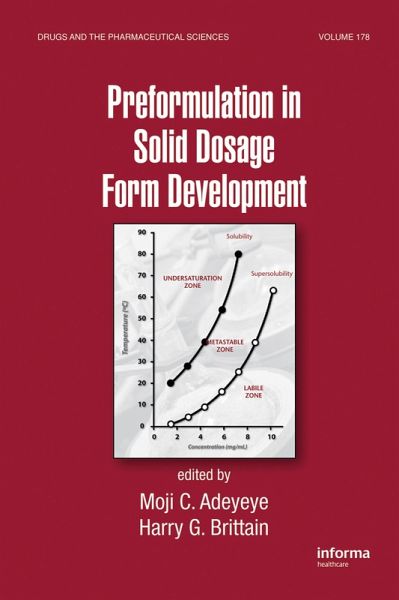
During the onset of any clinical trial there are many factors and variables to consider. Funding, time restraints, and regulatory agency guidelines are factors that often influence which variables will be studied, leaving other important information out of the study. Preformulation in Solid Dosage Form Development covers every topic of critical imp
During the onset of any clinical trial there are many factors and variables to consider. Funding, time restraints, and regulatory agency guidelines are factors that often influence which variables will be studied, leaving other important information out of the study. Preformulation in Solid Dosage Form Development covers every topic of critical imp
Dieser Download kann aus rechtlichen Gründen nur mit Rechnungsadresse in A, B, BG, CY, CZ, D, DK, EW, E, FIN, F, GR, HR, H, IRL, I, LT, L, LR, M, NL, PL, P, R, S, SLO, SK ausgeliefert werden.
Die Herstellerinformationen sind derzeit nicht verfügbar.
Autorenporträt
MOJI CHRISTIANAH ADEYEYE is currently a Professor of Pharmaceutics and Pharmaceutical Technology, a Fulbright Scholar, and a member of the graduate faculty at the School of Pharmacy, Duquesne University, Pittsburgh, Pennsylvania. She graduated from the University of Nigeria, Nsukka and the University of Georgia, Athens, where she earned her B.S., M.S., and Ph.D. respectively. Her research interests include, preformulation, drug/excipient characterization, delivery systems with a focus on bioavailability and bioequivalence of solid, semi-solid and liquid dosage forms (conventional, modified release). She has worked extensively on nonsteroidal anti-inflammatory drugs, steroids and excipients such as cyclodextrins, microcrystalline cellulose and silicified microcrystalline cellulose. She has published over 40 manuscripts and two patents and given over 100 scientific presentations. She was the past President of the Nigerian American Association of Pharmaceutical Scientists (NAAPS) and former Chair of the AAPS Preformulation Focus Group. She is the Founder and President of a non-profit organization-Drugs for AIDS and HIV Patients (DAHP) whose focus is to care and provide treatment for HIV/AIDS orphans and widows. She is a member of AAPS, APHA, CRS, AACP, AAUP and Christian Connections for International Health. HARRY G. BRITTAIN is Founder of the Center for Pharmaceutical Physics, Milford, New Jersey. Previously, Dr. Brittain was Vice President for Pharmaceutical Development at Discovery Laboratories, Inc. He also served as Director of Pharmaceutical Development at Ohmeda Inc., and led a variety of groups within the Analytical R&D Department at Bristol-Myers Squibb Co. Dr. Brittain has authored more than 275 research publications and book chapters and has presented numerous invited lectures and short courses in pharmaceutics. He is editor of several books including Physical Characterization of Pharmaceutical Solids, Polymorphism in Pharmaceutical Solids, and Spectroscopy of Pharmaceutical Solids (Taylor & Francis, Inc.). Dr. Brittain is an Associate Editor for the Journal of Pharmaceutical Sciences, and a member of the editorial boards of Pharmaceutical Development and Technology, AAPS PharmSciTech, and Chirality. Dr. Brittain is a Fellow of the American Association of Pharmaceutical Scientists and of the Royal Institute of Chemistry, and a recipient of the AAPS Research Achievement Award in Analysis and Pharmaceutical Quality.
Inhaltsangabe
1. Introduction and Overview. 2. Preliminary Preformulation. 2.1. Accelerating the Course of Preliminary-Preformulation through Prediction of Molecular Physical Properties and Integrated Analytical Data Management. 2.2. Prediction of Crystallographic Characteristics. 2.3. Salt Selection for Pharmaceutical Compounds. 2.4. Intelligent Preformulation Design and Predictions using Artificial Neural Networks. 3. Profiling the Drug Substance. 3.1. Developing a Profile of the Active Pharmaceutical Ingredient. 3.2. Particle Morphology and Characterization in Preformulation. 3.3. Preparation and Identification of Polymorphs and Solvatomorphs. 3.4. X-Ray Diffraction Methods for the Characterization of Solid Pharmaceutical Materials. 3.5. Spectroscopic Methods for the Characterization of Drug Substances. 3.6. Thermal Analysis and Calorimetric Methods for the Characterization of New Crystal Forms. 3.7. Solubility Methods for the Characterization of New Crystal Forms. 4. Development of the Ideal Formulation. 4.1. Overview of the Solid Dosage Form Preformulation Program . 4.2. Drug-Excipient Interactions Appropriate to Solid Dosage Forms. 4.3. Methods for the Determination of the Physical and Chemical Stability of a New Solid Dosage Form. 4.4. Dissolution Testing. 5. Beyond Preformulation. 5.1. Structure, Content, and Format of the Preformulation Report. 5.1. Significance of Drug Substance Physicochemical Properties in Regulatory Quality by Design.
1. Introduction and Overview. 2. Preliminary Preformulation. 2.1. Accelerating the Course of Preliminary-Preformulation through Prediction of Molecular Physical Properties and Integrated Analytical Data Management. 2.2. Prediction of Crystallographic Characteristics. 2.3. Salt Selection for Pharmaceutical Compounds. 2.4. Intelligent Preformulation Design and Predictions using Artificial Neural Networks. 3. Profiling the Drug Substance. 3.1. Developing a Profile of the Active Pharmaceutical Ingredient. 3.2. Particle Morphology and Characterization in Preformulation. 3.3. Preparation and Identification of Polymorphs and Solvatomorphs. 3.4. X-Ray Diffraction Methods for the Characterization of Solid Pharmaceutical Materials. 3.5. Spectroscopic Methods for the Characterization of Drug Substances. 3.6. Thermal Analysis and Calorimetric Methods for the Characterization of New Crystal Forms. 3.7. Solubility Methods for the Characterization of New Crystal Forms. 4. Development of the Ideal Formulation. 4.1. Overview of the Solid Dosage Form Preformulation Program . 4.2. Drug-Excipient Interactions Appropriate to Solid Dosage Forms. 4.3. Methods for the Determination of the Physical and Chemical Stability of a New Solid Dosage Form. 4.4. Dissolution Testing. 5. Beyond Preformulation. 5.1. Structure, Content, and Format of the Preformulation Report. 5.1. Significance of Drug Substance Physicochemical Properties in Regulatory Quality by Design.
Es gelten unsere Allgemeinen Geschäftsbedingungen: www.buecher.de/agb
Impressum
www.buecher.de ist ein Internetauftritt der buecher.de internetstores GmbH
Geschäftsführung: Monica Sawhney | Roland Kölbl | Günter Hilger
Sitz der Gesellschaft: Batheyer Straße 115 - 117, 58099 Hagen
Postanschrift: Bürgermeister-Wegele-Str. 12, 86167 Augsburg
Amtsgericht Hagen HRB 13257
Steuernummer: 321/5800/1497
USt-IdNr: DE450055826