38,95 €
inkl. MwSt.
Sofort per Download lieferbar
19 °P sammeln

Andere Kunden interessierten sich auch für
") Presidentialism and Democracy in East and Southeast Asia (eBook, ePUB)38,95 €
Presidentialism and Democracy in East and Southeast Asia (eBook, ePUB)38,95 €") Fake News and Elections in Southeast Asia (eBook, PDF)37,95 €
Fake News and Elections in Southeast Asia (eBook, PDF)37,95 €") Myanmar's Peace Process and the Role of Middle Power States (eBook, PDF)39,95 €
Myanmar's Peace Process and the Role of Middle Power States (eBook, PDF)39,95 €") Southeast Asia-North Korea Relations (eBook, PDF)42,95 €
Southeast Asia-North Korea Relations (eBook, PDF)42,95 €") Hedging Strategies in Southeast Asia (eBook, PDF)39,95 €
Hedging Strategies in Southeast Asia (eBook, PDF)39,95 €") Territorial Change and Conflict in Indonesia (eBook, PDF)39,95 €
Territorial Change and Conflict in Indonesia (eBook, PDF)39,95 €") The Minority Muslim Experience in Mainland Southeast Asia (eBook, PDF)39,95 €
The Minority Muslim Experience in Mainland Southeast Asia (eBook, PDF)39,95 €

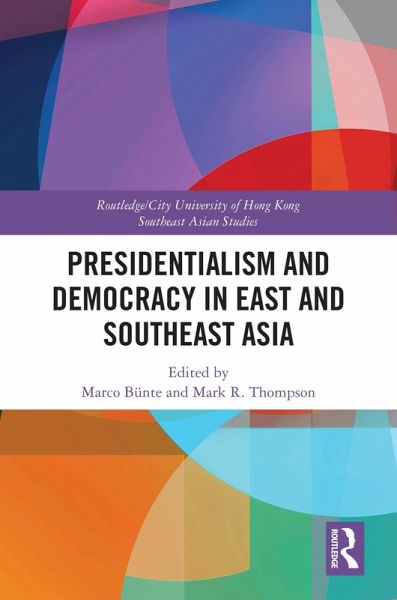
Presidentialism and Democracy in East and Southeast Asia examines the impact of presidential systems on democracies by examining three distinct literatures - the perilousness of competing legitimacies of the executive and legislative branches, issues of institutional design (particularly regarding semi-presidentialism), and the rise of executive aggrandizement.
Despite often intense political conflict and temporary instability in the East and Southeast Asia, presidential systems of various types - from relatively "pure" forms to semi-presidentialism and other hybrids - have largely been resilient. Although there are signs of growing autocratization in several cases, presidentialism, associated with both accommodation and conflict, has usually not driven it.
This book's contributions to presidentialism debates will be of interests to students and scholars of comparative politics while it also offers detailed analysis of the presidency in these East and Southeast Asian cases.
Despite often intense political conflict and temporary instability in the East and Southeast Asia, presidential systems of various types - from relatively "pure" forms to semi-presidentialism and other hybrids - have largely been resilient. Although there are signs of growing autocratization in several cases, presidentialism, associated with both accommodation and conflict, has usually not driven it.
This book's contributions to presidentialism debates will be of interests to students and scholars of comparative politics while it also offers detailed analysis of the presidency in these East and Southeast Asian cases.
Dieser Download kann aus rechtlichen Gründen nur mit Rechnungsadresse in A, B, BG, CY, CZ, D, DK, EW, E, FIN, F, GR, HR, H, IRL, I, LT, L, LR, M, NL, PL, P, R, S, SLO, SK ausgeliefert werden.
"This book offers important insights into the operation of presidentialism. As the editors point out, cases from East and Southeast Asia are very infrequently invoked in theoretical discussions of presidentialism. By offering theoretically informed analyses of these cases, this book begins to bridge a gaping empirical lacuna and will significantly advance our understanding of how presidential institutions work. It is a welcome addition to the literature on presidentialism." - José Antonio Cheibub, Texas A&M University, USA
"This is an important book. The analyses of six presidential and semi-presidential systems are of particular importance for the discussion about the current state of democracy and its future prospects in East and Southeast Asia. The case studies in this volume shows the virtues of empirical analysis of formal political institutions that takes context into account, avoids simplistic generalizations and shows how rich and varied constitutional norms, democratic procedures and informal institutions can be in this part of the world. The editors and the authors are to be much congratulated for bringing these neglected cases to the attention of presidentialism studies." - Aurel Croissant, Heidelberg University, Germany
"This is an important book. The analyses of six presidential and semi-presidential systems are of particular importance for the discussion about the current state of democracy and its future prospects in East and Southeast Asia. The case studies in this volume shows the virtues of empirical analysis of formal political institutions that takes context into account, avoids simplistic generalizations and shows how rich and varied constitutional norms, democratic procedures and informal institutions can be in this part of the world. The editors and the authors are to be much congratulated for bringing these neglected cases to the attention of presidentialism studies." - Aurel Croissant, Heidelberg University, Germany