125,95 €
125,95 €
inkl. MwSt.
Sofort per Download lieferbar

63 °P sammeln
125,95 €
Als Download kaufen
125,95 €
inkl. MwSt.
Sofort per Download lieferbar
63 °P sammeln
Jetzt verschenken
Alle Infos zum eBook verschenken
125,95 €
inkl. MwSt.
Sofort per Download lieferbar
Alle Infos zum eBook verschenken
63 °P sammeln

Andere Kunden interessierten sich auch für
") Proton Transfer (eBook, PDF)40,95 €
Proton Transfer (eBook, PDF)40,95 €") Proton-Transfer Reactions (eBook, PDF)40,95 €
Proton-Transfer Reactions (eBook, PDF)40,95 €") Proton Transfer in Hydrogen-Bonded Systems (eBook, PDF)40,95 €
Proton Transfer in Hydrogen-Bonded Systems (eBook, PDF)40,95 €") Ultrafast Hydrogen Bonding Dynamics and Proton Transfer Processes in the Condensed Phase (eBook, PDF)72,95 €
Ultrafast Hydrogen Bonding Dynamics and Proton Transfer Processes in the Condensed Phase (eBook, PDF)72,95 €") Electron Paramagnetic Resonance of Exchange Coupled Systems (eBook, PDF)40,95 €
Electron Paramagnetic Resonance of Exchange Coupled Systems (eBook, PDF)40,95 €") Proton-Conducting Ceramics (eBook, PDF)113,95 €
Proton-Conducting Ceramics (eBook, PDF)113,95 €") Recent Progress in Coupled Cluster Methods (eBook, PDF)232,95 €
Recent Progress in Coupled Cluster Methods (eBook, PDF)232,95 €

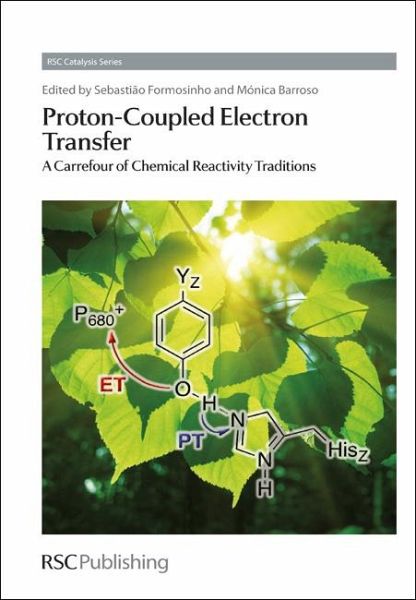
Proton-coupled electron transfer (PCET) is emerging as an important new class of reactions and, over the past decade, great strides have been made in our understanding of them. PCET reactions are studied in many branches of chemistry and are omnipresent in biological processes. This book covers recent developments from both the theoretical and experimental points of view. It concentrates on the importance of PCET in biological systems and for bioenergetic conversion. The oxidation of water in Photosystem II to produce oxygen, and the reduction of protons to hydrogen by hydrogenase, for energy storage gets particular emphasis. Chemical reactivity is currently explained in terms of several scientific principles. One of them is the bond-breaking-bond-forming process and is conceptually based on potential energy surfaces. Another incorporates the role of Franck-Condon factors resulting from the overlap of vibrational wavefunctions. A third, the so-called solvent reorganization, involves solvent configuration around a charged species. PCET brings together such concepts and links them to quantum mechanical tunnelling of the electron particle. This book uses personal accounts of experimental examples to provide additional insight on this important topic. It starts by presenting a general overview of the main theoretical approaches and experimental applications. The chapters then go on to cover topics including: the application of the Marcus Cross Relation; the solvation of ionic systems; experimental approaches in biological redox systems; metal ion-coupled electron transfer, and electrochemical concerted proton-electron transfers.
Dieser Download kann aus rechtlichen Gründen nur mit Rechnungsadresse in A, D ausgeliefert werden.