22,95 €
inkl. MwSt.
Sofort per Download lieferbar
11 °P sammeln

Andere Kunden interessierten sich auch für
") Psychoanalysis in a Plague Year (eBook, ePUB)22,95 €
Psychoanalysis in a Plague Year (eBook, ePUB)22,95 €") Good Enough Endings (eBook, PDF)47,95 €
Good Enough Endings (eBook, PDF)47,95 €") Toward an Emancipatory Psychoanalysis (eBook, PDF)44,95 €
Toward an Emancipatory Psychoanalysis (eBook, PDF)44,95 €") On Being One's Self (eBook, PDF)34,95 €
On Being One's Self (eBook, PDF)34,95 €") The Clinical Paradigms of Donald Winnicott and Wilfred Bion (eBook, PDF)33,95 €
The Clinical Paradigms of Donald Winnicott and Wilfred Bion (eBook, PDF)33,95 €") Addiction, Accommodation, and Vulnerability in Psychoanalysis (eBook, PDF)34,95 €
Addiction, Accommodation, and Vulnerability in Psychoanalysis (eBook, PDF)34,95 €") The Work of Donald Meltzer Revisited (eBook, PDF)33,95 €
The Work of Donald Meltzer Revisited (eBook, PDF)33,95 €




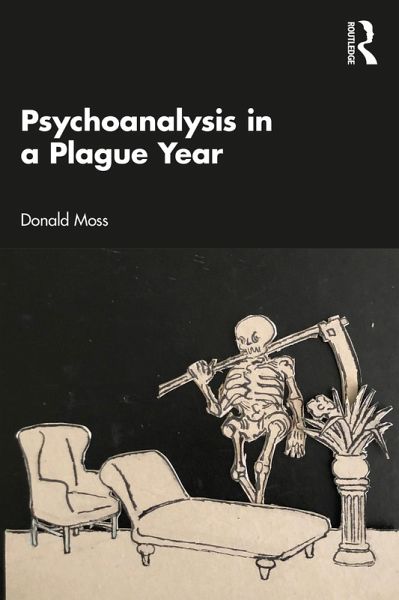
Selecting one sentence from each session every day, Donald Moss has recorded the words spoken by his patients during one year of 'Covid-time'. The patients conjure a moving mixture of the mundane and extraordinary, giving readers a perspective on psychoanalytic practice and treatment during the COVID-19 pandemic.
Clustered together in ways akin to poetic verse, these sentences preserve the mood of the analyst's working day, reflecting the common ground shared by analyst and patient in these unprecedented times. Pandemic-related concerns and everyday problems are seen to persist in these extreme circumstances, affording the reader clinical insights into the daily life of contemporary psychoanalysts. With a clear preface from the author and a remarkable foreword by Timothy J. Clark, the book is grounded in a contemporary psychoanalytic context.
An insightful companion into psychoanalytic practice, the book will interest therapists and analysts in training and in practice, as well as readers intrigued by what happens behind the closed doors of the consulting room.
Clustered together in ways akin to poetic verse, these sentences preserve the mood of the analyst's working day, reflecting the common ground shared by analyst and patient in these unprecedented times. Pandemic-related concerns and everyday problems are seen to persist in these extreme circumstances, affording the reader clinical insights into the daily life of contemporary psychoanalysts. With a clear preface from the author and a remarkable foreword by Timothy J. Clark, the book is grounded in a contemporary psychoanalytic context.
An insightful companion into psychoanalytic practice, the book will interest therapists and analysts in training and in practice, as well as readers intrigued by what happens behind the closed doors of the consulting room.
Dieser Download kann aus rechtlichen Gründen nur mit Rechnungsadresse in A, B, BG, CY, CZ, D, DK, EW, E, FIN, F, GR, HR, H, IRL, I, LT, L, LR, M, NL, PL, P, R, S, SLO, SK ausgeliefert werden.
'Donald Moss returns with a new book to give us evidence of his extraordinary ability to listen and care for mental suffering. Rivers of words have been written on the effects of COVID-19 on clinical work. We then need to distance ourselves from all this noise. Psychoanalysis in a Plague Year offers us this possibility. Not theories, concepts, abstractions; instead, the event, every time new and daily, lived many times but always amazing: the spoken word and the experience of a special space in which to welcome it. With delicacy, discretion and a fine sense of humor, Donald Moss brilliantly captures the essence of psychoanalysis in a dimension that is not purely cognitive, but also, and perhaps primarily, poetic-aesthetic, sensory and bodily.'
Giuseppe Civitarese is author of Sublime Subjects: Aesthetic Experience and Intersubjectivity in Psychoanalysis (2017)
'The reality of COVID-19 is present here not in the reported statements but in the shape they make onthe page, and the time (the timing) those shapes suggest. Many of the days' notations, looked at together, seem like negative sonnets, or lines on their way toward the full fourteen and no quite getting there. They are sonnets of negation, but so are most sonnets. How rare it is, whatever the surrounding calm of supporting belief, for verse to have happiness happen on the page or in the prosody-or even, if happiness is too much (the wrong thing) to ask for, then simply the feeling of things taking a turn for the better. Moments like these occur in the book, but they are rare. I think that is because they are rare in poetry in general.'
Timothy J. Clark is Professor Emeritus of the History of Art at the University of California, Berkeley. His most recent books are Picasso and Truth: From Cubism to Guernica (2013) and Heaven on Earth: Patining and the Life to Come (2018)
Giuseppe Civitarese is author of Sublime Subjects: Aesthetic Experience and Intersubjectivity in Psychoanalysis (2017)
'The reality of COVID-19 is present here not in the reported statements but in the shape they make onthe page, and the time (the timing) those shapes suggest. Many of the days' notations, looked at together, seem like negative sonnets, or lines on their way toward the full fourteen and no quite getting there. They are sonnets of negation, but so are most sonnets. How rare it is, whatever the surrounding calm of supporting belief, for verse to have happiness happen on the page or in the prosody-or even, if happiness is too much (the wrong thing) to ask for, then simply the feeling of things taking a turn for the better. Moments like these occur in the book, but they are rare. I think that is because they are rare in poetry in general.'
Timothy J. Clark is Professor Emeritus of the History of Art at the University of California, Berkeley. His most recent books are Picasso and Truth: From Cubism to Guernica (2013) and Heaven on Earth: Patining and the Life to Come (2018)