72,95 €
inkl. MwSt.
Sofort per Download lieferbar
36 °P sammeln

Andere Kunden interessierten sich auch für
") Fundamentals of Forensic Practice (eBook, PDF)72,95 €
Fundamentals of Forensic Practice (eBook, PDF)72,95 €") Methods of Research in Psychotherapy (eBook, PDF)40,95 €
Methods of Research in Psychotherapy (eBook, PDF)40,95 €") A Comprehensive Guide to Child Custody Evaluations: Mental Health and Legal Perspectives (eBook, PDF)68,95 €
A Comprehensive Guide to Child Custody Evaluations: Mental Health and Legal Perspectives (eBook, PDF)68,95 €") Reminiscence, Motivation, and Personality (eBook, PDF)40,95 €
Reminiscence, Motivation, and Personality (eBook, PDF)40,95 €") Psychology (eBook, PDF)40,95 €
Psychology (eBook, PDF)40,95 €") Serving Children and Families Through Community-University Partnerships (eBook, PDF)112,95 €
Serving Children and Families Through Community-University Partnerships (eBook, PDF)112,95 €") Analysis of Dynamic Psychological Systems (eBook, PDF)62,95 €
Analysis of Dynamic Psychological Systems (eBook, PDF)62,95 €


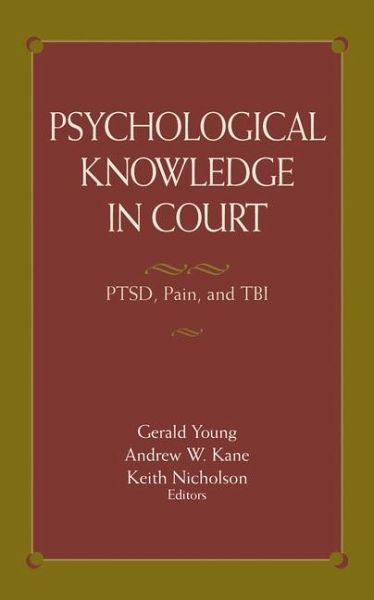
This book presents current theory and research on the way that psychological factors affect the presentation, diagnosis, and course of illness when causality is at issue. It offers an overview of the crucial scientific knowledge base and the appropriate, comprehensive assessment procedures to be followed in order to arrive at a proper determination for court or other related purposes. It posits and explores three primary factors that determine causality of psychological outcome: pre-stressor psychological vulnerabilities, the specified stressor, and post-stressor factors. Sections are disorder specific and separate chapters explore the facets mentioned.
Dieser Download kann aus rechtlichen Gründen nur mit Rechnungsadresse in A, B, BG, CY, CZ, D, DK, EW, E, FIN, F, GR, HR, H, IRL, I, LT, L, LR, M, NL, PL, P, R, S, SLO, SK ausgeliefert werden.
In Psychological Knowledge in Court: PTSD, Pain, and TBI, Gerald Young, Andrew W. Kane, and Keith Nicholson provide forensic psychologists, both new and experienced, with 20 well-selected chapters that should be read by anyone likely to testify in a courtroom. The selections cover much more than the title suggests. The editors provide an insightful and practical discussion of what is required when providing expert testimony. . . I do recommend Psychological Knowledge in Court, and I encourage any psychologist likely to be testifying as an expert witness to buy it and read it.
- John L. Caccavale, PsycCRITIQUES, Volume 51 (26), Article 11
PTSD, pain syndromes, traumatic brain injury: these three areas are common features of personal injury cases, often forming the cornerstone of expert testimony. Yet their complex interplay in an individual can make evaluation-and explaining the results in court-extremely difficult. Psychological Knowledge in Court focuses on this triad separately and in combination, creating a unique guide to forensic evaluations that fulfills both legal and clinical standards. Its meticulous review of the literature identifies and provides clear guidelines for addressing core issues in causality, chronicity, and assessment.
- R.K. McKinzey, Ph.D., Editor, WebPsychEmpiricist: www.wpe.info
- John L. Caccavale, PsycCRITIQUES, Volume 51 (26), Article 11
PTSD, pain syndromes, traumatic brain injury: these three areas are common features of personal injury cases, often forming the cornerstone of expert testimony. Yet their complex interplay in an individual can make evaluation-and explaining the results in court-extremely difficult. Psychological Knowledge in Court focuses on this triad separately and in combination, creating a unique guide to forensic evaluations that fulfills both legal and clinical standards. Its meticulous review of the literature identifies and provides clear guidelines for addressing core issues in causality, chronicity, and assessment.
- R.K. McKinzey, Ph.D., Editor, WebPsychEmpiricist: www.wpe.info
In Psychological Knowledge in Court: PTSD, Pain, and TBI, Gerald Young, Andrew W. Kane, and Keith Nicholson provide forensic psychologists, both new and experienced, with 20 well-selected chapters that should be read by anyone likely to testify in a courtroom. The selections cover much more than the title suggests. The editors provide an insightful and practical discussion of what is required when providing expert testimony. . . I do recommend Psychological Knowledge in Court, and I encourage any psychologist likely to be testifying as an expert witness to buy it and read it. - John L. Caccavale, PsycCRITIQUES, Volume 51 (26), Article 11 PTSD, pain syndromes, traumatic brain injury: these three areas are common features of personal injury cases, often forming the cornerstone of expert testimony. Yet their complex interplay in an individual can make evaluation-and explaining the results in court-extremely difficult. Psychological Knowledge in Court focuses on this triad separately and in combination, creating a unique guide to forensic evaluations that fulfills both legal and clinical standards. Its meticulous review of the literature identifies and provides clear guidelines for addressing core issues in causality, chronicity, and assessment. - R.K. McKinzey, Ph.D., Editor, WebPsychEmpiricist: www.wpe.info