44,95 €
44,95 €
inkl. MwSt.
Sofort per Download lieferbar

22 °P sammeln
44,95 €
Als Download kaufen
44,95 €
inkl. MwSt.
Sofort per Download lieferbar
22 °P sammeln
Jetzt verschenken
Alle Infos zum eBook verschenken
44,95 €
inkl. MwSt.
Sofort per Download lieferbar
Alle Infos zum eBook verschenken
22 °P sammeln

Andere Kunden interessierten sich auch für
") How the Internet Shapes Collective Actions (eBook, PDF)40,95 €
How the Internet Shapes Collective Actions (eBook, PDF)40,95 €") Gandhi and the Psychology of Nonviolence, Volume 2 (eBook, PDF)72,95 €
Gandhi and the Psychology of Nonviolence, Volume 2 (eBook, PDF)72,95 €") Applying Wisdom to Contemporary World Problems (eBook, PDF)22,95 €
Applying Wisdom to Contemporary World Problems (eBook, PDF)22,95 €") Youth Ethnic and National Identity in Bosnia and Herzegovina (eBook, PDF)72,95 €
Youth Ethnic and National Identity in Bosnia and Herzegovina (eBook, PDF)72,95 €") Social Relations in Human and Societal Development (eBook, PDF)40,95 €
Social Relations in Human and Societal Development (eBook, PDF)40,95 €") Phenomenological Psychology as Rigorous Science (eBook, PDF)56,95 €
Phenomenological Psychology as Rigorous Science (eBook, PDF)56,95 €") The Psychology of Brexit (eBook, PDF)28,95 €
The Psychology of Brexit (eBook, PDF)28,95 €






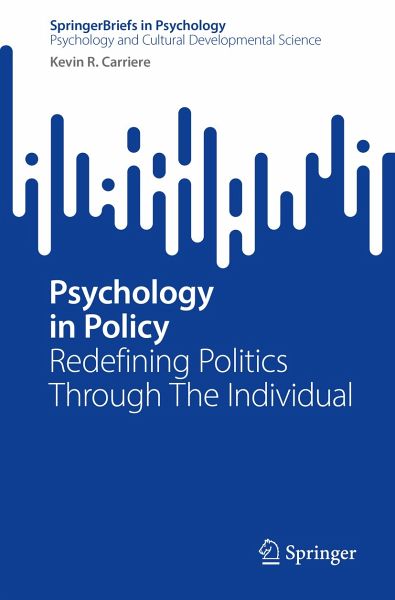
This book takes an insider perspective of the psychological issues of creating policy. Instead of considering what the products of policy are - often the case in psychological and political science work - this book examines the individual processes present in proposing and engaging with policy. The individual who engages with the policy and its meanings, the individual who resists the policy through conformity, and the individual who writes the policy for their own ideological purposes are all political actors in a psychological system.
This book puts forward a cultural political psychology as the psychological study of the process of values, policy, and power dynamics. Through exploring public policy through private policy generation and individual interaction, this book pushes theoretical understandings of policy and activism in new ways. Centering on an individual's own values in facing various policy restrictions from governments, parents, or peers, the importance of examining collective actions and also collective inactions of individuals is noted and expanded on in the text.
The book provides applications of its arguments through examining the processes of unionization and actualized democracy. It seeks to point out new research avenues, including the hypogeneralization of values, one's exclusion through activism, and everyday revolutions. This book addresses the centrality of the individual and meaning-making systems when considering where policy, politics, and psychology intersect.
This book is primarily addressed to psychologists and political scientists interested in how to make change in public policy. While the experiences within the book are United States-centric, the thoughts and theories behind them are meant to be applicable to a wide variety of political systems. As there is currently very little literature on the topic, this book seeks to fill the gap and offer concise information on such an important dimension of culturaland political psychology. It is expected that the book will be of great interest for researchers in these areas, as well as for graduate-level students. In particular, this book will be relevant to researchers and students working on political psychology, public policy, development, community psychology, social representations, semiotics, activism, and social movements, to name a few.
This book puts forward a cultural political psychology as the psychological study of the process of values, policy, and power dynamics. Through exploring public policy through private policy generation and individual interaction, this book pushes theoretical understandings of policy and activism in new ways. Centering on an individual's own values in facing various policy restrictions from governments, parents, or peers, the importance of examining collective actions and also collective inactions of individuals is noted and expanded on in the text.
The book provides applications of its arguments through examining the processes of unionization and actualized democracy. It seeks to point out new research avenues, including the hypogeneralization of values, one's exclusion through activism, and everyday revolutions. This book addresses the centrality of the individual and meaning-making systems when considering where policy, politics, and psychology intersect.
This book is primarily addressed to psychologists and political scientists interested in how to make change in public policy. While the experiences within the book are United States-centric, the thoughts and theories behind them are meant to be applicable to a wide variety of political systems. As there is currently very little literature on the topic, this book seeks to fill the gap and offer concise information on such an important dimension of culturaland political psychology. It is expected that the book will be of great interest for researchers in these areas, as well as for graduate-level students. In particular, this book will be relevant to researchers and students working on political psychology, public policy, development, community psychology, social representations, semiotics, activism, and social movements, to name a few.
Dieser Download kann aus rechtlichen Gründen nur mit Rechnungsadresse in A, B, BG, CY, CZ, D, DK, EW, E, FIN, F, GR, HR, H, IRL, I, LT, L, LR, M, NL, PL, P, R, S, SLO, SK ausgeliefert werden.