80,95 €
80,95 €
inkl. MwSt.
Sofort per Download lieferbar

40 °P sammeln
80,95 €
Als Download kaufen
80,95 €
inkl. MwSt.
Sofort per Download lieferbar
40 °P sammeln
Jetzt verschenken
Alle Infos zum eBook verschenken
80,95 €
inkl. MwSt.
Sofort per Download lieferbar
Alle Infos zum eBook verschenken
40 °P sammeln

Andere Kunden interessierten sich auch für
") Handbook of HIV Prevention (eBook, PDF)112,95 €
Handbook of HIV Prevention (eBook, PDF)112,95 €") African Americans and HIV/AIDS (eBook, PDF)72,95 €
African Americans and HIV/AIDS (eBook, PDF)72,95 €") Understanding Prevention for HIV Positive Gay Men (eBook, PDF)68,95 €
Understanding Prevention for HIV Positive Gay Men (eBook, PDF)68,95 €") Behavioral Interventions for Prevention and Control of Sexually Transmitted Diseases (eBook, PDF)40,95 €
Behavioral Interventions for Prevention and Control of Sexually Transmitted Diseases (eBook, PDF)40,95 €") Positive Prevention (eBook, PDF)72,95 €
Positive Prevention (eBook, PDF)72,95 €") HIV/AIDS in U.S. Communities of Color (eBook, PDF)40,95 €
HIV/AIDS in U.S. Communities of Color (eBook, PDF)40,95 €") AIDS Education (eBook, PDF)160,95 €
AIDS Education (eBook, PDF)160,95 €

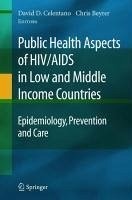
This edited volume systematically describes the emergence and epidemiology of HIV/AIDS in developing countries. It goes further, too, to examine the social, community and political response, and the various measures to confront and control the epidemic, which of course have had varying levels of success. Of particular importance are strategies that appear to have been useful in ameliorating the epidemic, while contrasting the situation in a neighboring country or region where contrasting prevention or care initiatives have had a deleterious outcome. Common to all responses has been the international multi-sectoral response represented by the Global Fund for HIV/AIDS, Malaria and Tuberculosis, the President's Emergency Plan for AIDS Relief, and the Gates Foundation, among others, to promote HIV pharmacologic therapy in resource-poor settings. The chapter authors explore the political challenges in meeting HIV/AIDS prevention and care in concert with the public health realities in specific country and regional context.
Dieser Download kann aus rechtlichen Gründen nur mit Rechnungsadresse in A, B, BG, CY, CZ, D, DK, EW, E, FIN, F, GR, HR, H, IRL, I, LT, L, LR, M, NL, PL, P, R, S, SLO, SK ausgeliefert werden.
"... A scientifically based account of the current global situation is needed to guide opinion leaders and decision makers in different sectors of society, as well as all those people engaged in activities against HIV/AIDS. ... Public Health Aspects of HIV/AIDS in Low and Middle Income Countries offers just such an account, with the help of many contributors with expert knowledge of the affected countries. The value of the book lies partly in the comprehensive presentation in one volume of up-todate and wide-ranging knowledge and also in its impartiality, since it might be perceived to be more independent than official publications by the UN or governments." -Lars O Kallings, The Lancet, Vol 372
"'Why is the world's response to AIDS failing?' Public Health Aspects of HIV/AIDS in Low and Middle Income Countries will be an outstanding resource for students, researchers, and public health and medical professionals seeking answers to this crucial question. The book both instructs and challenges readers to learn from the first 25 years of the HIV pandemic and to use this knowledge to shape its future." -R. Scott McClelland, MD, MPH, JAMA, August 5, 2009, Vol 302, No. 5
"'Why is the world's response to AIDS failing?' Public Health Aspects of HIV/AIDS in Low and Middle Income Countries will be an outstanding resource for students, researchers, and public health and medical professionals seeking answers to this crucial question. The book both instructs and challenges readers to learn from the first 25 years of the HIV pandemic and to use this knowledge to shape its future." -R. Scott McClelland, MD, MPH, JAMA, August 5, 2009, Vol 302, No. 5