41,95 €
inkl. MwSt.
Sofort per Download lieferbar
21 °P sammeln

Andere Kunden interessierten sich auch für
") Public History in Mexico (eBook, ePUB)41,95 €
Public History in Mexico (eBook, ePUB)41,95 €") Regional Voices in the Geo-Politics of Mexico and Central America, 1959-2019 (eBook, PDF)40,95 €
Regional Voices in the Geo-Politics of Mexico and Central America, 1959-2019 (eBook, PDF)40,95 €") Dynamics and Conflicts in a Cross-Border Region (eBook, PDF)41,95 €
Dynamics and Conflicts in a Cross-Border Region (eBook, PDF)41,95 €") Politics, Propaganda and the Press (eBook, PDF)40,95 €
Politics, Propaganda and the Press (eBook, PDF)40,95 €") Die mexikanische Arbeiterschaft und die kulturelle Globalisierung (eBook, PDF)23,99 €
Die mexikanische Arbeiterschaft und die kulturelle Globalisierung (eBook, PDF)23,99 €") Heroines in History (eBook, PDF)38,95 €
Heroines in History (eBook, PDF)38,95 €") Fascism, Nazism and the Holocaust (eBook, PDF)41,95 €
Fascism, Nazism and the Holocaust (eBook, PDF)41,95 €



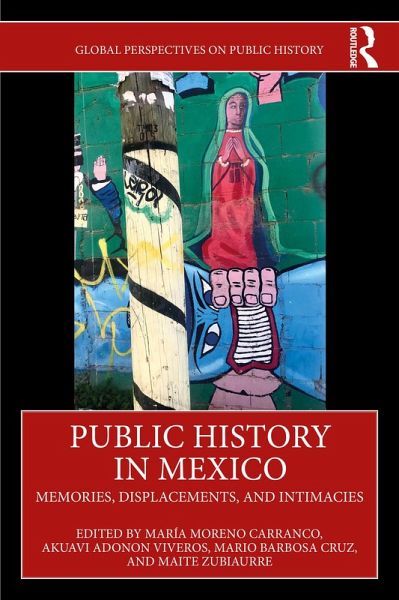
This collection of chapters explores how history is created, shared, and contested in urban and marginalized spaces by examining memory, displacement, resilience, and community-driven historical interventions across Mexico.
Bridging academic research with lived experiences, the book shows how public history is a powerful tool that both reflects on the past and projects more egalitarian futures of justice, representation, and cultural affirmation. Centred mainly around Mexico City, but also touching on the impact of migration at the northern border, it contributes to the debates around new forms of history construction and covers topics including territorial dispossession, deportation processes, the violence entailed in erased histories, and the reconfiguration of daily life during the COVID pandemic. Through diverse approaches and methodologies such as documentary film, digital storytelling, public art, museum interpretations, grassroots activism, and other collective or community work, it provides readers with valuable insights into how historical narratives shape identities, social movements, and public policies, as well as a deeper understanding of how communities engage with their past to reclaim space, resist erasure, and foster belonging.
This book is a useful resource for all upper-level undergraduates, postgraduates, and scholars interested in urban history, public history, cultural studies, anthropology, and Latin American studies.
Bridging academic research with lived experiences, the book shows how public history is a powerful tool that both reflects on the past and projects more egalitarian futures of justice, representation, and cultural affirmation. Centred mainly around Mexico City, but also touching on the impact of migration at the northern border, it contributes to the debates around new forms of history construction and covers topics including territorial dispossession, deportation processes, the violence entailed in erased histories, and the reconfiguration of daily life during the COVID pandemic. Through diverse approaches and methodologies such as documentary film, digital storytelling, public art, museum interpretations, grassroots activism, and other collective or community work, it provides readers with valuable insights into how historical narratives shape identities, social movements, and public policies, as well as a deeper understanding of how communities engage with their past to reclaim space, resist erasure, and foster belonging.
This book is a useful resource for all upper-level undergraduates, postgraduates, and scholars interested in urban history, public history, cultural studies, anthropology, and Latin American studies.
Dieser Download kann aus rechtlichen Gründen nur mit Rechnungsadresse in A, B, BG, CY, CZ, D, DK, EW, E, FIN, F, GR, HR, H, IRL, I, LT, L, LR, M, NL, PL, P, R, S, SLO, SK ausgeliefert werden.