52,95 €
52,95 €
inkl. MwSt.
Erscheint vor. 16.01.26

26 °P sammeln
52,95 €
Als Download kaufen
52,95 €
inkl. MwSt.
Erscheint vor. 16.01.26
26 °P sammeln
Jetzt verschenken
Alle Infos zum eBook verschenken
52,95 €
inkl. MwSt.
Erscheint vor. 16.01.26
Alle Infos zum eBook verschenken
26 °P sammeln

Andere Kunden interessierten sich auch für
 (eBook, ePUB)") Open Government (Routledge Revivals) (eBook, ePUB)39,95 €
Open Government (Routledge Revivals) (eBook, ePUB)39,95 €") The Study of Government (eBook, ePUB)27,95 €
The Study of Government (eBook, ePUB)27,95 €") Prime Minister and Cabinet Government (eBook, ePUB)37,95 €
Prime Minister and Cabinet Government (eBook, ePUB)37,95 €") Conflictual Democracy and the South African Constitution (eBook, ePUB)39,95 €
Conflictual Democracy and the South African Constitution (eBook, ePUB)39,95 €") Specialists and Generalists (eBook, ePUB)27,95 €
Specialists and Generalists (eBook, ePUB)27,95 €") Local Government and Thatcherism (eBook, ePUB)52,95 €
Local Government and Thatcherism (eBook, ePUB)52,95 €") Designing Public Policies (eBook, ePUB)38,95 €
Designing Public Policies (eBook, ePUB)38,95 €

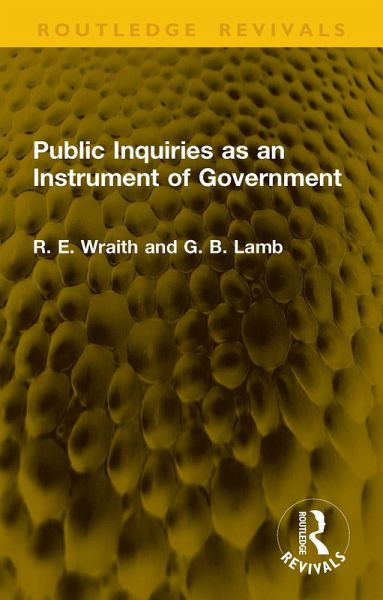
To the unfortunate citizen threatened by the demolition of his house to make way for a new road, or by the shattering of his peace through the building of a new airport, the public inquiry can provide a last hope of reprieve. It may also be called into play in less dramatic circumstances, when the local council declines to approve the building of a garage or when a property owner wishes to divide up his house into flats or bed-sitting rooms. Originally published in 1971, the nature and operation of these and similar inquiries are analysed in detail in this latest authoritative study undertaken by the Royal Institute of Public Administration.
Land use inquiries at the time, although foreshadowed in the early Inclosure Acts, had their main roots in the second half of the nineteenth century. The authors trace their development from the local government, public works and housing legislation of that period to the role designated for them in the great housing and planning Acts of modern times. The book shows how such inquiries become a device for holding a balance between legal and administrative interests; the lawyers regarding them as a means of preserving the rights of the individual, the administrators of balancing conflicting interests in the general social and economic interest of the community. The book also discusses many other types of inquiry, such as those into industrial negotiations, administrative reorganization, accidents and matters of public disquiet.
Wraith and Lamb make a comprehensive survey of the matters which are in dispute in the most commonly held inquiries, describe the various statutory provisions which give rise to them, and examine the extent to which inquiries are subject to review by the Council on Tribunals, the courts and Parliament. They analyse the conduct of inquiries and the practical problems of cost and delay, and discuss the way in which the rights and interests of third parties can be affected.
This book was the first study to examine comprehensively the role of public inquiries since the Report of the Franks Committee on Administrative Tribunals and Inquiries. A distinguished steering committee, under the chairmanship of Sir William Hart, was associated with the project.
Land use inquiries at the time, although foreshadowed in the early Inclosure Acts, had their main roots in the second half of the nineteenth century. The authors trace their development from the local government, public works and housing legislation of that period to the role designated for them in the great housing and planning Acts of modern times. The book shows how such inquiries become a device for holding a balance between legal and administrative interests; the lawyers regarding them as a means of preserving the rights of the individual, the administrators of balancing conflicting interests in the general social and economic interest of the community. The book also discusses many other types of inquiry, such as those into industrial negotiations, administrative reorganization, accidents and matters of public disquiet.
Wraith and Lamb make a comprehensive survey of the matters which are in dispute in the most commonly held inquiries, describe the various statutory provisions which give rise to them, and examine the extent to which inquiries are subject to review by the Council on Tribunals, the courts and Parliament. They analyse the conduct of inquiries and the practical problems of cost and delay, and discuss the way in which the rights and interests of third parties can be affected.
This book was the first study to examine comprehensively the role of public inquiries since the Report of the Franks Committee on Administrative Tribunals and Inquiries. A distinguished steering committee, under the chairmanship of Sir William Hart, was associated with the project.
Dieser Download kann aus rechtlichen Gründen nur mit Rechnungsadresse in A, B, BG, CY, CZ, D, DK, EW, E, FIN, F, GR, HR, H, IRL, I, LT, L, LR, M, NL, PL, P, R, S, SLO, SK ausgeliefert werden.