22,95 €
22,95 €
inkl. MwSt.
Sofort per Download lieferbar

11 °P sammeln
22,95 €
Als Download kaufen
22,95 €
inkl. MwSt.
Sofort per Download lieferbar
11 °P sammeln
Jetzt verschenken
Alle Infos zum eBook verschenken
22,95 €
inkl. MwSt.
Sofort per Download lieferbar
Alle Infos zum eBook verschenken
11 °P sammeln

Andere Kunden interessierten sich auch für
") Black Identity and Black Protest in the Antebellum North (eBook, ePUB)22,95 €
Black Identity and Black Protest in the Antebellum North (eBook, ePUB)22,95 €") The Young Crusaders (eBook, ePUB)10,95 €
The Young Crusaders (eBook, ePUB)10,95 €") White Evangelical Racism, Second Edition (eBook, ePUB)7,99 €
White Evangelical Racism, Second Edition (eBook, ePUB)7,99 €") Notes of a Native Son (eBook, ePUB)9,95 €
Notes of a Native Son (eBook, ePUB)9,95 €") Everybody's Protest Novel (eBook, ePUB)11,95 €
Everybody's Protest Novel (eBook, ePUB)11,95 €") America, Goddam (eBook, ePUB)18,95 €
America, Goddam (eBook, ePUB)18,95 €") Black Firsts (eBook, ePUB)11,95 €
Black Firsts (eBook, ePUB)11,95 €






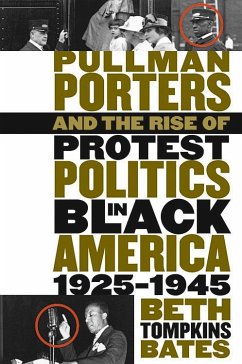
Between World War I and World War II, African Americans' quest for civil rights took on a more aggressive character as a new group of black activists challenged the politics of civility traditionally embraced by old-guard leaders in favor of a more forceful protest strategy. Beth Tompkins Bates traces the rise of this new protest politics — which was grounded in making demands and backing them up with collective action — by focusing on the struggle of the Brotherhood of Sleeping Car Porters (BSCP) to form a union in Chicago, headquarters of the Pullman Company. Bates shows how the BSCP overcame initial opposition from most of Chicago’s black leaders by linking its union message with the broader social movement for racial equality. As members of BSCP protest networks mobilized the black community around the quest for manhood rights and economic freedom, they broke down resistance to organized labor even as they expanded the boundaries of citizenship to include equal economic opportunity. By the mid-1930s, BSCP protest networks gained platforms at the national level, fusing Brotherhood activities first with those of the National Negro Congress and later with the March on Washington Movement. Lessons learned during this era guided the next generation of activists, who carried the black freedom struggle forward after World War II.
Dieser Download kann aus rechtlichen Gründen nur mit Rechnungsadresse in A, D ausgeliefert werden.