Christian Hill
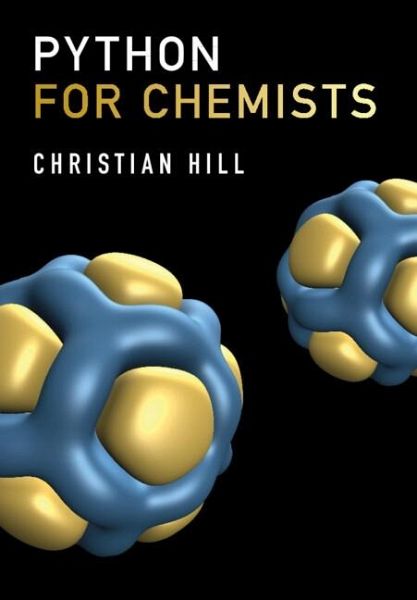
Python for Chemists (eBook, PDF)
36,95 €
36,95 €
inkl. MwSt.
Sofort per Download lieferbar
18 °P sammeln
36,95 €
Als Download kaufen
36,95 €
inkl. MwSt.
Sofort per Download lieferbar
18 °P sammeln
Jetzt verschenken
Alle Infos zum eBook verschenken
36,95 €
inkl. MwSt.
Sofort per Download lieferbar
Alle Infos zum eBook verschenken
18 °P sammeln
Christian Hill
Python for Chemists (eBook, PDF)
- Format: PDF
- Merkliste
- Auf die Merkliste
- Bewerten Bewerten
- Teilen
- Produkt teilen
- Produkterinnerung
- Produkterinnerung

Bitte loggen Sie sich zunächst in Ihr Kundenkonto ein oder registrieren Sie sich bei
bücher.de, um das eBook-Abo tolino select nutzen zu können.
Hier können Sie sich einloggen
Sie sind bereits eingeloggt. Klicken Sie auf 2. tolino select Abo, um fortzufahren.

Bitte loggen Sie sich zunächst in Ihr Kundenkonto ein oder registrieren Sie sich bei bücher.de, um das eBook-Abo tolino select nutzen zu können.
- Geräte: PC
- mit Kopierschutz
- eBook Hilfe
- Größe: 6.1MB
- FamilySharing(5)
Andere Kunden interessierten sich auch für
Kurt BinderMonte Carlo Simulation in Statistical Physics (eBook, PDF)64,95 €
Thomas J. PetersonCryogenic Safety (eBook, PDF)128,95 €
Simon SircaComputational Methods in Physics (eBook, PDF)88,95 €
Themis MatsoukasGeneralized Statistical Thermodynamics (eBook, PDF)136,95 €
Simon SircaComputational Methods in Physics (eBook, PDF)72,95 €
Hermann HakenSynergetics (eBook, PDF)62,95 €
Yannik KasprzakVergleich verschiedener Reaktionskoordinaten in MD-Simulationen anhand der Polypeptide Ala9, YQNPDGSQA und 1enh (eBook, PDF)54,99 €-
-
-
Produktdetails
- Verlag: Cambridge University Press
- Erscheinungstermin: 26. Oktober 2023
- Englisch
- ISBN-13: 9781009116824
- Artikelnr.: 70908894
Dieser Download kann aus rechtlichen Gründen nur mit Rechnungsadresse in A, B, BG, CY, CZ, D, DK, EW, E, FIN, F, GR, HR, H, IRL, I, LT, L, LR, M, NL, PL, P, R, S, SLO, SK ausgeliefert werden.
- Herstellerkennzeichnung Die Herstellerinformationen sind derzeit nicht verfügbar.
Christian Hill is a physicist and physical chemist with over twenty-five years' experience in scientific programming, data analysis and database design in atomic and molecular physics. Currently the Head of the Atomic and Molecular Data Unit at International Atomic Energy Agency, Vienna, he has previously held positions at the University of Cambridge, the University of Oxford, and University College London.
1. Introduction
2. Basic Python usage
3. Strings
4. Lists and loops
5. Comparisons and flow control
6. Functions
7. Data structures
8. File input/output
9. Basic numpy
10. Graph plotting with Matplotlib
11. The steady-state approximation
12. Liquid-vapour equilibrium
13. Jupyter notebook
14. LaTeX
15. Chemistry databases and file formats
16. More NumPy and Matplotlib
17. Thermodynamic cycles
18. Vectors, matrices and linear algebra
19. Linear least squares fitting I
20. Linear least squares fitting II
21. Numerical integration
22. Optimization with scipy.optimize
23. Vibrational spectroscopy
24. The morse oscillator
25. Solving ordinary differential equations
26. The oregonator
27. Root-finding with scipy.optimize
28. Rotational spectroscopy
29. Peak finding
30. Fitting the vibrational spectrum of CO
31. pandas
32. Simulating a powder diffraction spectrum
33. The Hückel approximation
34. Nonlinear fitting and constrained optimization
35. SymPy
36. Molecular orbital theory for H2+
37. Approximations of the helium atom electronic energy
38. Computational chemistry with Psi4 and Python
39. Atomic structure
40. Solutions.
2. Basic Python usage
3. Strings
4. Lists and loops
5. Comparisons and flow control
6. Functions
7. Data structures
8. File input/output
9. Basic numpy
10. Graph plotting with Matplotlib
11. The steady-state approximation
12. Liquid-vapour equilibrium
13. Jupyter notebook
14. LaTeX
15. Chemistry databases and file formats
16. More NumPy and Matplotlib
17. Thermodynamic cycles
18. Vectors, matrices and linear algebra
19. Linear least squares fitting I
20. Linear least squares fitting II
21. Numerical integration
22. Optimization with scipy.optimize
23. Vibrational spectroscopy
24. The morse oscillator
25. Solving ordinary differential equations
26. The oregonator
27. Root-finding with scipy.optimize
28. Rotational spectroscopy
29. Peak finding
30. Fitting the vibrational spectrum of CO
31. pandas
32. Simulating a powder diffraction spectrum
33. The Hückel approximation
34. Nonlinear fitting and constrained optimization
35. SymPy
36. Molecular orbital theory for H2+
37. Approximations of the helium atom electronic energy
38. Computational chemistry with Psi4 and Python
39. Atomic structure
40. Solutions.
1. Introduction
2. Basic Python usage
3. Strings
4. Lists and loops
5. Comparisons and flow control
6. Functions
7. Data structures
8. File input/output
9. Basic numpy
10. Graph plotting with Matplotlib
11. The steady-state approximation
12. Liquid-vapour equilibrium
13. Jupyter notebook
14. LaTeX
15. Chemistry databases and file formats
16. More NumPy and Matplotlib
17. Thermodynamic cycles
18. Vectors, matrices and linear algebra
19. Linear least squares fitting I
20. Linear least squares fitting II
21. Numerical integration
22. Optimization with scipy.optimize
23. Vibrational spectroscopy
24. The morse oscillator
25. Solving ordinary differential equations
26. The oregonator
27. Root-finding with scipy.optimize
28. Rotational spectroscopy
29. Peak finding
30. Fitting the vibrational spectrum of CO
31. pandas
32. Simulating a powder diffraction spectrum
33. The Hückel approximation
34. Nonlinear fitting and constrained optimization
35. SymPy
36. Molecular orbital theory for H2+
37. Approximations of the helium atom electronic energy
38. Computational chemistry with Psi4 and Python
39. Atomic structure
40. Solutions.
2. Basic Python usage
3. Strings
4. Lists and loops
5. Comparisons and flow control
6. Functions
7. Data structures
8. File input/output
9. Basic numpy
10. Graph plotting with Matplotlib
11. The steady-state approximation
12. Liquid-vapour equilibrium
13. Jupyter notebook
14. LaTeX
15. Chemistry databases and file formats
16. More NumPy and Matplotlib
17. Thermodynamic cycles
18. Vectors, matrices and linear algebra
19. Linear least squares fitting I
20. Linear least squares fitting II
21. Numerical integration
22. Optimization with scipy.optimize
23. Vibrational spectroscopy
24. The morse oscillator
25. Solving ordinary differential equations
26. The oregonator
27. Root-finding with scipy.optimize
28. Rotational spectroscopy
29. Peak finding
30. Fitting the vibrational spectrum of CO
31. pandas
32. Simulating a powder diffraction spectrum
33. The Hückel approximation
34. Nonlinear fitting and constrained optimization
35. SymPy
36. Molecular orbital theory for H2+
37. Approximations of the helium atom electronic energy
38. Computational chemistry with Psi4 and Python
39. Atomic structure
40. Solutions.