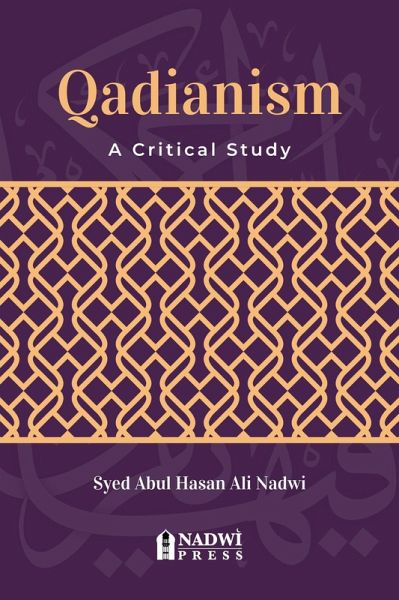
7,99 €
7,99 €
inkl. MwSt.
Sofort per Download lieferbar

4 °P sammeln
7,99 €
Als Download kaufen
7,99 €
inkl. MwSt.
Sofort per Download lieferbar
4 °P sammeln
Jetzt verschenken
Alle Infos zum eBook verschenken
7,99 €
inkl. MwSt.
Sofort per Download lieferbar
Alle Infos zum eBook verschenken
4 °P sammeln

Andere Kunden interessierten sich auch für
") The Musalman (eBook, ePUB)4,99 €
The Musalman (eBook, ePUB)4,99 €") Speaking plainly to the West (eBook, ePUB)2,99 €
Speaking plainly to the West (eBook, ePUB)2,99 €") Prophetic Maharaja (eBook, ePUB)25,95 €
Prophetic Maharaja (eBook, ePUB)25,95 €") The Hajj (eBook, ePUB)2,99 €
The Hajj (eBook, ePUB)2,99 €") Gospel of Peace (eBook, ePUB)2,99 €
Gospel of Peace (eBook, ePUB)2,99 €") Rethinking Meditation (eBook, ePUB)14,95 €
Rethinking Meditation (eBook, ePUB)14,95 €") Ardor (eBook, ePUB)8,99 €
Ardor (eBook, ePUB)8,99 €




A Definitive Scholarly Analysis of Modern Islam's Most Controversial Sectarian Movement
When Maulana Abul Hasan Ali Nadwi arrived in Lahore in early 1958, shortly after the conclusion of an International Islamic Colloquium hosted by Punjab University, he encountered an unexpected scholarly demand. Distinguished ulama from Egypt, Syria, and Iraq who had participated in the conference expressed keen interest in obtaining reliable information about the Ahmadiyya movementknown in South Asia as Qadianisma controversial religious movement that had emerged in the Indian subcontinent and claimed adherents throughout the Muslim world. Despite the movement's significance, no comprehensive, scholarly treatment existed in contemporary Arabic that could serve the needs of Middle Eastern scholars.
At the direction of his spiritual mentor, Maulana Abdul Qadir Raipuri, Nadwi undertook an intensive study of the movement and its founder, Mirza Ghulam Ahmad (1839-1908). For one month, he immersed himself completely in the subject, transforming his Lahore residence into "a full-fledged library on Qadianism." The result was al-Qadiyani wa al-Qadyaniyah in Arabic, later expanded into this comprehensive Urdu edition, which Nadwi himself characterized as "an independent work" with numerous valuable additions.
Historical Context and Emergence
Nadwi begins by meticulously reconstructing the 19th-century context that proved fertile ground for new religious movements in Muslim India. The crushing defeat of the 1857 independence struggle had left Muslims politically subjugated, culturally disoriented, and spiritually vulnerable. British colonial authorities had systematically excluded Muslims from administration and patronized Christian missionary activity aimed at undermining Islamic confidence. Sectarian conflicts had reached "frightful proportions," while charlatans and spiritual pretenders exploited popular craving for the miraculous and esoteric.
The Punjab emerged as the epicenter of this turmoil. Eighty years under Sikh rule had weakened Islamic education and practice. The province's religious landscape, in Iqbal's memorable characterization, showed people who were "fond of the latest" in religion, "readily succumbing to the game of Mentors and Disciples." Into this volatile environment came Mirza Ghulam Ahmad of Qadian, a village in Gurdaspur District, with a message that would evolve dramatically over three decades.
The Gradual Evolution of Claims
One of Nadwi's most significant contributions is his chronological analysis of how Mirza Ghulam Ahmad's claims escalated incrementally. Beginning in 1880 with Barahin-i-Ahmadiyah, Mirza initially positioned himself as Islam's champion against Christian missionaries and Hindu polemicists. This work brought him acclaim throughout Muslim India as a defender of the faith. However, Nadwi argues, embedded within even this early work were seeds of later developmentsemphasis on continuous divine inspiration, claims of receiving revelations, and assertions of special spiritual status.
By 1891, influenced significantly by his close associate Hakim Nuruddin, Mirza proclaimed himself the Promised Messiah whose advent Muslims had long anticipated. This required innovative reinterpretations of Islamic texts: Damascus became metaphorical for Qadian, Jesus had died natural death in Kashmir, and various hadith descriptions were given symbolic rather than literal meanings. Each reinterpretation, Nadwi demonstrates through extensive documentation, moved further from established Islamic understanding.
The final transformation occurred around 1900-1901, when Mirza explicitly claimed prophethoodnot merely metaphorical or spiritual prophethood, but actual prophethood including reception of divine revelation, authority to prescribe religious obligations, and the right to excommunicate those who rejected his claims. This represented an unambiguous challenge to the Islamic doctrine of Khatm al-Nubuwwahthe finality of prophethood with Muhammad.
Theological Analysis and Implications
Nadwi's analysis of the theological dimensions proves particularly valuable. The doctrine that Muhammad is the final prophet serves, he argues, not merely as one belief among many, but as a foundation stone of Islamic identity and unity. It prevents the endless fragmentation that would result if charismatic leaders could claim divine mandate to establish new religious communities. It affirms that divine guidance has reached completion, that humanity has received its final revelation, and that Muslims need no new prophet but only faithful adherence to the existing message.
By challenging this doctrine, Qadianism opened doors that, Nadwi demonstrates, led to predictable consequences: proliferation of subsequent prophetic claimants (he documents seven such figures by 1936), fracturing of Muslim unity, and creation of parallel religious institutions that mimicked Islamic ones while claiming superioritya "heavenly graveyard" in Qadian positioned as equal to sacred sites in Mecca and Medina, annual pilgrimages to Qadian as "Zilli Hajj" (shadow pilgrimage), even a distinctive Qadiani calendar with renamed months.
The British Connection
Among the work's most controversial elements is Nadwi's extensive documentation of Mirza Ghulam Ahmad's relationship with British colonial authorities. Drawing from Mirza's own writings, Nadwi shows how enthusiastically he proclaimed loyalty to British rule, characterized it as divinely ordained, and made this loyalty a religious obligation. Most significantly, Mirza declared jihad permanently abrogateda position that served British interests by neutering potential religious resistance to colonial rule.
Nadwi carefully contextualizes this within broader patterns of colonial manipulation of religious sentiment. He notes Sir Iqbal's observation that movements like Qadianism effectively served colonial interests by redirecting Muslim energies from anti-colonial resistance into internal theological disputes. Whether this resulted from deliberate British cultivation or merely opportunistic exploitation remains debated, but the political dimensions cannot be ignored.
Scholarly Methodology and Approach
Throughout, Nadwi emphasizes his commitment to historical objectivity over polemical denunciation. He writes: "This book has been written with historical objectivity rather than the bigoted zeal of a debater." His methodology relies heavily on primary sourcesparticularly the voluminous writings of Mirza Ghulam Ahmad himselfrather than secondary accounts or hearsay. He attempts to trace doctrinal evolution chronologically, letting the movement's development speak for itself.
This approach, while maintaining Nadwi's clear orthodox Sunni theological position, represents a significant departure from traditional Muslim anti-Qadiani polemic, which often resorted to vilification rather than analysis. Nadwi explicitly notes: "For some time, literature on controversial religious subjects has had a peculiar language and style... This writer has not considered himself bound by this polemical tradition."
Comparative Analysis: Qadiani and Lahori Branches
Nadwi provides valuable analysis of the movement's internal split following Mirza Ghulam Ahmad's death in 1908. The Qadiani branch under Mirza Bashiruddin Mahmud (the founder's son) explicitly maintained prophetic claims and regarded non-Ahmadis as kafirs (unbelievers). The Lahori branch under Maulavi Muhammad Ali attempted to reinterpret the founder's statements metaphorically, denying explicit prophetic claims while maintaining belief in his status as Promised Messiah.
Nadwi critiques both positions but reserves particular attention for the Lahori approach, which he sees as intellectually dishonestattempting to maintain connection to Islam while advancing claims fundamentally incompatible with Islamic doctrine. His analysis of Muhammad Ali's Quranic commentary demonstrates how allegorical reinterpretation, pushed to extremes, can evacuate texts of their plain meaning.
Contemporary Relevance
While rooted in mid-20th century scholarship, this work remains relevant for multiple audiences. For Muslims, it articulates the theological basis for mainstream Islam's rejection of Ahmadiyya claims. For scholars of religion, it provides invaluable primary source access and insider perspective on sectarian formation. For students of South Asian history, it illuminates religious dynamics in colonial and post-colonial contexts. For sociologists of religion, it offers a case study in boundary maintenance, excommunication practices, and the tension between religious innovation and tradition.
The work also raises enduring questions: How do religious communities distinguish authentic renewal from heretical innovation? What role do political contexts play in religious movements' emergence and reception? How should scholars navigate between empathetic understanding and critical evaluation when studying controversial movements? What are the consequencestheological, social, politicalof denying or affirming prophetic finality?
Critical Reading and Multiple Perspectives
Responsible engagement with this work requires acknowledging its limitations. Nadwi writes from a committed orthodox Sunni position with the explicit goal of defending traditional Islamic doctrine. Readers seeking comprehensive understanding should engage with materials representing Ahmadiyya perspectives, particularly works by their own scholars explaining their beliefs in their own terms. Academic studies by Western scholars such as Yohanan Friedmann and Spencer Lavan provide additional external perspectives.
Nevertheless, within its genre and purpose, Nadwi's work stands as a model of scholarly engagement with controversial subject matterextensively documented, historically contextualized, and intellectually substantial. It has shaped Muslim scholarly discourse for over six decades and remains essential reading for anyone seeking to understand one of modern Islam's most significant theological controversies.
When Maulana Abul Hasan Ali Nadwi arrived in Lahore in early 1958, shortly after the conclusion of an International Islamic Colloquium hosted by Punjab University, he encountered an unexpected scholarly demand. Distinguished ulama from Egypt, Syria, and Iraq who had participated in the conference expressed keen interest in obtaining reliable information about the Ahmadiyya movementknown in South Asia as Qadianisma controversial religious movement that had emerged in the Indian subcontinent and claimed adherents throughout the Muslim world. Despite the movement's significance, no comprehensive, scholarly treatment existed in contemporary Arabic that could serve the needs of Middle Eastern scholars.
At the direction of his spiritual mentor, Maulana Abdul Qadir Raipuri, Nadwi undertook an intensive study of the movement and its founder, Mirza Ghulam Ahmad (1839-1908). For one month, he immersed himself completely in the subject, transforming his Lahore residence into "a full-fledged library on Qadianism." The result was al-Qadiyani wa al-Qadyaniyah in Arabic, later expanded into this comprehensive Urdu edition, which Nadwi himself characterized as "an independent work" with numerous valuable additions.
Historical Context and Emergence
Nadwi begins by meticulously reconstructing the 19th-century context that proved fertile ground for new religious movements in Muslim India. The crushing defeat of the 1857 independence struggle had left Muslims politically subjugated, culturally disoriented, and spiritually vulnerable. British colonial authorities had systematically excluded Muslims from administration and patronized Christian missionary activity aimed at undermining Islamic confidence. Sectarian conflicts had reached "frightful proportions," while charlatans and spiritual pretenders exploited popular craving for the miraculous and esoteric.
The Punjab emerged as the epicenter of this turmoil. Eighty years under Sikh rule had weakened Islamic education and practice. The province's religious landscape, in Iqbal's memorable characterization, showed people who were "fond of the latest" in religion, "readily succumbing to the game of Mentors and Disciples." Into this volatile environment came Mirza Ghulam Ahmad of Qadian, a village in Gurdaspur District, with a message that would evolve dramatically over three decades.
The Gradual Evolution of Claims
One of Nadwi's most significant contributions is his chronological analysis of how Mirza Ghulam Ahmad's claims escalated incrementally. Beginning in 1880 with Barahin-i-Ahmadiyah, Mirza initially positioned himself as Islam's champion against Christian missionaries and Hindu polemicists. This work brought him acclaim throughout Muslim India as a defender of the faith. However, Nadwi argues, embedded within even this early work were seeds of later developmentsemphasis on continuous divine inspiration, claims of receiving revelations, and assertions of special spiritual status.
By 1891, influenced significantly by his close associate Hakim Nuruddin, Mirza proclaimed himself the Promised Messiah whose advent Muslims had long anticipated. This required innovative reinterpretations of Islamic texts: Damascus became metaphorical for Qadian, Jesus had died natural death in Kashmir, and various hadith descriptions were given symbolic rather than literal meanings. Each reinterpretation, Nadwi demonstrates through extensive documentation, moved further from established Islamic understanding.
The final transformation occurred around 1900-1901, when Mirza explicitly claimed prophethoodnot merely metaphorical or spiritual prophethood, but actual prophethood including reception of divine revelation, authority to prescribe religious obligations, and the right to excommunicate those who rejected his claims. This represented an unambiguous challenge to the Islamic doctrine of Khatm al-Nubuwwahthe finality of prophethood with Muhammad.
Theological Analysis and Implications
Nadwi's analysis of the theological dimensions proves particularly valuable. The doctrine that Muhammad is the final prophet serves, he argues, not merely as one belief among many, but as a foundation stone of Islamic identity and unity. It prevents the endless fragmentation that would result if charismatic leaders could claim divine mandate to establish new religious communities. It affirms that divine guidance has reached completion, that humanity has received its final revelation, and that Muslims need no new prophet but only faithful adherence to the existing message.
By challenging this doctrine, Qadianism opened doors that, Nadwi demonstrates, led to predictable consequences: proliferation of subsequent prophetic claimants (he documents seven such figures by 1936), fracturing of Muslim unity, and creation of parallel religious institutions that mimicked Islamic ones while claiming superioritya "heavenly graveyard" in Qadian positioned as equal to sacred sites in Mecca and Medina, annual pilgrimages to Qadian as "Zilli Hajj" (shadow pilgrimage), even a distinctive Qadiani calendar with renamed months.
The British Connection
Among the work's most controversial elements is Nadwi's extensive documentation of Mirza Ghulam Ahmad's relationship with British colonial authorities. Drawing from Mirza's own writings, Nadwi shows how enthusiastically he proclaimed loyalty to British rule, characterized it as divinely ordained, and made this loyalty a religious obligation. Most significantly, Mirza declared jihad permanently abrogateda position that served British interests by neutering potential religious resistance to colonial rule.
Nadwi carefully contextualizes this within broader patterns of colonial manipulation of religious sentiment. He notes Sir Iqbal's observation that movements like Qadianism effectively served colonial interests by redirecting Muslim energies from anti-colonial resistance into internal theological disputes. Whether this resulted from deliberate British cultivation or merely opportunistic exploitation remains debated, but the political dimensions cannot be ignored.
Scholarly Methodology and Approach
Throughout, Nadwi emphasizes his commitment to historical objectivity over polemical denunciation. He writes: "This book has been written with historical objectivity rather than the bigoted zeal of a debater." His methodology relies heavily on primary sourcesparticularly the voluminous writings of Mirza Ghulam Ahmad himselfrather than secondary accounts or hearsay. He attempts to trace doctrinal evolution chronologically, letting the movement's development speak for itself.
This approach, while maintaining Nadwi's clear orthodox Sunni theological position, represents a significant departure from traditional Muslim anti-Qadiani polemic, which often resorted to vilification rather than analysis. Nadwi explicitly notes: "For some time, literature on controversial religious subjects has had a peculiar language and style... This writer has not considered himself bound by this polemical tradition."
Comparative Analysis: Qadiani and Lahori Branches
Nadwi provides valuable analysis of the movement's internal split following Mirza Ghulam Ahmad's death in 1908. The Qadiani branch under Mirza Bashiruddin Mahmud (the founder's son) explicitly maintained prophetic claims and regarded non-Ahmadis as kafirs (unbelievers). The Lahori branch under Maulavi Muhammad Ali attempted to reinterpret the founder's statements metaphorically, denying explicit prophetic claims while maintaining belief in his status as Promised Messiah.
Nadwi critiques both positions but reserves particular attention for the Lahori approach, which he sees as intellectually dishonestattempting to maintain connection to Islam while advancing claims fundamentally incompatible with Islamic doctrine. His analysis of Muhammad Ali's Quranic commentary demonstrates how allegorical reinterpretation, pushed to extremes, can evacuate texts of their plain meaning.
Contemporary Relevance
While rooted in mid-20th century scholarship, this work remains relevant for multiple audiences. For Muslims, it articulates the theological basis for mainstream Islam's rejection of Ahmadiyya claims. For scholars of religion, it provides invaluable primary source access and insider perspective on sectarian formation. For students of South Asian history, it illuminates religious dynamics in colonial and post-colonial contexts. For sociologists of religion, it offers a case study in boundary maintenance, excommunication practices, and the tension between religious innovation and tradition.
The work also raises enduring questions: How do religious communities distinguish authentic renewal from heretical innovation? What role do political contexts play in religious movements' emergence and reception? How should scholars navigate between empathetic understanding and critical evaluation when studying controversial movements? What are the consequencestheological, social, politicalof denying or affirming prophetic finality?
Critical Reading and Multiple Perspectives
Responsible engagement with this work requires acknowledging its limitations. Nadwi writes from a committed orthodox Sunni position with the explicit goal of defending traditional Islamic doctrine. Readers seeking comprehensive understanding should engage with materials representing Ahmadiyya perspectives, particularly works by their own scholars explaining their beliefs in their own terms. Academic studies by Western scholars such as Yohanan Friedmann and Spencer Lavan provide additional external perspectives.
Nevertheless, within its genre and purpose, Nadwi's work stands as a model of scholarly engagement with controversial subject matterextensively documented, historically contextualized, and intellectually substantial. It has shaped Muslim scholarly discourse for over six decades and remains essential reading for anyone seeking to understand one of modern Islam's most significant theological controversies.
Dieser Download kann aus rechtlichen Gründen nur mit Rechnungsadresse in A, D ausgeliefert werden.