42,95 €
42,95 €
inkl. MwSt.
Sofort per Download lieferbar

21 °P sammeln
42,95 €
Als Download kaufen
42,95 €
inkl. MwSt.
Sofort per Download lieferbar
21 °P sammeln
Jetzt verschenken
Alle Infos zum eBook verschenken
42,95 €
inkl. MwSt.
Sofort per Download lieferbar
Alle Infos zum eBook verschenken
21 °P sammeln

Andere Kunden interessierten sich auch für
") Einstein, Tagore and the Nature of Reality (eBook, ePUB)42,95 €
Einstein, Tagore and the Nature of Reality (eBook, ePUB)42,95 €") Scientific Understanding and Representation (eBook, ePUB)39,95 €
Scientific Understanding and Representation (eBook, ePUB)39,95 €") A Historicized Ontology for the Quantum World (eBook, ePUB)42,95 €
A Historicized Ontology for the Quantum World (eBook, ePUB)42,95 €") Understanding Perspectivism (eBook, ePUB)0,00 €
Understanding Perspectivism (eBook, ePUB)0,00 €") New Perspectives on Neo-Kantianism and the Sciences (eBook, ePUB)42,95 €
New Perspectives on Neo-Kantianism and the Sciences (eBook, ePUB)42,95 €") Structure, Evidence, and Heuristic (eBook, ePUB)42,95 €
Structure, Evidence, and Heuristic (eBook, ePUB)42,95 €") The Internet and Philosophy of Science (eBook, ePUB)39,95 €
The Internet and Philosophy of Science (eBook, ePUB)39,95 €




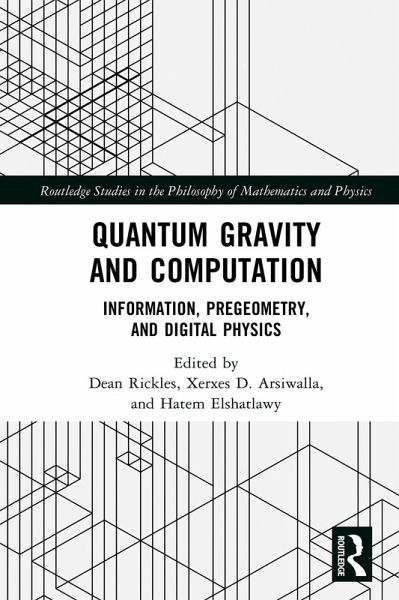
This volume argues that concepts from the theory of computation-including information theory, formal languages, and discrete structures-might provide novel paths towards a solution to the problem of quantum gravity. By combining elements of physics with computer science and mathematics, the volume proposes to transform the foundations of spacetime physics and bring it into the digital age.
In recent years, it has become increasingly apparent a new theoretical framework will be needed to solve the problem of quantum gravity. This kind of framework-sometimes referred to as "pregeometry" or even "prephysics"-goes beyond conventional mathematical conceptions of space, time, and matter, seeking their building blocks in more fundamental elements. The essays in this volume explore this approach from a variety of perspectives, including physics-based, mathematical, computational, and philosophical. The new formal frameworks needed to discuss such approaches have their roots in homotopy type theory, formal language theory, and higher category theory; the computational perspective is informed by connections between pregeometric structures and formal proofs and programs. The new philosophical fulcrum supporting these new avenues is inspired by constructivism and meta-structures. By probing at a level of structure beneath the ordinary structures used in general relativity and quantum mechanics, this volume seeks to find new ways of showing how these higher-order structures can be constructed from the deeper elements.
Quantum Gravity and Computation is an essential resource for scholars and graduate students interested in the philosophy of physics, quantum mechanics, and computational science.
In recent years, it has become increasingly apparent a new theoretical framework will be needed to solve the problem of quantum gravity. This kind of framework-sometimes referred to as "pregeometry" or even "prephysics"-goes beyond conventional mathematical conceptions of space, time, and matter, seeking their building blocks in more fundamental elements. The essays in this volume explore this approach from a variety of perspectives, including physics-based, mathematical, computational, and philosophical. The new formal frameworks needed to discuss such approaches have their roots in homotopy type theory, formal language theory, and higher category theory; the computational perspective is informed by connections between pregeometric structures and formal proofs and programs. The new philosophical fulcrum supporting these new avenues is inspired by constructivism and meta-structures. By probing at a level of structure beneath the ordinary structures used in general relativity and quantum mechanics, this volume seeks to find new ways of showing how these higher-order structures can be constructed from the deeper elements.
Quantum Gravity and Computation is an essential resource for scholars and graduate students interested in the philosophy of physics, quantum mechanics, and computational science.
Dieser Download kann aus rechtlichen Gründen nur mit Rechnungsadresse in A, B, BG, CY, CZ, D, DK, EW, E, FIN, F, GR, HR, H, IRL, I, LT, L, LR, M, NL, PL, P, R, S, SLO, SK ausgeliefert werden.