167,95 €
inkl. MwSt.
Sofort per Download lieferbar
84 °P sammeln

Andere Kunden interessierten sich auch für
") Soliton Management in Periodic Systems (eBook, PDF)72,95 €
Soliton Management in Periodic Systems (eBook, PDF)72,95 €") Decoherence, Entanglement and Information Protection in Complex Quantum Systems (eBook, PDF)112,95 €
Decoherence, Entanglement and Information Protection in Complex Quantum Systems (eBook, PDF)112,95 €") Testing Quantum Theory with Higher-Order Interference in Many-Particle Correlations (eBook, PDF)120,95 €
Testing Quantum Theory with Higher-Order Interference in Many-Particle Correlations (eBook, PDF)120,95 €") Quantum Many-Body Physics in a Nutshell (eBook, PDF)62,95 €
Quantum Many-Body Physics in a Nutshell (eBook, PDF)62,95 €") Quantum Mechanics (eBook, PDF)64,95 €
Quantum Mechanics (eBook, PDF)64,95 €") Laser Spectroscopy (eBook, PDF)62,95 €
Laser Spectroscopy (eBook, PDF)62,95 €") Coherence and Quantum Optics VIII (eBook, PDF)160,95 €
Coherence and Quantum Optics VIII (eBook, PDF)160,95 €




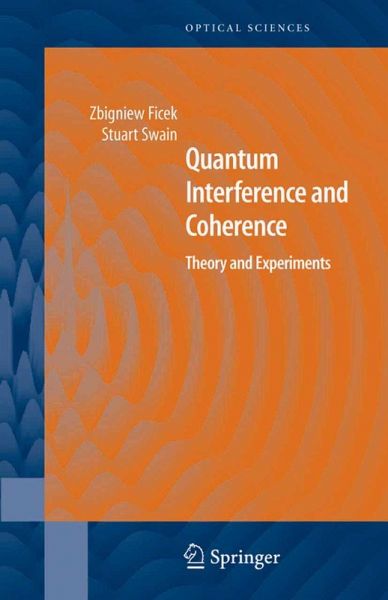
The ?eld that encompasses the term "quantum interference" combines a number of separate concepts, and has a variety of manifestations in d- ferent areas of physics. In the sense considered here, quantum interference is concerned with coherence and correlation phenomena in radiation ?elds and between their sources. It is intimately connected with the phenomenon of non-separability (or entanglement) in quantum mechanics. On account of this, it is obvious that quantum interference may be regarded as a com- nent of quantum information theory, which investigates the ability of the electromagnetic ?eld to transfer information between correlated (entangled) systems. Since it is important to transfer information with the minimum of corruption, the theory of quantum interference is naturally related to the theory of quantum ?uctuations and decoherence. Since the early days of quantum mechanics, interference has been - scribed as the real quantum mystery. Feynman, in his famous introduction to the lectures on the single particle superposition principle, referred in the following way to the phenomenon of interference: "it has in it the heart of quantum mechanics", and it is really 'the only mystery' of quantum mech- ics. With the development of experimental techniques, it has been possible to carry out many of the early Gedanken experiments that played an important role in developing our understanding of the fundamentals of quantum int- ference and entanglement. Despite its long history, quantum interference still challenges our understanding, and continues to excite our imagination.
Dieser Download kann aus rechtlichen Gründen nur mit Rechnungsadresse in A, B, BG, CY, CZ, D, DK, EW, E, FIN, F, GR, HR, H, IRL, I, LT, L, LR, M, NL, PL, P, R, S, SLO, SK ausgeliefert werden.