0,49 €
inkl. MwSt.
Sofort per Download lieferbar

payback
0 °P sammeln
  • Format: ePub

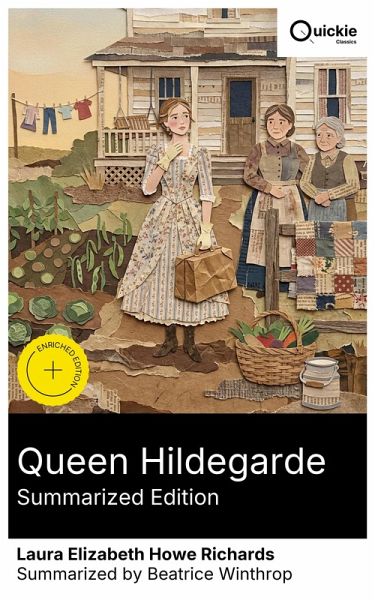
Queen Hildegarde introduces a pampered city girl exiled to a plain New England farm, where she trades borrowed "royalty" for the nobility of work, loyalty, and neighborly duty. Richards's brisk, companionable prose blends comic episodes with keen observation of domestic labor, its gentle didacticism characteristic of late-nineteenth-century girls' fiction. Episodic chapters form a moral apprenticeship, while local-color detail-kitchen garden, quilting, village calls-grounds the conversion narrative. In the Alcottian tradition, 'queenship' becomes character rather than pedigree. Laura Elizabeth…mehr

  • Geräte: eReader
  • ohne Kopierschutz
  • eBook Hilfe
  • Größe: 0.98MB
  • FamilySharing(5)
Produktbeschreibung
Queen Hildegarde introduces a pampered city girl exiled to a plain New England farm, where she trades borrowed "royalty" for the nobility of work, loyalty, and neighborly duty. Richards's brisk, companionable prose blends comic episodes with keen observation of domestic labor, its gentle didacticism characteristic of late-nineteenth-century girls' fiction. Episodic chapters form a moral apprenticeship, while local-color detail-kitchen garden, quilting, village calls-grounds the conversion narrative. In the Alcottian tradition, 'queenship' becomes character rather than pedigree. Laura Elizabeth Howe Richards, daughter of reformers Julia Ward Howe and Samuel Gridley Howe, wrote from a household steeped in service and letters. Living in Maine, she produced lively juvenile fiction and verse, and later won a Pulitzer for coauthoring her mother's biography. Her conviction that cheerful industry and community obligation refine the self animates Hildegarde's arc; the rural setting distills rhythms she knew and respected. Recommended to readers who relish character-driven tales and historically grounded portraits of girlhood, Queen Hildegarde rewards with warmth, wit, and a clear moral intelligence. It will especially suit admirers of Alcott and Burnett, students of Gilded Age juvenile literature, and anyone curious how ordinary tasks teach extraordinary grace. Quickie Classics summarizes timeless works with precision, preserving the author's voice and keeping the prose clear, fast, and readable-distilled, never diluted. Enriched Edition extras: Introduction · Synopsis · Historical Context · Brief Analysis · 4 Reflection Q&As · Editorial Footnotes.

Dieser Download kann aus rechtlichen Gründen nur mit Rechnungsadresse in A, B, BG, CY, CZ, D, DK, EW, FIN, F, GR, H, IRL, I, LT, L, LR, M, NL, PL, P, R, S, SLO, SK ausgeliefert werden.

Autorenporträt
Laura Elizabeth Howe Richards was an American writer. She wrote almost 90 books, including biographies, poetry, and many for children. Eletelephony, a literary nonsense verse, is one of her best-known children's poems. Laura Elizabeth Howe was born in Boston, Massachusetts, on February 27, 1850. Her father, Dr. Samuel Gridley Howe, was an abolitionist who founded the Perkins Institution and the Massachusetts School for the Blind. She was named after his famous deaf-blind student, Laura Bridgman. "The Battle Hymn of the Republic" was written by her mother, Julia Ward Howe. Laura and Henry Richards got married in 1871. In 1876, he accepted a management position at his family's paper mill in Gardiner, Maine, where he moved with his wife and three children. Laura was awarded the Pulitzer Prize in 1917 for her biography Julia Ward Howe, 1819-1910, which she co-authored with her sisters Maud Howe Elliott and Florence Hall. Her name is borne by an elementary school in Gardiner, Maine, that serves prekindergarten through fifth grade students. Her children's book Tirra Lirra received the Lewis Carroll Shelf Award in 1959. Her home in Gardiner, the Laura E. Richards House, is on the National Register of Historic Places.
