41,95 €
inkl. MwSt.
Sofort per Download lieferbar
21 °P sammeln

Andere Kunden interessierten sich auch für
") Radicalization in Pakistan (eBook, PDF)41,95 €
Radicalization in Pakistan (eBook, PDF)41,95 €") Negotiating Cultural Diversity in Afghanistan (eBook, ePUB)41,95 €
Negotiating Cultural Diversity in Afghanistan (eBook, ePUB)41,95 €") Routledge Handbook of Counterterrorism and Counterinsurgency in Africa (eBook, ePUB)45,95 €
Routledge Handbook of Counterterrorism and Counterinsurgency in Africa (eBook, ePUB)45,95 €") Law and Con¿ict Resolution in Kashmir (eBook, ePUB)38,95 €
Law and Con¿ict Resolution in Kashmir (eBook, ePUB)38,95 €") US-Pakistan Relations (eBook, ePUB)41,95 €
US-Pakistan Relations (eBook, ePUB)41,95 € (eBook, ePUB)") Islam and Politics (3rd edition) (eBook, ePUB)42,95 €
Islam and Politics (3rd edition) (eBook, ePUB)42,95 €") Pakistan's Nuclear Weapons (eBook, ePUB)45,95 €
Pakistan's Nuclear Weapons (eBook, ePUB)45,95 €
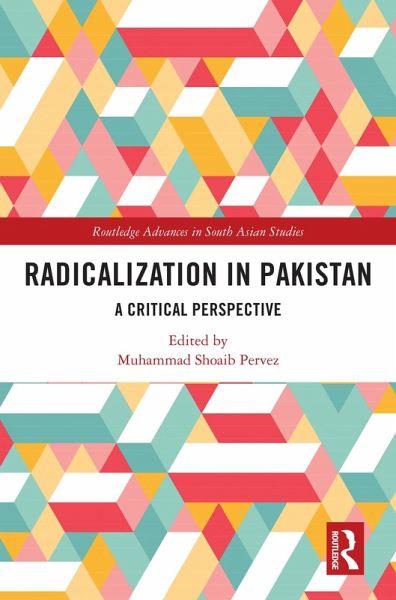
This book offers a critical analysis of radicalization in Pakistan by deconstructing the global and the official state narratives designed to restrain Pakistani radicalization.
Chapters are centered around three distinct themes: educational norms, religious practices and geo-political aspects of radicalization to examine the prevalent state and global practices which propagate Pakistani radicalization discourse. The book argues that there is both a global agenda, which presents Pakistan as the epicenter and sponsor of terrorism, and a domestic, or official, agenda that portrays Pakistan as the state which sacrificed and suffered the most in the recent War on Terror, which allow the country to gain sympathy as a victim. Delineating both conflicting agendas through a critical analysis of global and state practices in order to understand the myths and narratives of radicalization in Pakistan constructed by powerful elites, the book enables readers to gain a better understanding of this phenomenon.
A multidisciplinary critical approach to comprehending radicalization in Pakistan with innovative prescriptions for counter-radicalization policy, this book will be of interest to researchers working in the fields of International Relations, Security Studies, Asian Politics, as well as Religious Studies and Education, in particular in the context of South Asia.
Chapters are centered around three distinct themes: educational norms, religious practices and geo-political aspects of radicalization to examine the prevalent state and global practices which propagate Pakistani radicalization discourse. The book argues that there is both a global agenda, which presents Pakistan as the epicenter and sponsor of terrorism, and a domestic, or official, agenda that portrays Pakistan as the state which sacrificed and suffered the most in the recent War on Terror, which allow the country to gain sympathy as a victim. Delineating both conflicting agendas through a critical analysis of global and state practices in order to understand the myths and narratives of radicalization in Pakistan constructed by powerful elites, the book enables readers to gain a better understanding of this phenomenon.
A multidisciplinary critical approach to comprehending radicalization in Pakistan with innovative prescriptions for counter-radicalization policy, this book will be of interest to researchers working in the fields of International Relations, Security Studies, Asian Politics, as well as Religious Studies and Education, in particular in the context of South Asia.
Dieser Download kann aus rechtlichen Gründen nur mit Rechnungsadresse in A, B, BG, CY, CZ, D, DK, EW, E, FIN, F, GR, HR, H, IRL, I, LT, L, LR, M, NL, PL, P, R, S, SLO, SK ausgeliefert werden.
"In a nutshell, this book forms a great read for anyone interested in the place of knowledge production systems in radicalisation, extremism, and counterterrorism studies. [...] it clarifies how the nuances in the education curriculum exacerbate the problem of systemic radicalisation in society." Critical Studies on Terrorism. April 2021.
"Dr. Pervez's book is an intriguing and challenging read for any Pakistani or a student of Pakistan politics who has a desire to academically approach the question of radicalization. Structurally, the book has been divided into three broad categories: educational norms, religious practices, and geopolitical aspects of radicalization. The underlying idea is to explore different dimensions of radicalization and dissect the existing policy discourse with an aim to offer an alternative perspective. [...] Overall, this book is an interesting read for anybody interested to understand radicalization, its various dimensions and alternative policy measures to counter it." Farah Adeed, University of Management & Technology, Pakistan, Global Village Space, May 2021
"Dr. Pervez's book is an intriguing and challenging read for any Pakistani or a student of Pakistan politics who has a desire to academically approach the question of radicalization. Structurally, the book has been divided into three broad categories: educational norms, religious practices, and geopolitical aspects of radicalization. The underlying idea is to explore different dimensions of radicalization and dissect the existing policy discourse with an aim to offer an alternative perspective. [...] Overall, this book is an interesting read for anybody interested to understand radicalization, its various dimensions and alternative policy measures to counter it." Farah Adeed, University of Management & Technology, Pakistan, Global Village Space, May 2021