Lawrence E. Williams
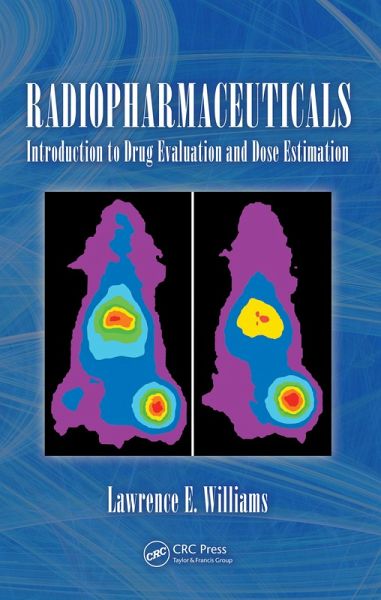
Radiopharmaceuticals (eBook, PDF)
Introduction to Drug Evaluation and Dose Estimation
47,95 €
47,95 €
inkl. MwSt.
Sofort per Download lieferbar

24 °P sammeln
47,95 €
Als Download kaufen
47,95 €
inkl. MwSt.
Sofort per Download lieferbar
24 °P sammeln
Jetzt verschenken
Alle Infos zum eBook verschenken
47,95 €
inkl. MwSt.
Sofort per Download lieferbar
Alle Infos zum eBook verschenken
24 °P sammeln

Lawrence E. Williams
Radiopharmaceuticals (eBook, PDF)
Introduction to Drug Evaluation and Dose Estimation
- Format: PDF
- Merkliste
- Auf die Merkliste
- Bewerten Bewerten
- Teilen
- Produkt teilen
- Produkterinnerung
- Produkterinnerung

Bitte loggen Sie sich zunächst in Ihr Kundenkonto ein oder registrieren Sie sich bei
bücher.de, um das eBook-Abo tolino select nutzen zu können.
Hier können Sie sich einloggen
Sie sind bereits eingeloggt. Klicken Sie auf 2. tolino select Abo, um fortzufahren.

Bitte loggen Sie sich zunächst in Ihr Kundenkonto ein oder registrieren Sie sich bei bücher.de, um das eBook-Abo tolino select nutzen zu können.
Nanoengineering, energized by the desire to find specific targeting agents, is leading to dramatic acceleration in novel drug design. However, in this flurry of activity, some issues may be overlooked. This is especially true in the area of determining dosage and evaluating the effects of multiple agents designed to target more than one site of met
- Geräte: PC
- mit Kopierschutz
- eBook Hilfe
Andere Kunden interessierten sich auch für
The Art and Science of Physiologically-Based Pharmacokinetics Modeling (eBook, PDF)49,95 €
Organ Specific Drug Delivery and Targeting to the Lungs (eBook, PDF)52,95 €
David E. ThurstonChemistry and Pharmacology of Anticancer Drugs (eBook, PDF)128,95 €
Sarfaraz K. NiaziHandbook of Preformulation (eBook, PDF)47,95 €
Sarfaraz K. NiaziHandbook of Pharmaceutical Manufacturing Formulations, Third Edition (eBook, PDF)45,95 €
Manuchair EbadiPharmacodynamic Basis of Herbal Medicine (eBook, PDF)226,95 €
Wing Shing HoActive Phytochemicals from Chinese Herbal Medicines (eBook, PDF)61,95 €-
-
-
Nanoengineering, energized by the desire to find specific targeting agents, is leading to dramatic acceleration in novel drug design. However, in this flurry of activity, some issues may be overlooked. This is especially true in the area of determining dosage and evaluating the effects of multiple agents designed to target more than one site of met
Dieser Download kann aus rechtlichen Gründen nur mit Rechnungsadresse in A, B, BG, CY, CZ, D, DK, EW, E, FIN, F, GR, HR, H, IRL, I, LT, L, LR, M, NL, PL, P, R, S, SLO, SK ausgeliefert werden.
Produktdetails
- Produktdetails
- Verlag: Taylor & Francis eBooks
- Seitenzahl: 326
- Erscheinungstermin: 19. April 2016
- Englisch
- ISBN-13: 9781439810682
- Artikelnr.: 57534008
- Verlag: Taylor & Francis eBooks
- Seitenzahl: 326
- Erscheinungstermin: 19. April 2016
- Englisch
- ISBN-13: 9781439810682
- Artikelnr.: 57534008
- Herstellerkennzeichnung Die Herstellerinformationen sind derzeit nicht verfügbar.
Lawrence E. Williams, Ph.D., is a professor of radiology and an imaging physicist
at City of Hope National Medical Center in Duarte, California. In addition, he is an
adjunct professor of radiology at University of California-Los Angeles (UCLA).
While in high school, he was one of 40 national winners of the Westinghouse (now
Intel) Science Talent Search. Dr. Williams obtained his B.S. from Carnegie Mellon
University and his M.S. and Ph.D. degrees (both in physics) from the University of
Minnesota, where he was a National Science Foundation (NSF) fellow. His initial
graduate training was in nuclear reactions at Minnesota, where he demonstrated
excited states of the mass-4 system (4He*). He later extended this work by finding
excited levels of mass-3 nuclides while working at the Rutherford High Energy
Laboratory in England. Since obtaining the National Institutes of Health (NIH) support
to become a medical physicist, Dr. Williams has devoted most of his research to
tumor detection and treatment and has written approximately 250 total publications
as well as a number of patents in nuclear imaging and radionuclide therapy. He is a
coauthor of Biophysical Science (Prentice Hall, 1979) and editor of Nuclear Medicine
Physics (CRC Press, 1987). He has been a grant and site reviewer for NIH since the
mid-1990s. Dr. Williams is associate editor of Medical Physics and a reviewer for
several other journals. He is a member of the American Association of Physicists
in Medicine (AAPM), the Society of Nuclear Medicine, the New York Academy of
Sciences, Sigma Xi, Society of Imaging Informatics in Medicine (SIIM), and the
Society of Breast Imaging. Dr. Williams has received a lifetime service award from
the American Board of Radiology.
Among Dr. Williams' most significant biophysical discoveries is the mass-law
for tumor uptake as a function of tumor size. He was also codiscoverer (with Richard
Proffitt) of tumor targeting with liposomes. This work involved one of the first applications of normal organ blockage by use of an unlabeled agent-that is, a two-step
process. Dr. Williams has developed a pair of indices for quantifying the ability of a
radiopharmaceutical to permit imaging or therapy of lesions in animals or patients. He
has also demonstrated that radioactive decay must be considered inherently as one possible exit route in modeling analysis of radioactive drugs. With his colleagues at City of Hope, Dr. Williams measured and calculated the brake radiation dose result for a source of 90Y in a humanoid phantom. This study remains as one of the few examples of a comparison of dose estimates and measurement in the nuclear medicine literature.
at City of Hope National Medical Center in Duarte, California. In addition, he is an
adjunct professor of radiology at University of California-Los Angeles (UCLA).
While in high school, he was one of 40 national winners of the Westinghouse (now
Intel) Science Talent Search. Dr. Williams obtained his B.S. from Carnegie Mellon
University and his M.S. and Ph.D. degrees (both in physics) from the University of
Minnesota, where he was a National Science Foundation (NSF) fellow. His initial
graduate training was in nuclear reactions at Minnesota, where he demonstrated
excited states of the mass-4 system (4He*). He later extended this work by finding
excited levels of mass-3 nuclides while working at the Rutherford High Energy
Laboratory in England. Since obtaining the National Institutes of Health (NIH) support
to become a medical physicist, Dr. Williams has devoted most of his research to
tumor detection and treatment and has written approximately 250 total publications
as well as a number of patents in nuclear imaging and radionuclide therapy. He is a
coauthor of Biophysical Science (Prentice Hall, 1979) and editor of Nuclear Medicine
Physics (CRC Press, 1987). He has been a grant and site reviewer for NIH since the
mid-1990s. Dr. Williams is associate editor of Medical Physics and a reviewer for
several other journals. He is a member of the American Association of Physicists
in Medicine (AAPM), the Society of Nuclear Medicine, the New York Academy of
Sciences, Sigma Xi, Society of Imaging Informatics in Medicine (SIIM), and the
Society of Breast Imaging. Dr. Williams has received a lifetime service award from
the American Board of Radiology.
Among Dr. Williams' most significant biophysical discoveries is the mass-law
for tumor uptake as a function of tumor size. He was also codiscoverer (with Richard
Proffitt) of tumor targeting with liposomes. This work involved one of the first applications of normal organ blockage by use of an unlabeled agent-that is, a two-step
process. Dr. Williams has developed a pair of indices for quantifying the ability of a
radiopharmaceutical to permit imaging or therapy of lesions in animals or patients. He
has also demonstrated that radioactive decay must be considered inherently as one possible exit route in modeling analysis of radioactive drugs. With his colleagues at City of Hope, Dr. Williams measured and calculated the brake radiation dose result for a source of 90Y in a humanoid phantom. This study remains as one of the few examples of a comparison of dose estimates and measurement in the nuclear medicine literature.
Tumor Targeting and a Problem of Plenty. Preclinical Development of
Radiopharmaceuticals and Planning of Clinical Trials. Selection of
Radiopharmaceuticals for Clinical Trials. Absorbed Dose Estimation and
Measurement. Determination of Activity In Vivo. Modeling and Temporal
Integration. Functions Used to Determine Absorbed Dose Given Activity
Integrals. Absorbed Dose Estimates without Clinical Correlations. Dose
Estimates and Correlations with Laboratory and Clinical Results.
Multiple-Modality Therapy of Tumors. Allometry (Of Mice and Men). Summary
of Radiopharm-aceuticals and Dose Estimation. Index.
Radiopharmaceuticals and Planning of Clinical Trials. Selection of
Radiopharmaceuticals for Clinical Trials. Absorbed Dose Estimation and
Measurement. Determination of Activity In Vivo. Modeling and Temporal
Integration. Functions Used to Determine Absorbed Dose Given Activity
Integrals. Absorbed Dose Estimates without Clinical Correlations. Dose
Estimates and Correlations with Laboratory and Clinical Results.
Multiple-Modality Therapy of Tumors. Allometry (Of Mice and Men). Summary
of Radiopharm-aceuticals and Dose Estimation. Index.
Tumor Targeting and a Problem of Plenty. Preclinical Development of
Radiopharmaceuticals and Planning of Clinical Trials. Selection of
Radiopharmaceuticals for Clinical Trials. Absorbed Dose Estimation and
Measurement. Determination of Activity In Vivo. Modeling and Temporal
Integration. Functions Used to Determine Absorbed Dose Given Activity
Integrals. Absorbed Dose Estimates without Clinical Correlations. Dose
Estimates and Correlations with Laboratory and Clinical Results.
Multiple-Modality Therapy of Tumors. Allometry (Of Mice and Men). Summary
of Radiopharm-aceuticals and Dose Estimation. Index.
Radiopharmaceuticals and Planning of Clinical Trials. Selection of
Radiopharmaceuticals for Clinical Trials. Absorbed Dose Estimation and
Measurement. Determination of Activity In Vivo. Modeling and Temporal
Integration. Functions Used to Determine Absorbed Dose Given Activity
Integrals. Absorbed Dose Estimates without Clinical Correlations. Dose
Estimates and Correlations with Laboratory and Clinical Results.
Multiple-Modality Therapy of Tumors. Allometry (Of Mice and Men). Summary
of Radiopharm-aceuticals and Dose Estimation. Index.