133,95 €
inkl. MwSt.
Sofort per Download lieferbar
67 °P sammeln

Andere Kunden interessierten sich auch für
 (eBook, PDF)") Diffusion and Stresses (International Workshop) (eBook, PDF)136,95 €
Diffusion and Stresses (International Workshop) (eBook, PDF)136,95 €") Explosion, Shock Wave and High-Energy Reaction Phenomena (eBook, PDF)136,95 €
Explosion, Shock Wave and High-Energy Reaction Phenomena (eBook, PDF)136,95 €") Recent Progress in Diffusion Thermodynamics and Kinetics in Intermetallic Compounds (eBook, PDF)110,95 €
Recent Progress in Diffusion Thermodynamics and Kinetics in Intermetallic Compounds (eBook, PDF)110,95 €") Solid State Nuclear Track Detectors and their Applications (eBook, PDF)114,95 €
Solid State Nuclear Track Detectors and their Applications (eBook, PDF)114,95 €") Solid State Science and Technology XXX (eBook, PDF)136,95 €
Solid State Science and Technology XXX (eBook, PDF)136,95 €") Solid-State Properties of Nitrides, Carbonitrides and Carbonitride-Based Cermets (eBook, PDF)121,95 €
Solid-State Properties of Nitrides, Carbonitrides and Carbonitride-Based Cermets (eBook, PDF)121,95 €") Solid State Science and Technology IV (eBook, PDF)133,95 €
Solid State Science and Technology IV (eBook, PDF)133,95 €

Volume is indexed by Thomson Reuters BCI (WoS).
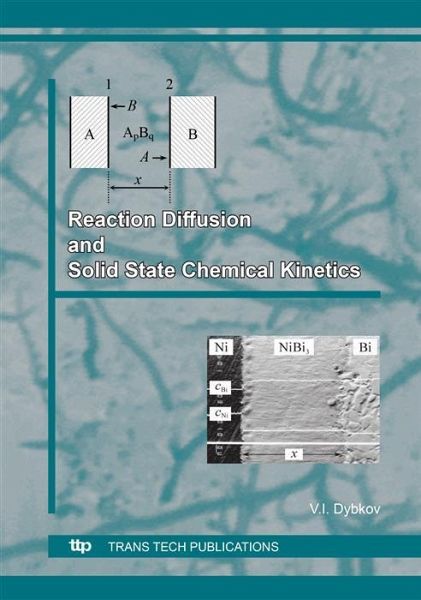
This monograph deals with a physico-chemical approach to the problem of the solid-state growth of chemical compound layers and reaction-diffusion in binary heterogeneous systems formed by two solids; as well as a solid with a liquid or a gas. It is explained why the number of compound layers growing at the interface between the original phases is usually much lower than the number of chemical compounds in the phase diagram of a given binary system. For example, of the eight intermetallic compounds which exist in the aluminium-zirconium binary system, only ZrAl3 was found to grow as a separate layer at the Al-Zr interface under isothermal conditions. The physico-chemical approach predicts that, in most cases, the number of compound layers should not exceed two; with the main factor, resulting in the appearance of additional layers, being crack formation due to thermal expansion and volume effects.
This monograph deals with a physico-chemical approach to the problem of the solid-state growth of chemical compound layers and reaction-diffusion in binary heterogeneous systems formed by two solids; as well as a solid with a liquid or a gas. It is explained why the number of compound layers growing at the interface between the original phases is usually much lower than the number of chemical compounds in the phase diagram of a given binary system. For example, of the eight intermetallic compounds which exist in the aluminium-zirconium binary system, only ZrAl3 was found to grow as a separate layer at the Al-Zr interface under isothermal conditions. The physico-chemical approach predicts that, in most cases, the number of compound layers should not exceed two; with the main factor, resulting in the appearance of additional layers, being crack formation due to thermal expansion and volume effects.
Dieser Download kann aus rechtlichen Gründen nur mit Rechnungsadresse in A, B, BG, CY, CZ, D, DK, EW, E, FIN, F, GR, HR, H, IRL, I, LT, L, LR, M, NL, PL, P, R, S, SLO, SK ausgeliefert werden.