Sie sind bereits eingeloggt. Klicken Sie auf 2. tolino select Abo, um fortzufahren.
Bitte loggen Sie sich zunächst in Ihr Kundenkonto ein oder registrieren Sie sich bei bücher.de, um das eBook-Abo tolino select nutzen zu können.
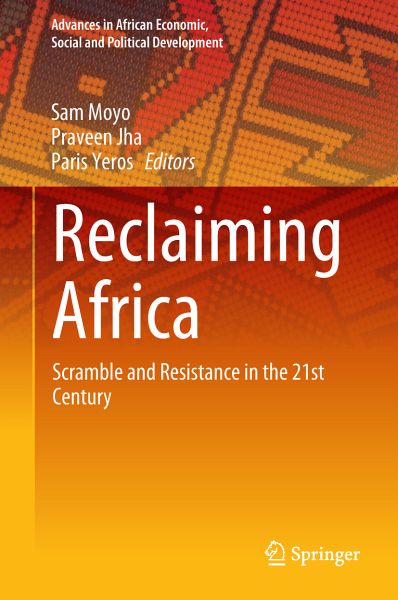
Presents a Southern perspective on the contradictions of the new scramble for Africa and the struggles for development in the 21st century Compares the strategies employed by emerging powers in their engagement with Africa Explores the forms of local, regional, and national resistance to the expropriation of land and natural resources in Africa
Presents a Southern perspective on the contradictions of the new scramble for Africa and the struggles for development in the 21st century
Compares the strategies employed by emerging powers in their engagement with Africa
Explores the forms of local, regional, and national resistance to the expropriation of land and natural resources in Africa
Dieser Download kann aus rechtlichen Gründen nur mit Rechnungsadresse in A, B, BG, CY, CZ, D, DK, EW, E, FIN, F, GR, HR, H, IRL, I, LT, L, LR, M, NL, PL, P, R, S, SLO, SK ausgeliefert werden.
Die Herstellerinformationen sind derzeit nicht verfügbar.
Autorenporträt
Sam Moyo (1954-2015) was Executive Director of the African Institute for Agrarian Studies (AIAS, 2002-15), Harare, Zimbabwe, President of the Council for the Development of Social Science Research in Africa (CODESRIA, 2009-11), and Founding Editor-in-Chief of Agrarian South: Journal of Political Economy (2012-15). An eminent scholar of land and agrarian studies, he published widely in academic journals and authored several books, including, among the most recent, The Agrarian Question in the Neoliberal Era (Pambazuka, 2011), Land and Agrarian Reform in Zimbabwe: Beyond White-Settler Capitalism (CODESRIA, 2013), and Land in the Struggles for Citizenship in Africa (CODESRIA, 2015). Praveen K. Jha is Professor of Economics at the Centre for Economic Studies and Planning (CESP) and adjunct at the Centre for Informal Sector and Labour Studies (CISLS), School of Social Sciences, Jawaharlal Nehru University (JNU), New Delhi, India. He has been a visiting fellow at a number of universities and institutions in Germany, China, Switzerland, South Africa, and Zimbabwe, and has collaborated in research programmes with UN agencies, including the ILO, UNICEF, UNDP, and FAO. He has published widely on labour and agrarian relations, the economics of education, and public finance. He is a co-editor of Agrarian South: Journal of Political Economy. Paris Yeros is Professor of International Economics at the Federal University of ABC (UFABC), São Paulo, Brazil, and co-editor of Agrarian South: Journal of Political Economy. He has been a visiting fellow at universities and institutes in Brazil, South Africa, and Zimbabwe, and has published widely on labour and agrarian relations, social movements, and nationalism. He is a co-editor of Agrarian South: Journal of Political Economy.
Inhaltsangabe
1. Introduction.- 1.1 Overview: Scramble, Primitive Accumulation and Resistance.- 1.2 Trajectories of Gender Relations.- 1.3 Trajectories of Agrarian Transformation.- 2. The Scramblers: Sources and Strategies.- 2.1 USA.- 2.2 China.- 2.3 India.- 2.4 Brazil.- 2.5 South Africa.- 3. National Experiences of Primitive Accumulation and Resistance.- 3.1 Angola.- 3.2 Botswana.- 3.3 Ghana.- 3.4 Mali.- 3.5 Senegal and Mauritania.- 3.6 Tanzania.- 3.7 Uganda.- 3.8 Kenya.- 3.9 Zambia.- 3.10 Zimbabwe.- 4. Resistance, Pan-Africanism and Non-Alignment.- 5. Conclusion.