34,95 €
inkl. MwSt.
Sofort per Download lieferbar
17 °P sammeln

Andere Kunden interessierten sich auch für
") Marx's 'Capital' (eBook, ePUB)11,95 €
Marx's 'Capital' (eBook, ePUB)11,95 €") Marx's 'Capital' (eBook, ePUB)14,95 €
Marx's 'Capital' (eBook, ePUB)14,95 €") In Marx's Shadow (eBook, ePUB)88,95 €
In Marx's Shadow (eBook, ePUB)88,95 €") Reclaiming Latin America (eBook, ePUB)22,95 €
Reclaiming Latin America (eBook, ePUB)22,95 € (eBook, ePUB)") Marx's Proletariat (RLE Marxism) (eBook, ePUB)37,95 €
Marx's Proletariat (RLE Marxism) (eBook, ePUB)37,95 € (eBook, ePUB)") Marx's Construction of Social Theory (RLE Marxism) (eBook, ePUB)26,95 €
Marx's Construction of Social Theory (RLE Marxism) (eBook, ePUB)26,95 € (eBook, ePUB)") Marx's Critical/Dialectical Procedure (RLE Marxism) (eBook, ePUB)41,95 €
Marx's Critical/Dialectical Procedure (RLE Marxism) (eBook, ePUB)41,95 €







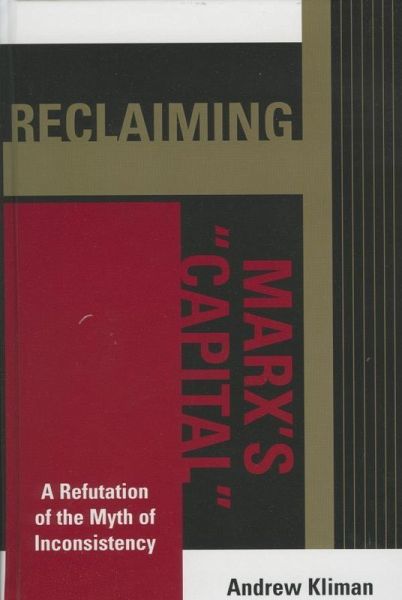
This book seeks to reclaim Capital from the myth of internal inconsistency, a myth that serves to justify the censorship of Marx's critique of political economy and present-day research based upon it. Andrew Kliman shows that the alleged inconsistencies are actually caused by misinterpretation. By modifying the standard interpretation of Marx's value theory in two simple ways, the recent 'temporal single-system interpretation' eliminates all of the alleged inconsistencies. Written especially for the non-specialist reader, in a clear, accessible style and with the bare minimum of mathematics, Reclaiming Marx's 'Capital' introduces readers to Marx's value theory and contrasting interpretations of it, the history of the internal inconsistency controversy, and interpretive standards and methods. Kliman then surveys Marx's falling-rate-of-profit theory, the relationship of prices to values (the 'transformation problem'), Marx's exploitation theory of profit, and other topics. The book ends with a discussion of why the myth of inconsistency persists, and a call to set the record straight.