96,95 €
96,95 €
inkl. MwSt.
Sofort per Download lieferbar

48 °P sammeln
96,95 €
Als Download kaufen
96,95 €
inkl. MwSt.
Sofort per Download lieferbar
48 °P sammeln
Jetzt verschenken
Alle Infos zum eBook verschenken
96,95 €
inkl. MwSt.
Sofort per Download lieferbar
Alle Infos zum eBook verschenken
48 °P sammeln

Andere Kunden interessierten sich auch für
") Health and Prosperity (eBook, PDF)40,95 €
Health and Prosperity (eBook, PDF)40,95 €") Public Economics (eBook, PDF)96,95 €
Public Economics (eBook, PDF)96,95 €") Hidden Markov Models (eBook, PDF)72,95 €
Hidden Markov Models (eBook, PDF)72,95 €") Public Debt Management (eBook, PDF)72,95 €
Public Debt Management (eBook, PDF)72,95 €") The Changing Geography of Banking and Finance (eBook, PDF)112,95 €
The Changing Geography of Banking and Finance (eBook, PDF)112,95 €") Computational Methods in Financial Engineering (eBook, PDF)72,95 €
Computational Methods in Financial Engineering (eBook, PDF)72,95 €") Research on China's Public Finance Construction Index System (eBook, PDF)40,95 €
Research on China's Public Finance Construction Index System (eBook, PDF)40,95 €





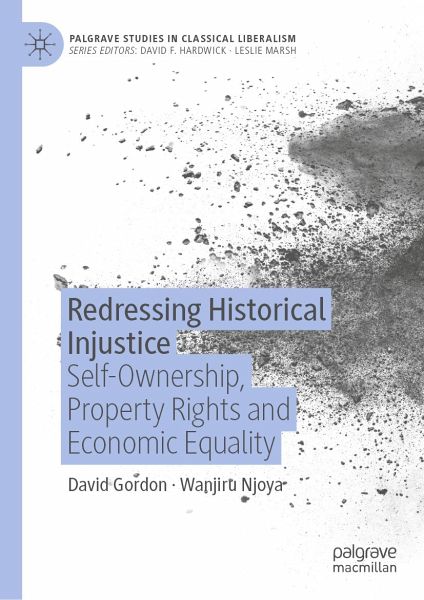
This book offers an alternative to perspectives of distributive justice which fail to resolve economic inequality and exacerbate social problems by ignoring the real causes of inequality. The main impact of the book is to highlight the importance of self-ownership and private property, showing how market participation advances liberty and prosperity.
The idea that we should pay reparations to disadvantaged racial groups as compensation for historical injustice is deeply contested. The debates often focus on the practical implications of paying reparations, but overlook more fundamental questions about the meaning of justice. What is justice? What are the implications of wealth redistribution for individual liberty and the rule of law? This book answers these questions through an analysis of classical liberal perspectives in law, philosophy and economics.
The book questions whether economic inequality stems from historical injustice, and explores the wider implications of attempting to create equal outcomes through legislative mandates. The book argues that free markets, resting on libertarian rights, are the best way to help disadvantaged members of society and to create the conditions more likely to advance economic equality. The book will be of interest to researchers and students of economics, law, politics and philosophy.
The idea that we should pay reparations to disadvantaged racial groups as compensation for historical injustice is deeply contested. The debates often focus on the practical implications of paying reparations, but overlook more fundamental questions about the meaning of justice. What is justice? What are the implications of wealth redistribution for individual liberty and the rule of law? This book answers these questions through an analysis of classical liberal perspectives in law, philosophy and economics.
The book questions whether economic inequality stems from historical injustice, and explores the wider implications of attempting to create equal outcomes through legislative mandates. The book argues that free markets, resting on libertarian rights, are the best way to help disadvantaged members of society and to create the conditions more likely to advance economic equality. The book will be of interest to researchers and students of economics, law, politics and philosophy.
Dieser Download kann aus rechtlichen Gründen nur mit Rechnungsadresse in A, B, BG, CY, CZ, D, DK, EW, E, FIN, F, GR, HR, H, IRL, I, LT, L, LR, M, NL, PL, P, R, S, SLO, SK ausgeliefert werden.