48,95 €
inkl. MwSt.
Sofort per Download lieferbar
24 °P sammeln

Andere Kunden interessierten sich auch für
") China's Green Consensus (eBook, PDF)40,95 €
China's Green Consensus (eBook, PDF)40,95 €") China's Search for 'National Rejuvenation' (eBook, PDF)88,95 €
China's Search for 'National Rejuvenation' (eBook, PDF)88,95 €") Political Opposition in Authoritarianism (eBook, PDF)36,95 €
Political Opposition in Authoritarianism (eBook, PDF)36,95 €") Civil Society in Bangladesh (eBook, PDF)96,95 €
Civil Society in Bangladesh (eBook, PDF)96,95 €") The Vortex of Power (eBook, PDF)48,95 €
The Vortex of Power (eBook, PDF)48,95 €") Practicing Deliberative Democracy in China (eBook, PDF)96,95 €
Practicing Deliberative Democracy in China (eBook, PDF)96,95 €") Consultative Democracy or Consultative Authoritarianism? (eBook, PDF)96,95 €
Consultative Democracy or Consultative Authoritarianism? (eBook, PDF)96,95 €


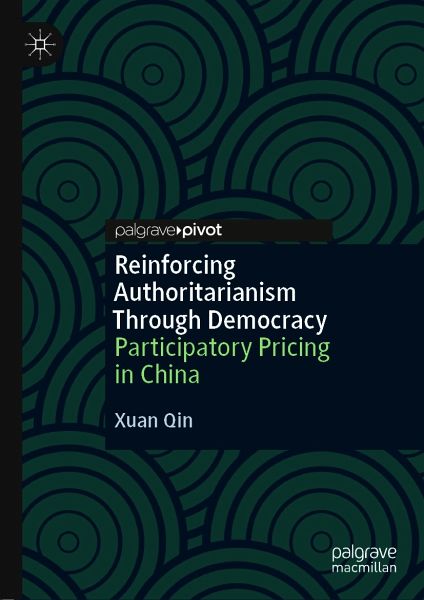
This book provides empirical evidence to show how democratic experiments are harnessed to achieve control and support authoritarianism, through the lens of participatory pricing, which is one of the most important forms of deliberative democracy in China. The crucial point is an interlacement of easily perceptible improvement in empowerment (voluntary enrollment, disclosure of information and opportunities for expression during events) and hidden control (delicately designed procedures and pre-existing frameworks that influence participants in how they think, and when they talk).
The mixture of these two mechanisms assures participants and educates them, producing cooperative citizens desired by the government. This is referred to as the partial empowerment strategy, which challenges the traditional assumption of the correlation between deliberation and empowerment. When authoritarian control influences deliberations in a form that obstructs the natural developmental process of empowerment, it acts as a filter that encourages only some form of empowerment, but precludes those that are too risky for the government. This exertion of dominance through a participatory form reflects the development of governance capability of China as a modern authoritarian state and explains its "surprising" resilience.
The mixture of these two mechanisms assures participants and educates them, producing cooperative citizens desired by the government. This is referred to as the partial empowerment strategy, which challenges the traditional assumption of the correlation between deliberation and empowerment. When authoritarian control influences deliberations in a form that obstructs the natural developmental process of empowerment, it acts as a filter that encourages only some form of empowerment, but precludes those that are too risky for the government. This exertion of dominance through a participatory form reflects the development of governance capability of China as a modern authoritarian state and explains its "surprising" resilience.
Dieser Download kann aus rechtlichen Gründen nur mit Rechnungsadresse in A, B, BG, CY, CZ, D, DK, EW, E, FIN, F, GR, HR, H, IRL, I, LT, L, LR, M, NL, PL, P, R, S, SLO, SK ausgeliefert werden.