Sie sind bereits eingeloggt. Klicken Sie auf 2. tolino select Abo, um fortzufahren.
Bitte loggen Sie sich zunächst in Ihr Kundenkonto ein oder registrieren Sie sich bei bücher.de, um das eBook-Abo tolino select nutzen zu können.
While Romantic-era concepts of childhood nostalgia have been understood as the desire to retrieve the ephemeral mindset of the child, this collection proposes that the emergence of digital media has altered this reflective gesture towards the past. No longer is childhood nostalgia reliant on individual memory. Rather, it is associated through contemporary convergence culture with the commodities of one's youth as they are recycled from one media platform to another. Essays in the volume's first section identify recurrent patterns in the recycling, adaptation, and remediation of children's toys…mehr
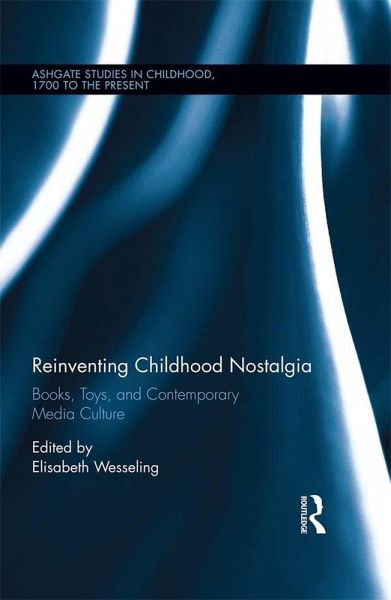
While Romantic-era concepts of childhood nostalgia have been understood as the desire to retrieve the ephemeral mindset of the child, this collection proposes that the emergence of digital media has altered this reflective gesture towards the past. No longer is childhood nostalgia reliant on individual memory. Rather, it is associated through contemporary convergence culture with the commodities of one's youth as they are recycled from one media platform to another. Essays in the volume's first section identify recurrent patterns in the recycling, adaptation, and remediation of children's toys and media, providing context for section two's exploration of childhood nostalgia in memorial practices. In these essays, the contributors suggest that childhood toys and media play a role in the construction of s the imagined communities (Benedict Anderson) that define nations and nationalism. Eschewing the dichotomy between restorative and reflexive nostalgia, the essays in section three address the ethics of nostalgia in terms of child agency and depictions of childhood. In a departure from the notion that childhood nostalgia is the exclusive prerogative of narrative fiction, section four looks for its traces in the child sciences. Pushing against nostalgia's persistent associations with wishful thinking, false memories, and distortion, this collection suggests nostalgia is never categorically good or bad in itself, but owes its benefits or defects to the ways in which it is brought to bear on the representation of children and childhood.
Dieser Download kann aus rechtlichen Gründen nur mit Rechnungsadresse in A, B, BG, CY, CZ, D, DK, EW, E, FIN, F, GR, HR, H, IRL, I, LT, L, LR, M, NL, PL, P, R, S, SLO, SK ausgeliefert werden.
Die Herstellerinformationen sind derzeit nicht verfügbar.
Autorenporträt
Elisabeth Wesseling is Director of the Centre for Gender and Diversity at Maastricht University, The Netherlands.
Inhaltsangabe
CONTENTS Acknowledgments List of Figures Introduction, Elisabeth Wesseling Part I: The Cultural Dynamics of Cross-Generational (Re-)appropriation 1 Historical Roots of Consumption-Based Nostalgia for Childhood in the US., Gary Cross 2 Nostalgia or Innovation? The Adaptation of Dutch Children's Books into Films, Helma van Lierop, 3 Superheroes and Identity: The Role of Nostalgia in Comic Book Culture, Carol Tilley 4 (Re-)Constructing Childhood Memories: Nostalgia, Creativity and the Expanded Worlds of the Lego Fan Community, Lincoln Geraghty Part II: Childhood Nostalgia and Memorial Politics 5 Nostalgic Panoramas of Childhood: Toy Objects in Ireland (1851-1909), Vanessa Rutherford 6 Making Children's 'Classics': Making Past Childhoods Children's 'Classics' as Sites for Memory Politics and Nostalgia, Helle Strandgaard Jensen 7 Propaganda and Nostalgia: Constructing Memories about the German Democratic Republic for Secondary School Children, Luke Springman 8 Communist Childhoods and Nostalgia: A Cultural Analysis of Online Remembrance Strategies (2006-2011), Codruta Pohrib 9 Lost in Nostalgia: Images of Childhood in Photo Books for Children, Bettina Kümmerling-Meibauer Part III: Modalities of Nostalgia 10 Looking for Asymmetries: A Theoretical Approach to Childhood Nostalgia in Pre-Figurative Culture, Mariano Narodowski 11 Perverse Nostalgia: Child Sex Abuse as Trauma Commodity in Neo-Victorian Fiction, Mel Kohlke 12 "Scared Straight" and Beyond: The Presumption of Teenaged Guilt and the Perpetuation of Defeated Paradigms, Joshua Garrison 13 Teenage Nostalgia: Perpetual Adolescents in Little Children (2006) and Young Adult (2011), Anita Wohlmann 14 Ambivalent longings: Nostalgia in the Picturebooks of Pieter Gaudesaboos, Vanessa Joosen 15 Children's Music and Nostalgia: Digging in the Past with an Eye to the Future, Ingeborg Lunde Vestad 16 Happiness is Quite Common: Postmemory of the 1950s in De Daltons (1999-2010), Elisabeth Wesseling Part IV: Nostalgic Science 17 Comics, Childhood, and Nostalgia: Frederic Wertham and the Comic Book Panic of the 1950s, Andrew O'Malley 18 Back to Where We Came From: Evolutionary Psychology and Children's Literature and Media, Karin Lesnik-Oberstein and Neil Cocks Notes on Contributors Index
Es gelten unsere Allgemeinen Geschäftsbedingungen: www.buecher.de/agb
Impressum
www.buecher.de ist ein Internetauftritt der buecher.de internetstores GmbH
Geschäftsführung: Monica Sawhney | Roland Kölbl | Günter Hilger
Sitz der Gesellschaft: Batheyer Straße 115 - 117, 58099 Hagen
Postanschrift: Bürgermeister-Wegele-Str. 12, 86167 Augsburg
Amtsgericht Hagen HRB 13257
Steuernummer: 321/5800/1497
USt-IdNr: DE450055826