35,95 €
35,95 €
inkl. MwSt.
Sofort per Download lieferbar

18 °P sammeln
35,95 €
Als Download kaufen
35,95 €
inkl. MwSt.
Sofort per Download lieferbar
18 °P sammeln
Jetzt verschenken
Alle Infos zum eBook verschenken
35,95 €
inkl. MwSt.
Sofort per Download lieferbar
Alle Infos zum eBook verschenken
18 °P sammeln

Andere Kunden interessierten sich auch für
") Relationship Economics (eBook, PDF)35,95 €
Relationship Economics (eBook, PDF)35,95 €") The Business Case for Sustainable Finance (eBook, ePUB)45,95 €
The Business Case for Sustainable Finance (eBook, ePUB)45,95 €") Accounting Ethics Education (eBook, ePUB)39,95 €
Accounting Ethics Education (eBook, ePUB)39,95 €") The Social Function of Accounts (eBook, ePUB)45,95 €
The Social Function of Accounts (eBook, ePUB)45,95 €") The Routledge Handbook of Critical Finance Studies (eBook, ePUB)43,95 €
The Routledge Handbook of Critical Finance Studies (eBook, ePUB)43,95 €") Economic Growth (eBook, ePUB)157,95 €
Economic Growth (eBook, ePUB)157,95 €") The Societal Relevance of Management Accounting (eBook, ePUB)33,95 €
The Societal Relevance of Management Accounting (eBook, ePUB)33,95 €







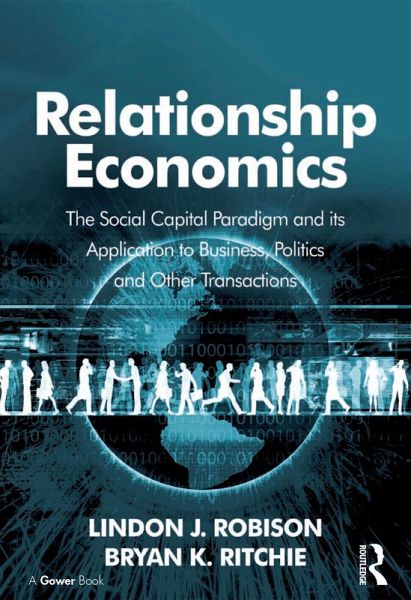
In a 24/7 world and a global economy, there is no doubt that relationships impact virtually every economic transaction. In Relationship Economics, Lindon Robison and Bryan Ritchie argue that what needs to be understood is not just whether relationships matter (which, of course, they do), but also, how much, and in what circumstances they should matter. Providing a rigorous and measurable definition of the way that relationships among individuals create a capital, social capital, that can be saved, spent, and used like other forms of capital, Robison and Ritchie use numerous examples and insightful analysis, to explain how social capital shapes our ability to reduce poverty, understand corruption, encourage democracy, facilitate income equality, and respond to globalization. The first part of the book explains how social capital can be manipulated, stored, expended, and invested. The second part explores how levels of social capital within relationships influence economic transactions both positively and negatively, which in turn shape poverty levels, economic efficiency, levels and types of political participation, and institutional structures.
Dieser Download kann aus rechtlichen Gründen nur mit Rechnungsadresse in A, B, BG, CY, CZ, D, DK, EW, E, FIN, F, GR, HR, H, IRL, I, LT, L, LR, M, NL, PL, P, R, S, SLO, SK ausgeliefert werden.