41,95 €
41,95 €
inkl. MwSt.
Sofort per Download lieferbar

21 °P sammeln
41,95 €
Als Download kaufen
41,95 €
inkl. MwSt.
Sofort per Download lieferbar
21 °P sammeln
Jetzt verschenken
Alle Infos zum eBook verschenken
41,95 €
inkl. MwSt.
Sofort per Download lieferbar
Alle Infos zum eBook verschenken
21 °P sammeln

Andere Kunden interessierten sich auch für
") Religious Actors and Conflict Transformation in Southeast Asia (eBook, ePUB)41,95 €
Religious Actors and Conflict Transformation in Southeast Asia (eBook, ePUB)41,95 €") Ahmadiyya Islam and the Muslim Diaspora (eBook, PDF)0,00 €
Ahmadiyya Islam and the Muslim Diaspora (eBook, PDF)0,00 €") Race, Ethnicity and Religion in Conflict Across Asia (eBook, PDF)41,95 €
Race, Ethnicity and Religion in Conflict Across Asia (eBook, PDF)41,95 €") Arab Criminology (eBook, PDF)18,95 €
Arab Criminology (eBook, PDF)18,95 €") Islamic Charity (eBook, PDF)19,95 €
Islamic Charity (eBook, PDF)19,95 €") The Politics of Religion in South and Southeast Asia (eBook, PDF)39,95 €
The Politics of Religion in South and Southeast Asia (eBook, PDF)39,95 €") Moral Pedagogies for Africa (eBook, PDF)39,95 €
Moral Pedagogies for Africa (eBook, PDF)39,95 €
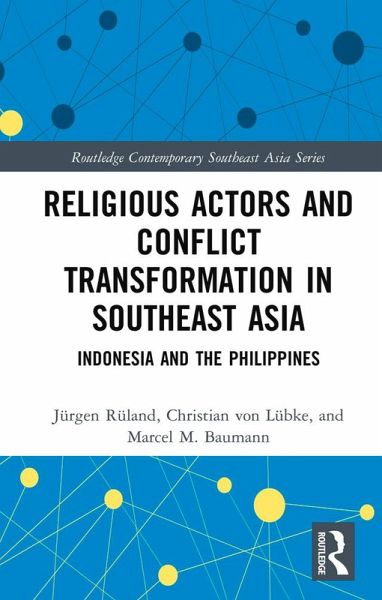
Drawing on a rich body of multimethod field research, this book examines the ways in which Indonesian and Philippine religious actors have fostered conflict resolution and under what conditions these efforts have been met with success or limited success.
The book addresses two central questions: In what ways, and to what extent, have post-conflict peacebuilding activities of Christian churches contributed to conflict transformation in Mindanao (Philippines) and Maluku (Indonesia)? And to what extent have these church-based efforts been affected by specific economic, political, or social contexts? Based on extensive fieldwork, the study operates with a nested, multi-dimensional, and multi-layered methodological concept which combines qualitative and quantitative methods. Major findings are that church-based peace activities do matter, that they have higher approval rates than state projects, and that they have fostered interreligious understanding.
Through innovative analysis, this book fills a lacuna in the study of ethno-religious conflicts. Informed by the novel Comparative Area Studies (CAS) approach, this book is strictly comparative, includes in-case and cross-case comparisons, and bridges disciplinary research with Area Studies. It will be of interest to academics in the fields of conflict and peacebuilding studies, interreligious dialogue, Southeast Asian Studies, and Asian Politics.
The book addresses two central questions: In what ways, and to what extent, have post-conflict peacebuilding activities of Christian churches contributed to conflict transformation in Mindanao (Philippines) and Maluku (Indonesia)? And to what extent have these church-based efforts been affected by specific economic, political, or social contexts? Based on extensive fieldwork, the study operates with a nested, multi-dimensional, and multi-layered methodological concept which combines qualitative and quantitative methods. Major findings are that church-based peace activities do matter, that they have higher approval rates than state projects, and that they have fostered interreligious understanding.
Through innovative analysis, this book fills a lacuna in the study of ethno-religious conflicts. Informed by the novel Comparative Area Studies (CAS) approach, this book is strictly comparative, includes in-case and cross-case comparisons, and bridges disciplinary research with Area Studies. It will be of interest to academics in the fields of conflict and peacebuilding studies, interreligious dialogue, Southeast Asian Studies, and Asian Politics.
Dieser Download kann aus rechtlichen Gründen nur mit Rechnungsadresse in A, B, BG, CY, CZ, D, DK, EW, E, FIN, F, GR, HR, H, IRL, I, LT, L, LR, M, NL, PL, P, R, S, SLO, SK ausgeliefert werden.