0,49 €
inkl. MwSt.
Sofort per Download lieferbar
0 °P sammeln

Andere Kunden interessierten sich auch für
") Report on Manufactures (eBook, ePUB)1,99 €
Report on Manufactures (eBook, ePUB)1,99 €") Report on Manufactures (eBook, ePUB)1,99 €
Report on Manufactures (eBook, ePUB)1,99 €") Report on Manufactures (eBook, ePUB)1,99 €
Report on Manufactures (eBook, ePUB)1,99 €") A history of commerce (eBook, ePUB)1,99 €
A history of commerce (eBook, ePUB)1,99 €") The Elephant and the Dragon (eBook, ePUB)8,95 €
The Elephant and the Dragon (eBook, ePUB)8,95 € (eBook, ePUB)") A Tract on Monetary Reform (Summarized Edition) (eBook, ePUB)0,49 €
A Tract on Monetary Reform (Summarized Edition) (eBook, ePUB)0,49 € (eBook, ePUB)") Fifty Years in Wall Street (Summarized Edition) (eBook, ePUB)0,49 €
Fifty Years in Wall Street (Summarized Edition) (eBook, ePUB)0,49 €

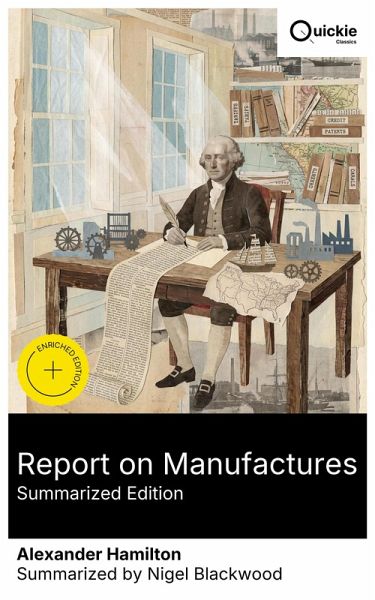
Report on Manufactures is a state paper that fuses economic reasoning with republican statecraft. Written in 1791, it lays out a comprehensive program to accelerate American industry: moderate protective tariffs, targeted bounties and premiums, encouragement of patents and skilled immigration, and federal support for internal improvements. Hamilton defends division of labor, mechanization, and diversification as sources of national wealth and resilience, explicitly countering agrarian exceptionalism. The prose is lawyerly and enumerative, marshalling comparative examples from Britain and continental Europe, and embedding policy within a wider Atlantic debate over commerce and national power. A West Indian immigrant, Revolutionary War aide to Washington, and the new republic's first Treasury Secretary, Hamilton had just established public credit and the national bank when Congress asked for this report. Wartime shortages, exposure to British mercantilism, and a realist concern for security convinced him that manufacturing capacity was essential to independence and prosperity. Readers interested in economic history, political theory, and policy design will find a foundational blueprint here. Whether one embraces or contests its activism, the Report remains indispensable for understanding American state formation, the infant-industry argument, and the origins of a national innovation system. Quickie Classics summarizes timeless works with precision, preserving the author's voice and keeping the prose clear, fast, and readable-distilled, never diluted. Enriched Edition extras: Introduction · Synopsis · Historical Context · Author Biography · Brief Analysis · 4 Reflection Q&As · Editorial Footnotes.
Dieser Download kann aus rechtlichen Gründen nur mit Rechnungsadresse in A, B, BG, CY, CZ, D, DK, EW, E, FIN, F, GR, H, IRL, I, LT, L, LR, M, NL, PL, P, R, S, SLO, SK ausgeliefert werden.