41,95 €
41,95 €
inkl. MwSt.
Sofort per Download lieferbar

21 °P sammeln
41,95 €
Als Download kaufen
41,95 €
inkl. MwSt.
Sofort per Download lieferbar
21 °P sammeln
Jetzt verschenken
Alle Infos zum eBook verschenken
41,95 €
inkl. MwSt.
Sofort per Download lieferbar
Alle Infos zum eBook verschenken
21 °P sammeln

Andere Kunden interessierten sich auch für
") Smart Cities (eBook, ePUB)49,95 €
Smart Cities (eBook, ePUB)49,95 €") Blue Urbanism (eBook, ePUB)29,95 €
Blue Urbanism (eBook, ePUB)29,95 €") Urban Density Contextualized (eBook, ePUB)35,95 €
Urban Density Contextualized (eBook, ePUB)35,95 €") Canopy Cities (eBook, ePUB)39,95 €
Canopy Cities (eBook, ePUB)39,95 €") Biophilic Urbanism (eBook, ePUB)34,95 €
Biophilic Urbanism (eBook, ePUB)34,95 €") Public Space (eBook, ePUB)29,95 €
Public Space (eBook, ePUB)29,95 €") Planning and Urban Design for Attractive Arctic Cities (eBook, ePUB)36,95 €
Planning and Urban Design for Attractive Arctic Cities (eBook, ePUB)36,95 €




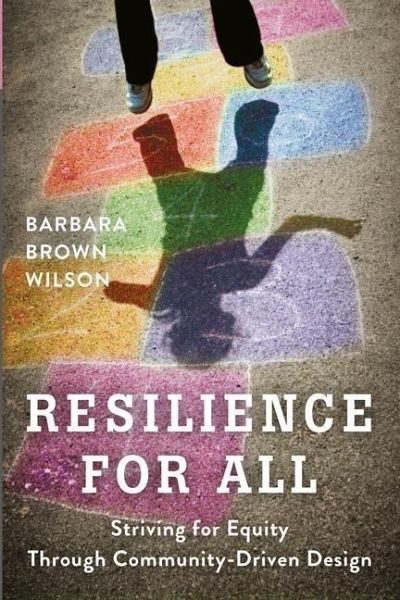
In the United States, people of color are disproportionally more likely to live in environments with poor air quality, in closeproximity to toxic waste, and in locations more vulnerable to climate change and extreme weather events.In many vulnerable neighborhoods, structural racism and classism prevent residents from having a seat at the table when decisions are made about their community. In an effort to overcome power imbalances and ensure local knowledgeinforms decision-making, a new approach to community engagement is essential.In Resilience for All, Barbara Brown Wilson looks at less conventional, but often more effective methods to makecommunities more resilient. She takes an in-depth look at what equitable, positive change through community-drivendesign looks like in four communities-East Biloxi, Mississippi; the Lower East Side of Manhattan; the Denbyneighborhood in Detroit, Michigan; and the Cully neighborhood in Portland, Oregon. These vulnerable communities haveprevailed in spite of serious urban stressors such as climate change, gentrification, and disinvestment. Wilson looks at how the lessons in the case studies and other examples might more broadly inform future practice. She shows how community-driven design projects in underserved neighborhoods can not only change the built world, but also provide opportunities for residents to build their own capacities.
Dieser Download kann aus rechtlichen Gründen nur mit Rechnungsadresse in A, B, BG, CY, CZ, D, DK, EW, E, FIN, F, GR, HR, H, IRL, I, LT, L, LR, M, NL, PL, P, R, S, SLO, SK ausgeliefert werden.