41,95 €
inkl. MwSt.
Sofort per Download lieferbar
21 °P sammeln

Andere Kunden interessierten sich auch für
") Resilience of Democracy (eBook, ePUB)41,95 €
Resilience of Democracy (eBook, ePUB)41,95 €") Authoritarian Gravity Centers (eBook, PDF)44,95 €
Authoritarian Gravity Centers (eBook, PDF)44,95 €") The Global Rise of Autocracy (eBook, PDF)41,95 €
The Global Rise of Autocracy (eBook, PDF)41,95 €") Democratic Regressions in Asia (eBook, PDF)41,95 €
Democratic Regressions in Asia (eBook, PDF)41,95 €") The Rise and Decline of Modern Democracy (eBook, PDF)40,95 €
The Rise and Decline of Modern Democracy (eBook, PDF)40,95 €") Routledge Handbook of Illiberalism (eBook, PDF)83,95 €
Routledge Handbook of Illiberalism (eBook, PDF)83,95 €") Post-Truth, Fake News and Democracy (eBook, PDF)40,95 €
Post-Truth, Fake News and Democracy (eBook, PDF)40,95 €






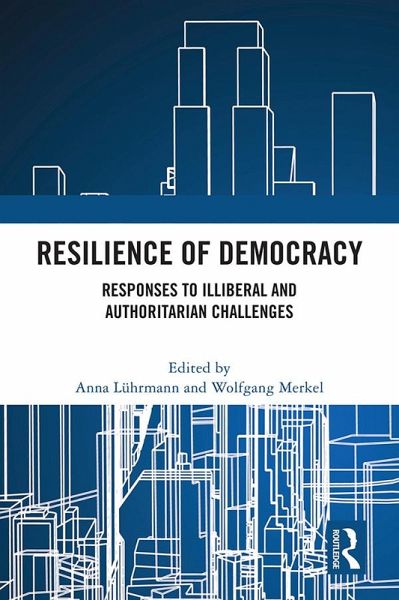
Illiberalism and authoritarianism have become major threats to democracy across the world. In response to this development, research on the causes and processes of democratic declines has blossomed. Much less scholarly attention has been devoted to the issue of democratic resilience. Why are some democracies more resilient than others to the current trend of autocratization? What role do institutions, actors and structural factors play in this regard? What options do democratic actors have to address illiberal and authoritarian challenges? This book addresses all these questions.
The present introduction sets the stage by developing a new concept of democratic resilience as the ability of a democratic system, its institutions, political actors, and citizens to prevent or react to external and internal challenges, stresses, and assaults. The book posits three potential reactions of democratic regimes: to withstand without changes, to adapt through internal changes, and to recover without losing the democratic character of its regime and its constitutive core institutions, organizations, and processes. The more democracies are resilient on all four levels of the political system (political community, institutions, actors, citizens) the less vulnerable they turn out to be in the present and future.
This edited volume will be of great value to students, academics, and researchers interested in politics, political regimes and theories, democracy and democratization, autocracy and autocratization, polarization, social democracy, and comparative government. The chapters in this book were originally published as a special issue of Democratization.
The present introduction sets the stage by developing a new concept of democratic resilience as the ability of a democratic system, its institutions, political actors, and citizens to prevent or react to external and internal challenges, stresses, and assaults. The book posits three potential reactions of democratic regimes: to withstand without changes, to adapt through internal changes, and to recover without losing the democratic character of its regime and its constitutive core institutions, organizations, and processes. The more democracies are resilient on all four levels of the political system (political community, institutions, actors, citizens) the less vulnerable they turn out to be in the present and future.
This edited volume will be of great value to students, academics, and researchers interested in politics, political regimes and theories, democracy and democratization, autocracy and autocratization, polarization, social democracy, and comparative government. The chapters in this book were originally published as a special issue of Democratization.
Dieser Download kann aus rechtlichen Gründen nur mit Rechnungsadresse in A, B, BG, CY, CZ, D, DK, EW, E, FIN, F, GR, HR, H, IRL, I, LT, L, LR, M, NL, PL, P, R, S, SLO, SK ausgeliefert werden.