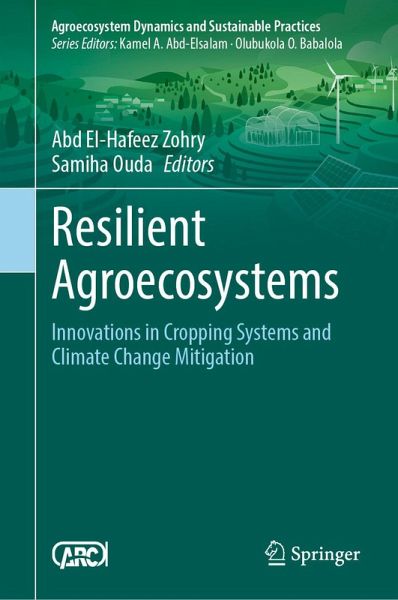
Resilient Agroecosystems (eBook, PDF)
Innovations in Cropping Systems and Climate Change Mitigation
Redaktion: Zohry, Abd El-Hafeez; Ouda, Samiha
Alle Infos zum eBook verschenken
Resilient Agroecosystems (eBook, PDF)
Innovations in Cropping Systems and Climate Change Mitigation
Redaktion: Zohry, Abd El-Hafeez; Ouda, Samiha
- Format: PDF
- Merkliste
- Auf die Merkliste
- Bewerten Bewerten
- Teilen
- Produkt teilen
- Produkterinnerung
- Produkterinnerung

Hier können Sie sich einloggen

Bitte loggen Sie sich zunächst in Ihr Kundenkonto ein oder registrieren Sie sich bei bücher.de, um das eBook-Abo tolino select nutzen zu können.
This book explores the latest advancements in sustainable soil and water management for crop production. It also examines the impacts of climate change, strategies for its mitigation, and the role of machine learning in assessing these effects. Key topics in this contributed volume include: a) enhancing agricultural sustainability through conservation practices, b) the impact of climate change on soil-water-crop systems, c) mitigation strategies for climate change in agriculture, and d) utilizing machine learning to assess climate change effects on crop production.
This book is an essential…mehr
- Geräte: PC
- ohne Kopierschutz
- eBook Hilfe
- Größe: 19.48MB
IoT and AI in Agriculture (eBook, PDF)144,95 €
Unmanned Aerial Systems in Precision Agriculture (eBook, PDF)136,95 €
Tancredo SouzaAdvanced Statistical Analysis for Soil Scientists (eBook, PDF)104,95 €
Muhammad Azhar IqbalDigital Agriculture (eBook, PDF)36,95 €
Biochar: A Precious Resource from Biological Waste (eBook, PDF)160,95 €
Global Climate Change: Resilient and Smart Agriculture (eBook, PDF)136,95 €-
-
-
This book is an essential resource for graduate students, researchers, extension workers, and policymakers, who are seeking to advance sustainable agricultural practices and address the challenges posed by climate change.
Dieser Download kann aus rechtlichen Gründen nur mit Rechnungsadresse in A, B, BG, CY, CZ, D, DK, EW, E, FIN, F, GR, HR, H, IRL, I, LT, L, LR, M, NL, PL, P, R, S, SLO, SK ausgeliefert werden.
- Produktdetails
- Verlag: Springer Nature Singapore
- Seitenzahl: 413
- Erscheinungstermin: 26. September 2025
- Englisch
- ISBN-13: 9789819696307
- Artikelnr.: 75531589
- Verlag: Springer Nature Singapore
- Seitenzahl: 413
- Erscheinungstermin: 26. September 2025
- Englisch
- ISBN-13: 9789819696307
- Artikelnr.: 75531589
- Herstellerkennzeichnung Die Herstellerinformationen sind derzeit nicht verfügbar.
.- Part I: Innovative Cropping Systems for Resilience
.- Chapter 2_ Agroecological intensification of legume-cereal intercropping systems: The 4C approach.
.- Chapter 3_ Innovative cropping systems to maximize the use of available natural resources.
.- Part II: Augment the soybean intercropping system with maize
.- Chapter 4_ Enhancing the efficiency of light interception in soybean and maize intercropping system.
.- Chapter 5_ Mitigation of shading stress on soybean varieties through intercropping with maize.
.- Chapter 6_ Advanced soybean breeding techniques to alleviate biotic and abiotic stresses under intercropping.
.- Part III: Untraditional approaches to maximize agricultural production
.- Chapter 7_ Opportunities and challenges of greenhouses and soilless agricultural systems in combating food insecurity.
.- Chapter 8_ Using Fishponds Wastewater to Enhance Agricultural Crop Productivity and Sustainability.
.- Part IV: Climate change impacts and mitigation
.- Chapter 9_ Adaptation techniques to irrigation water shortages due to climate change.
.- Chapter 10_ Climate change effects on sustainable field crops production in Egypt: challenges and prospective.
.- Chapter 11_ AquaCrop model for simulating maize productivity with varying planting dates under deficit irrigation in the context of climate change.
.- Chapter 12_ Legume-based intercropping systems mitigate climate change.
.- Chapter 13_ Evaluating soil degradation processes and their exacerbation by climate change in the Nile Delta of Egypt.
.- Chapter 14_ Impact of climate change drivers on soil microbial communities and nutrient cycling in agricultural soils in the Nile Delta of Egypt.
.- Part V: Machin learning use in crop production
.- Chapter 15_ Climate change impacts on crop yield prediction: A machine learning perspective.
.- Chapter 16_ Coupling process-based models with machine learning for robust predictions of soil, water, and crop dynamics.
.- Chapter 17_ Fusion of process-based models, machine learning, and remote sensing for yield gap assessment.
.- Chapter 18_ Conclusions, and Recommendations to Resilient Agroecosystems: Innovations in Cropping Systems and Climate Change Mitigation .
.- Part I: Innovative Cropping Systems for Resilience
.- Chapter 2_ Agroecological intensification of legume-cereal intercropping systems: The 4C approach.
.- Chapter 3_ Innovative cropping systems to maximize the use of available natural resources.
.- Part II: Augment the soybean intercropping system with maize
.- Chapter 4_ Enhancing the efficiency of light interception in soybean and maize intercropping system.
.- Chapter 5_ Mitigation of shading stress on soybean varieties through intercropping with maize.
.- Chapter 6_ Advanced soybean breeding techniques to alleviate biotic and abiotic stresses under intercropping.
.- Part III: Untraditional approaches to maximize agricultural production
.- Chapter 7_ Opportunities and challenges of greenhouses and soilless agricultural systems in combating food insecurity.
.- Chapter 8_ Using Fishponds Wastewater to Enhance Agricultural Crop Productivity and Sustainability.
.- Part IV: Climate change impacts and mitigation
.- Chapter 9_ Adaptation techniques to irrigation water shortages due to climate change.
.- Chapter 10_ Climate change effects on sustainable field crops production in Egypt: challenges and prospective.
.- Chapter 11_ AquaCrop model for simulating maize productivity with varying planting dates under deficit irrigation in the context of climate change.
.- Chapter 12_ Legume-based intercropping systems mitigate climate change.
.- Chapter 13_ Evaluating soil degradation processes and their exacerbation by climate change in the Nile Delta of Egypt.
.- Chapter 14_ Impact of climate change drivers on soil microbial communities and nutrient cycling in agricultural soils in the Nile Delta of Egypt.
.- Part V: Machin learning use in crop production
.- Chapter 15_ Climate change impacts on crop yield prediction: A machine learning perspective.
.- Chapter 16_ Coupling process-based models with machine learning for robust predictions of soil, water, and crop dynamics.
.- Chapter 17_ Fusion of process-based models, machine learning, and remote sensing for yield gap assessment.
.- Chapter 18_ Conclusions, and Recommendations to Resilient Agroecosystems: Innovations in Cropping Systems and Climate Change Mitigation .