49,95 €
inkl. MwSt.
Sofort per Download lieferbar
25 °P sammeln

Andere Kunden interessierten sich auch für
") State Responses to International Law (eBook, ePUB)39,95 €
State Responses to International Law (eBook, ePUB)39,95 €") Democratic Responses To Terrorism (eBook, ePUB)43,95 €
Democratic Responses To Terrorism (eBook, ePUB)43,95 €") State Responses to Human Security (eBook, ePUB)42,95 €
State Responses to Human Security (eBook, ePUB)42,95 €") US Democracy Promotion in the Middle East (eBook, ePUB)37,95 €
US Democracy Promotion in the Middle East (eBook, ePUB)37,95 €") The United Nations and Human Rights (eBook, ePUB)38,95 €
The United Nations and Human Rights (eBook, ePUB)38,95 €") The International Politics of Democratization (eBook, ePUB)30,95 €
The International Politics of Democratization (eBook, ePUB)30,95 €") Peremptory International Legal Norms and the Democratic Rule of Law (eBook, ePUB)41,95 €
Peremptory International Legal Norms and the Democratic Rule of Law (eBook, ePUB)41,95 €





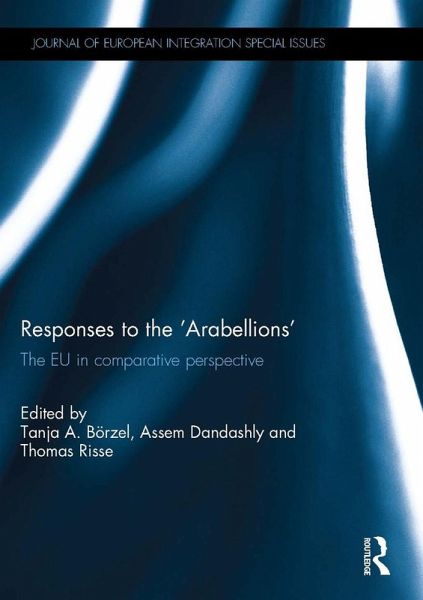
This book studies the reactions by external actors, including the European Union, to the events unfolding in the Arab world beginning in December 2010. In particular, contributors look at external actors' attempts to balance their desire for stability with their normative principles toward human rights and democracy. The book compares the action (and inaction) of the EU with other international and regional players, including the United States, Russia, Turkey and Israel, and assesses the response of these actors to the Arabellions' events, analysing changes in their approaches to the Arab region.
The contributions to this book answer three questions: (1) How have external actors assessed the 'Arabellions' and what role did they see for themselves in this context? (2) Which goals and instruments did external actors pursue toward the MENA region? In particular, how did they deal with conflicting goals, such as support for human rights and democracy, on the one hand, and concerns about security and stability, on the other? (3) How can we explain the varying responses of external actors to the Arabellions?
This book was published as a special issue of the Journal of European Integration.
The contributions to this book answer three questions: (1) How have external actors assessed the 'Arabellions' and what role did they see for themselves in this context? (2) Which goals and instruments did external actors pursue toward the MENA region? In particular, how did they deal with conflicting goals, such as support for human rights and democracy, on the one hand, and concerns about security and stability, on the other? (3) How can we explain the varying responses of external actors to the Arabellions?
This book was published as a special issue of the Journal of European Integration.
Dieser Download kann aus rechtlichen Gründen nur mit Rechnungsadresse in A, B, BG, CY, CZ, D, DK, EW, E, FIN, F, GR, HR, H, IRL, I, LT, L, LR, M, NL, PL, P, R, S, SLO, SK ausgeliefert werden.