32,99 €
inkl. MwSt.
Sofort per Download lieferbar
0 °P sammeln

Andere Kunden interessierten sich auch für
") A Flow-of-Funds Perspective on the Financial Crisis Volume II (eBook, PDF)72,95 €
A Flow-of-Funds Perspective on the Financial Crisis Volume II (eBook, PDF)72,95 €") Financial Stability (eBook, PDF)57,99 €
Financial Stability (eBook, PDF)57,99 €") The Exhaustion of the Dollar (eBook, PDF)72,95 €
The Exhaustion of the Dollar (eBook, PDF)72,95 €") An Inquiry into the Nature and Causes of the Wealth of States (eBook, PDF)20,99 €
An Inquiry into the Nature and Causes of the Wealth of States (eBook, PDF)20,99 €") Financial Risk Management (eBook, PDF)60,99 €
Financial Risk Management (eBook, PDF)60,99 €") Macrofinancial Risk Analysis (eBook, PDF)96,99 €
Macrofinancial Risk Analysis (eBook, PDF)96,99 €") Implementing Financial Regulation (eBook, PDF)91,99 €
Implementing Financial Regulation (eBook, PDF)91,99 €


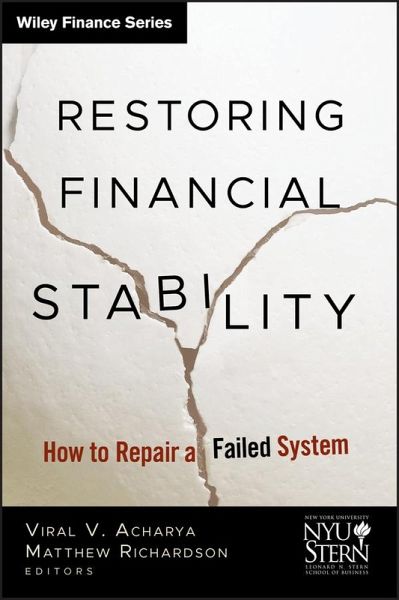
An insightful look at how to reform our broken financial system The financial crisis that unfolded in September 2008 transformed the United States and world economies. As each day's headlines brought stories of bank failures and rescues, government policies drawn and redrawn against the backdrop of an historic Presidential election, and solutions that seemed to be discarded almost as soon as they were proposed, a group of thirty-three academics at New York University Stern School of Business began tackling the hard questions behind the headlines. Representing fields of finance, economics, and accounting, these professors-led by Dean Thomas Cooley and Vice Dean Ingo Walter-shaped eighteen independent policy papers that proposed market-focused solutions to the problems within a common framework. In December, with great urgency, they sent hand-bound copies to Washington. Restoring Financial Stability is the culmination of their work. * Proposes bold, yet principled approaches-including financial policy alternatives and specific courses of action-to deal with this unprecedented, systemic financial crisis * Created by the contributions of various academics from New York University's Stern School of Business * Provides important perspectives on both the causes of the global financial crisis as well as proposed solutions to ensure it doesn't happen again * Contains detailed evaluations and analyses covering many spectrums of the marketplace Edited by Matthew Richardson and Viral Acharya, this reliable resource brings together the best thinking of finance and economics from the faculty of one of the top universities in world.
Dieser Download kann aus rechtlichen Gründen nur mit Rechnungsadresse in D ausgeliefert werden.
"The best available on this extraordinary and fascinating subject. . . brilliant idea, superbly executed, and has first-class content. Buy it." -- VoxEu.org
"packed with telling facts and sophisticated analysis, and alone is worth the . . . cover price. . . careful to avoid academic gobbledygook and complex equations." -- The Economist
"packed with telling facts and sophisticated analysis, and alone is worth the . . . cover price. . . careful to avoid academic gobbledygook and complex equations." -- The Economist
"In conclusion, this book should be read by every serious observer of the crisis. It is an outstanding contribution." (Lombard Street)
"...ably tackles complex issues and covers a wide spectrum of the current debate, including the multiplicity of regulators, the need for international regulatory coordination, transparency, fair value accounting, compensation reform, and the extent to which monetary policy should address systemic asset bubbles." (The Investment Professional)
"...the book that best combines history, analysis and prescription is "Restoring Financial Stability", a series of essays by academics at New York University's Stern School of Business. The 60-page prologue is packed with telling facts and sophisticated analysis, and alone is worth the steep cover price. The individual chapters deal methodically with the myriad issues raised by the crunch, and the policy changes that will be needed, covering everything from the American mortgage market to the need for international cooperation in regulating finance." (The Economist)
"We are always better analysts with a 20/20 hindsight. Indeed, an ex post reading about events leading up to a crisis appears logical, and often leaves one with the question about why the evolution of the crisis could not be seen and corrected in time. Still, policy-makers know that such a review and understanding are important to learning from mistakes. Restoring Financial Stability (Wiley) acts as a catalyst to that understanding by offering a comprehensive sequencing of the causes and progression of the build-up of the financial strains that . . evolved into a full-blown global financial crisis. . . highly recommended even though bankers will remain bankers and will probably figure out ways to beat the new system." (Business Standard)
"...ably tackles complex issues and covers a wide spectrum of the current debate, including the multiplicity of regulators, the need for international regulatory coordination, transparency, fair value accounting, compensation reform, and the extent to which monetary policy should address systemic asset bubbles." (The Investment Professional)
"...the book that best combines history, analysis and prescription is "Restoring Financial Stability", a series of essays by academics at New York University's Stern School of Business. The 60-page prologue is packed with telling facts and sophisticated analysis, and alone is worth the steep cover price. The individual chapters deal methodically with the myriad issues raised by the crunch, and the policy changes that will be needed, covering everything from the American mortgage market to the need for international cooperation in regulating finance." (The Economist)
"We are always better analysts with a 20/20 hindsight. Indeed, an ex post reading about events leading up to a crisis appears logical, and often leaves one with the question about why the evolution of the crisis could not be seen and corrected in time. Still, policy-makers know that such a review and understanding are important to learning from mistakes. Restoring Financial Stability (Wiley) acts as a catalyst to that understanding by offering a comprehensive sequencing of the causes and progression of the build-up of the financial strains that . . evolved into a full-blown global financial crisis. . . highly recommended even though bankers will remain bankers and will probably figure out ways to beat the new system." (Business Standard)