42,95 €
42,95 €
inkl. MwSt.
Sofort per Download lieferbar

21 °P sammeln
42,95 €
Als Download kaufen
42,95 €
inkl. MwSt.
Sofort per Download lieferbar
21 °P sammeln
Jetzt verschenken
Alle Infos zum eBook verschenken
42,95 €
inkl. MwSt.
Sofort per Download lieferbar
Alle Infos zum eBook verschenken
21 °P sammeln

Andere Kunden interessierten sich auch für
") Post-Keynesian Theories of the Firm (eBook, PDF)39,95 €
Post-Keynesian Theories of the Firm (eBook, PDF)39,95 €") Transformations of Contemporary Capitalism (eBook, PDF)42,95 €
Transformations of Contemporary Capitalism (eBook, PDF)42,95 €") Economic Freedom and Prosperity (eBook, PDF)41,95 €
Economic Freedom and Prosperity (eBook, PDF)41,95 €") Order and Control in American Socio-Economic Thought (eBook, PDF)51,95 €
Order and Control in American Socio-Economic Thought (eBook, PDF)51,95 € (eBook, PDF)") Theories of Surplus and Transfer (Routledge Revivals) (eBook, PDF)36,95 €
Theories of Surplus and Transfer (Routledge Revivals) (eBook, PDF)36,95 € (eBook, PDF)") Theories of Modern Capitalism (Routledge Revivals) (eBook, PDF)55,95 €
Theories of Modern Capitalism (Routledge Revivals) (eBook, PDF)55,95 €") Theories of the Bargaining Process (eBook, PDF)45,95 €
Theories of the Bargaining Process (eBook, PDF)45,95 €
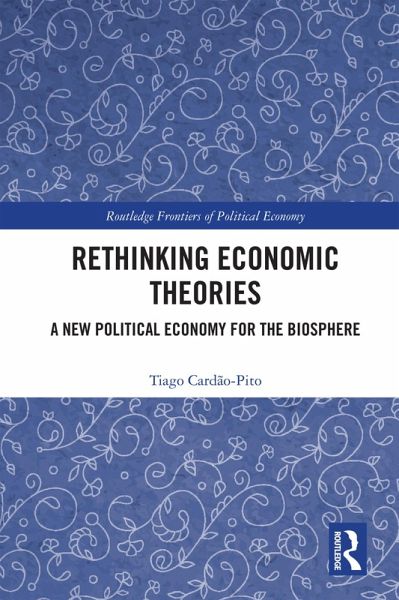
In recent times, economic theories have provided the dominant explanations of how to understand and organize human societies. This book argues that the study of economic theories must not be restricted to the disciplines of economics, political economy, or economic sociology and must encompass our relationship to the biosphere.
In this new volume, Tiago Cardão-Pito further develops his innovative system to organize the major economic theories into two major theoretical groups: one is termed "hedonist economic theory" (primarily mainstream economics which generally defends moneyed persons politically) and the other is work-based economic theory (the most well-known version of which is Marxism, which defends workers politically). It is shown that economics can only be understood through the political disputes between these two major theories, but it is also argued that both major economic theories are fundamentally unprepared for addressing human societies and the biosphere. They both attribute metaphysical status to money, describing monetary flows as the constitutive being of economic, social, and ecological phenomena. Furthermore, both theories follow the overinclusive and tautological post-Adam Smith concept of capital, which confuses monetary and non-monetary flows. Although human work remains highly relevant in our technologically enhanced times, this book demonstrates that returning to work-based economic theory is no longer a viable option to contest the dominance of hedonist economic theory. A new bio-social theory is required to explain the integration of human societies into the biosphere.
This book is a vital reading for students and scholars of economic and social theory, political economy, economic sociology, organization, sustainability, and ecological issues, environment and economics, environment and philosophy, environment and society, environment and business, environmental politics, environmental studies, philosophy of social science and political philosophy.
In this new volume, Tiago Cardão-Pito further develops his innovative system to organize the major economic theories into two major theoretical groups: one is termed "hedonist economic theory" (primarily mainstream economics which generally defends moneyed persons politically) and the other is work-based economic theory (the most well-known version of which is Marxism, which defends workers politically). It is shown that economics can only be understood through the political disputes between these two major theories, but it is also argued that both major economic theories are fundamentally unprepared for addressing human societies and the biosphere. They both attribute metaphysical status to money, describing monetary flows as the constitutive being of economic, social, and ecological phenomena. Furthermore, both theories follow the overinclusive and tautological post-Adam Smith concept of capital, which confuses monetary and non-monetary flows. Although human work remains highly relevant in our technologically enhanced times, this book demonstrates that returning to work-based economic theory is no longer a viable option to contest the dominance of hedonist economic theory. A new bio-social theory is required to explain the integration of human societies into the biosphere.
This book is a vital reading for students and scholars of economic and social theory, political economy, economic sociology, organization, sustainability, and ecological issues, environment and economics, environment and philosophy, environment and society, environment and business, environmental politics, environmental studies, philosophy of social science and political philosophy.
Dieser Download kann aus rechtlichen Gründen nur mit Rechnungsadresse in A, B, BG, CY, CZ, D, DK, EW, E, FIN, F, GR, HR, H, IRL, I, LT, L, LR, M, NL, PL, P, R, S, SLO, SK ausgeliefert werden.