Sie sind bereits eingeloggt. Klicken Sie auf 2. tolino select Abo, um fortzufahren.
Bitte loggen Sie sich zunächst in Ihr Kundenkonto ein oder registrieren Sie sich bei bücher.de, um das eBook-Abo tolino select nutzen zu können.
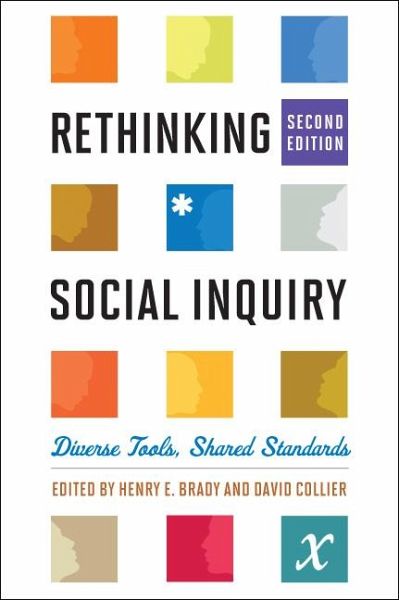
With innovative new chapters on process tracing, regression analysis, and natural experiments, the second edition of Rethinking Social Inquiry further extends the reach of this path-breaking book. The original debate with King, Keohane, and Verba_now updated_remains central to the volume, and the new material illuminates evolving discussions of essential methodological tools. Thus, process tracing is often invoked as fundamental to qualitative analysis, but is rarely applied with precision. Pitfalls of regression analysis are sometimes noted, but often are inadequately examined. And the…mehr
With innovative new chapters on process tracing, regression analysis, and natural experiments, the second edition of Rethinking Social Inquiry further extends the reach of this path-breaking book. The original debate with King, Keohane, and Verba_now updated_remains central to the volume, and the new material illuminates evolving discussions of essential methodological tools. Thus, process tracing is often invoked as fundamental to qualitative analysis, but is rarely applied with precision. Pitfalls of regression analysis are sometimes noted, but often are inadequately examined. And the complex assumptions and trade-offs of natural experiments are poorly understood. The second edition extends the methodological horizon through exploring these critical tools. A distinctive feature of this edition is the online placement of four chapters from the prior edition, all focused on the dialogue with King, Keohane, and Verba.
Die Herstellerinformationen sind derzeit nicht verfügbar.
Autorenporträt
Henry E. Brady is dean of the Goldman School of Public Policy and Class of 1941 Monroe Deutsch Professor of Political Science and Public Policy at the University of California at Berkeley. He is currently president of the American Political Science Association. David Collier is Robson Professor of Political Science at the University of California at Berkeley.
Inhaltsangabe
Introduction to the Second Edition: A Sea Change in Political Methodology Part I: A Debate on Methodology A. Framing the Debate 1. Refocusing the Discussion of Methodology 2. The Quest for Standards: King, Keohane, and Verba's Designing Social Inquiry B. Critiques of the Quantitative Template 3. Doing Good and Doing Better: How Far Does the Quantitative Template Get Us? 4. Some Unfulfilled Promises of Quantitative Imperialism 5. How Inference in the Social (but Not the Physical) Sciences Neglects Theoretical Anomaly C. Linking the Quantitative and Qualitative Traditions 6. Bridging the Quantitative-Qualitative Divide 7. The Importance of Research Design D. Diverse Tools, Shared Standards 8. Critiques, Responses, and Trade-Offs: Drawing Together the Debate 9. Sources of Leverage in Causal Inference: Toward an Alternative View of Methodology Part II. Causal Inference: Old Dilemmas, New Tools Introduction to Part II E. Qualitative Tools for Causal Inference 10. Process Tracing and Causal Inference 11. On Types of Scientific Inquiry: The Role of Qualitative Reasoning 12. Data-Set Observations versus Causal-Process Observations: The 2000 U.S. Presidential Election Addendum: Teaching Process Tracing F. Quantitative Tools for Causal Inference 13. Regression-Based Inference: A Case Study in Failed Causal Assessment 14. Design-Based Inference: Beyond the Pitfalls of Regression Analysis? Glossary Bibliography
Es gelten unsere Allgemeinen Geschäftsbedingungen: www.buecher.de/agb
Impressum
www.buecher.de ist ein Internetauftritt der buecher.de internetstores GmbH
Geschäftsführung: Monica Sawhney | Roland Kölbl | Günter Hilger
Sitz der Gesellschaft: Batheyer Straße 115 - 117, 58099 Hagen
Postanschrift: Bürgermeister-Wegele-Str. 12, 86167 Augsburg
Amtsgericht Hagen HRB 13257
Steuernummer: 321/5800/1497
USt-IdNr: DE450055826